
India's First Private Orbital Rocket Vikram-1 Launches on Mission Aagaman
On July 18, 2026, India crossed a threshold that had long seemed distant: a privately developed rocket reached orbital velocity from Indian soil for the first time. Skyroot Aerospace’s Vikram-1 lifted off carrying not only commercial payloads but also the symbolic weight of a nation redefining who may reach for the stars.
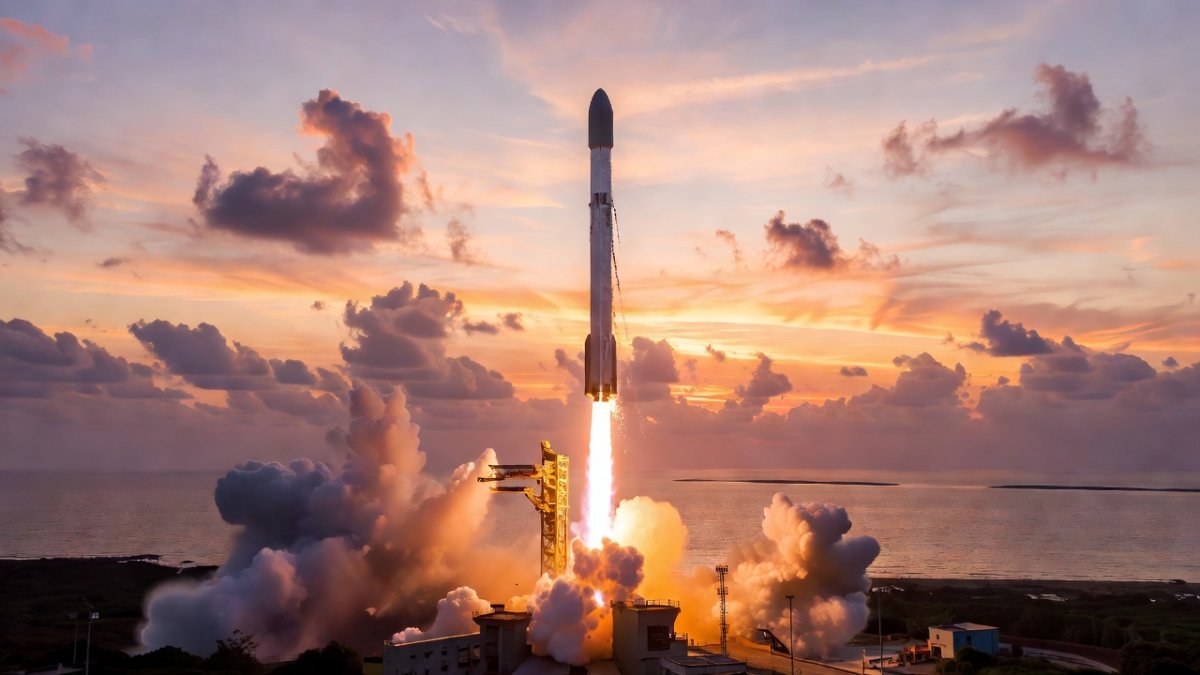
On July 18, 2026, India crossed a threshold that had long seemed distant: a privately developed rocket reached orbital velocity from Indian soil for the first time. Skyroot Aerospace’s Vikram-1 lifted off carrying not only commercial payloads but also the symbolic weight of a nation redefining who may reach for the stars. The successful flight of Mission Aagaman signals that the country’s space future will be shaped by both its storied public agency and a new generation of agile private firms.
SEO Headline: India's First Private Orbital Rocket Vikram-1 Launches on Mission Aagaman
Sriharikota, Andhra Pradesh – July 18, 2026 — On this day, Skyroot Aerospace’s Vikram-1 rocket lifted off from the Satish Dhawan Space Centre in Sriharikota, Andhra Pradesh, marking India’s first private orbital launch. The mission, named Aagaman (Sanskrit for “Arrival”), carried a 350 kg payload capacity to Low Earth Orbit and 260 kg to Sun-Synchronous Orbit while transporting Prime Minister Narendra Modi’s handwritten “Vande Mataram” postcard alongside commemorative items from the Skyroot team and supporters.
Technical Capabilities of Vikram-1
Vikram-1 features a second stage powered by the Kalam-250 solid-fuel motor, named after Dr. APJ Abdul Kalam. The rocket supports assembly and launch within 24 hours from any site, enabling dedicated and rideshare small satellite missions. This design directly addresses the needs of India’s growing satellite operators in cities such as Bengaluru and Hyderabad.
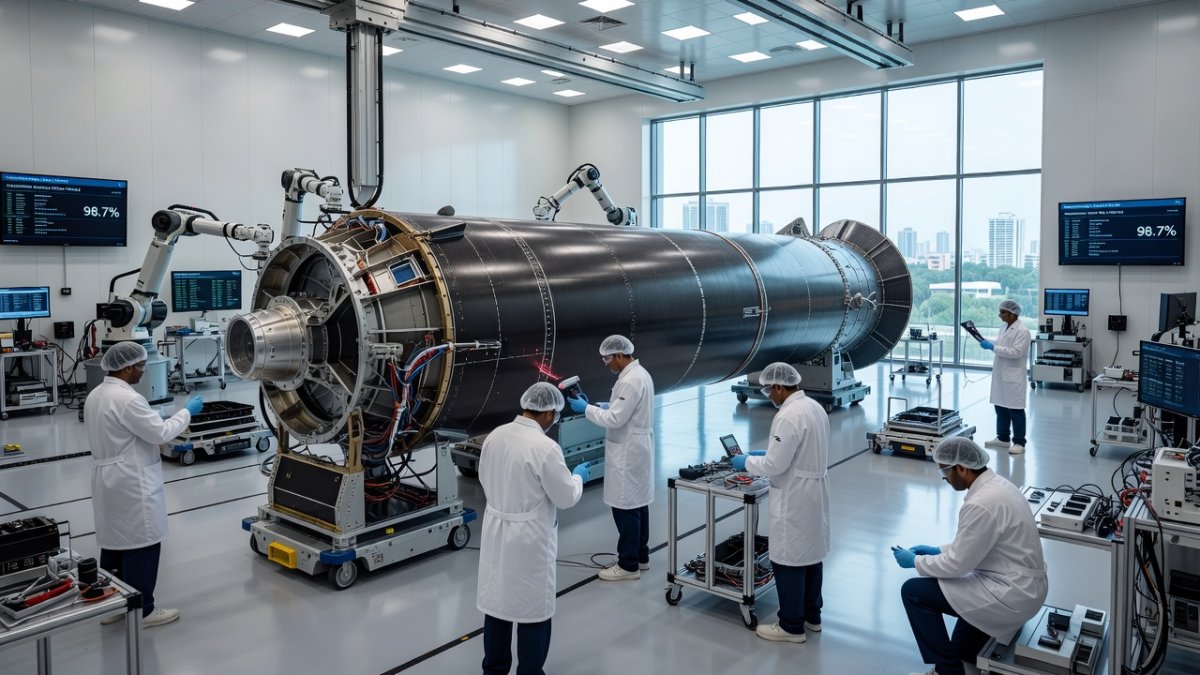
The Kalam-250 solid-fuel motor generates approximately 250 kN of thrust at sea level, with a burn time of around 80 seconds. Designed and manufactured entirely in India at Skyroot’s Hyderabad facility, this motor uses advanced composite casings that reduce structural mass while maintaining pressure tolerance. Vikram-1 is a three-stage rocket: the first stage uses a larger solid booster, the second stage employs the Kalam-250, and the third stage is a liquid-fueled engine optimized for precise orbital insertion. The payload fairing, constructed from carbon-fibre composite, protects satellites during atmospheric ascent and separates cleanly at altitude. The entire vehicle stands approximately 20 metres tall with a lift-off mass of roughly 65 tonnes.
Skyroot’s telemetry and guidance systems draw on indigenous navigation electronics developed in partnership with Indian defence research laboratories. The 24-hour turnaround capability — from arrival at the launch site to lift-off — is achieved through a mobile launch support system that pre-integrates stages at the Hyderabad factory and transports them in specialised containers. This rapid-deployment feature has no direct equivalent among ISRO’s own rockets, which require weeks of on-site preparation, and gives Vikram-1 a unique value proposition for emergency satellite replacement or time-sensitive defence payloads. Cost-per-kilogram estimates place Vikram-1 at under $15,000 per kg to LEO, compared to roughly $5,000-6,000 for PSLV on bulk government contracts, but significantly below the $20,000+ per kg range typical of small-satellite launchers internationally.
Skyroot Aerospace, headquartered in Hyderabad, Telangana, was founded by former ISRO scientists Pawan Kumar Chandana and Naga Bharath Daka. The company previously achieved India’s first private suborbital flight with Vikram-S in November 2022. Vikram-1 itself is named after Dr. Vikram Sarabhai, establishing a direct link between India’s public and private space efforts.
India’s Private Space Ecosystem Under IN-SPACe
The Indian Space Policy 2023 created the framework that allowed this launch. IN-SPACe has streamlined approvals for private entities, shifting from ISRO’s monopoly to a regulated commercial model. This change benefits taxpayers by reducing government expenditure on routine launches while freeing ISRO for deeper scientific missions.
IN-SPACe, the Indian National Space Promotion and Authorisation Centre, has processed over 80 applications from private space entities since its inception, with 40+ approvals granted as of mid-2026. The single-window clearance system — introduced in early 2025 — reduced the average permit timeline from over 12 months to under 90 days. Skyroot’s Mission Aagaman was among the first test-flight authorisations processed under this framework, serving as a template for future private orbital attempts. NewSpace India Limited (NSIL), ISRO’s commercial arm, facilitated infrastructure sharing at Sriharikota by brokering the launchpad access agreement between Skyroot and ISRO. This public-private infrastructure model — unique to India among emerging spacefaring nations — allows Skyroot to use a modified version of ISRO’s Small Satellite Launch Vehicle (SSLV) launchpad without bearing the full capital cost of constructing its own facility. By contrast, private launch operators in the United States must build their own launch sites, a barrier that costs tens of millions of dollars and years of environmental permitting.
The public viewing gallery opened by ISRO at Sriharikota allows students from engineering colleges in Chennai and Pune to witness the event. This visibility encourages more graduates to pursue careers in propulsion and satellite systems rather than migrating abroad. Startups in Pune and Ahmedabad now see clearer pathways to secure launch slots without relying solely on foreign providers.
Comparison with Global Private Launch Providers
SpaceX demonstrated reusable orbital rockets at scale, while Rocket Lab achieved frequent small-satellite launches from New Zealand. Vikram-1’s 24-hour turnaround time positions India to compete in the dedicated small-satellite segment. Unlike these foreign firms, Skyroot operates under India’s cost structure and regulatory environment, offering lower prices for domestic customers.
SpaceX’s Falcon 9 launches at approximately $2,700 per kg to LEO, but this figure applies to large rideshare missions of 15+ tonnes. Small-satellite operators seeking dedicated launches typically pay $20,000-$30,000 per kg through providers like Rocket Lab (whose Electron rocket lifts 300 kg to LEO for roughly $7.5 million per flight). Skyroot targets a price of $12,000-$15,000 per kg for Vikram-1, undercutting Rocket Lab on a per-kg basis while offering a larger payload capacity (350 kg vs Electron’s 300 kg). Virgin Orbit’s bankruptcy in 2023 demonstrated the risks of the air-launch model, strengthening the case for ground-launched small-satellite rockets like Vikram-1. Skyroot’s advantage lies in its talent pipeline: the company’s engineers trained at ISRO institutions like the Vikram Sarabhai Space Centre and the Liquid Propulsion Systems Centre, bringing decades of combined experience that no startup outside India can replicate without poaching from a national space agency. Reusability is on Skyroot’s roadmap: the company has publicly discussed plans for a recoverable first stage on the Vikram-2 variant, aiming for first recovery tests by 2028.
Economic Impact on India’s Space Sector
India’s space economy stands at $8 billion today and targets $44 billion by 2040. Vikram-1’s success accelerates this growth by enabling private satellite constellations for agriculture monitoring in states like Punjab and Maharashtra. The launch creates direct employment in Telangana’s aerospace corridor and indirect jobs in electronics manufacturing across Tamil Nadu and Karnataka.
The $44 billion target breaks down into three segments: launch services ($5-6 billion), satellite manufacturing ($10-12 billion), and downstream applications ($27-29 billion). The downstream segment — data analytics, weather forecasting, telemedicine, broadband connectivity — relies directly on affordable and frequent launch access that Vikram-1 promises. India has seen the registration of over 140 space-tech startups since the sector opened in 2020, with cumulative venture capital investment crossing $550 million by early 2026. Notable players include Pixxel (hyperspectral earth imaging), Dhruva Space (satellite platforms), Agnikul Cosmos (small-satellite launch), and Bellatrix Aerospace (propulsion systems). All of these companies now have a domestic launch option for their payloads, eliminating dependence on foreign agencies. Skyroot itself employs over 400 engineers and technicians at its Hyderabad facility, and the company’s supply chain spans 80+ vendors across Telangana, Karnataka, Tamil Nadu, and Maharashtra.
Vikram-1 establishes a repeatable private launch capability that aligns with national goals for satellite broadband and Earth observation. Continued flights will strengthen India’s position in the global small-satellite market while supporting the government’s target of a self-reliant space industry by 2040.
— By Dr. Raj Patel, Staff Writer
This article was produced with AI-assisted research and editorial support. Reporting is based on sources cited in the article.
What's Your Reaction?
 Like
0
Like
0
 Dislike
0
Dislike
0
 Love
0
Love
0
 Funny
0
Funny
0
 Wow
0
Wow
0
 Sad
0
Sad
0
 Angry
0
Angry
0

India/South Asia Correspondent at Global1.News. Analytical voice with a background in science and health journalism. Based in New Delhi, covering Indian politics, education, healthcare, technology, and policy. Breaks down complex data into clear, actionable reporting.














Comments (0)