
Men Disguised as Police Execute Ecuadorean Drug Lord's Brother in Olón
A brother of Ecuador's most notorious drug lord Adolfo "Fito" Macías was gunned down in Olón by men disguised as police officers. The hit on David Macías delivers another devastating blow to Los Choneros, already reeling from back-to-back leadership arrests.
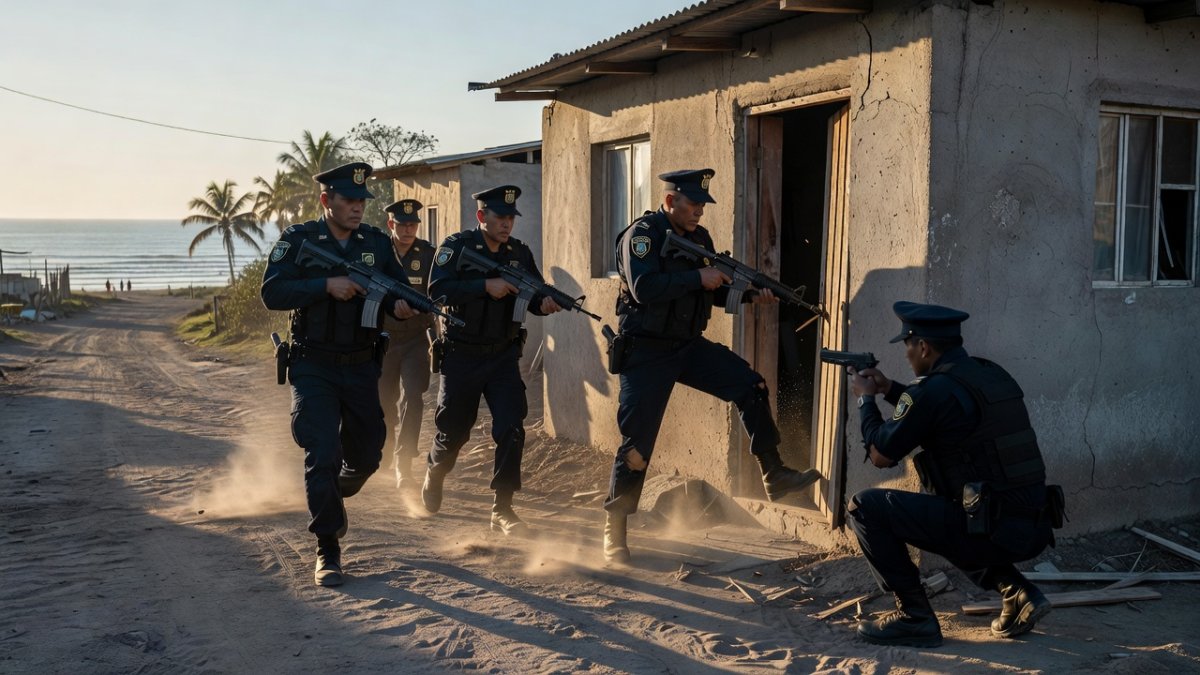
The Pacific coast town of Olón, usually known for its quiet beaches and surf-friendly waves, became the scene of a brazen assassination over the weekend. Gunmen disguised as police officers stormed a rented home in an upscale neighbourhood and executed David Macías, the 35-year-old brother of Ecuador's most infamous drug lord, Adolfo "Fito" Macías.
The killing marks yet another chapter in the violent unraveling of Los Choneros, the powerful criminal organization that has fuelled Ecuador's transformation from one of South America's safest countries to one of its most dangerous.
Olón, Ecuador — The attack unfolded in the early hours of Sunday morning, when witnesses reported seeing men dressed in police uniforms approach a home Macías had been renting in a residential area of the coastal town. Within minutes, shots rang out. By the time authorities arrived, the gunmen had vanished and David Macías lay dead.
The Execution
According to local police, the assailants arrived in what appeared to be an official vehicle and were dressed in uniforms that closely resembled those of Ecuador's national police force. They gained entry without raising suspicion, a tactic rarely used outside of highly orchestrated cartel hits.
Once inside, the gunmen opened fire. Ecuadorian media outlet Metro Ecuador reported that Macías was shot more than 30 times, with many of the wounds concentrated on his head — a method of execution that signals a message, not merely a killing. The message is almost certainly for Los Choneros.
Police confirmed that so far, no arrests have been made and no suspects have been identified. The investigation is ongoing, but officials have not ruled out the involvement of rival criminal organizations or even internal factions within Los Choneros itself.
Who Was David Macías?
David Macías was no innocent bystander caught in his brother's shadow. Police records show he had pleaded guilty to criminal conspiracy charges in 2018 and had a substantial criminal history. During his time in prison, he allegedly recruited inmates for Los Choneros and consolidated the gang's control over the facility where he was held.
By the time of his death, authorities had identified him as a regional leader within the organization — a man who managed operations and maintained discipline among the gang's foot soldiers. His role, while less visible than his brother's, was critical to the day-to-day functioning of Los Choneros' criminal enterprise.
The Macías Brothers: A Family at War
David's killing is the third major blow to the Macías family in just over a year. The dominoes began falling in June 2025, when Adolfo Macías — known universally as "Fito" — was captured in an underground bunker after one of the most extensive manhunts in Ecuadoran history. He was subsequently extradited to the United States, where he now awaits trial on drug trafficking and organized crime charges.
Then came the arrest of Javier Macías Villamar, another brother, who was captured in Bogotá, Colombia, last month. He was swiftly extradited to Ecuador on June 18, 2026, where he faces charges related to his activities as a senior member of Los Choneros.
Now David is dead. Three brothers. One awaiting trial in the United States. One behind bars in Ecuador. One in the ground.
For an organization built on family loyalty and the cult of personality surrounding Fito, the losses are catastrophic.
Los Choneros: From Street Gang to Transnational Empire
Los Choneros emerged in the 1990s as a modest street gang in Ecuador's western province of Manabí. Over three decades, they evolved into one of the most feared criminal organizations in Latin America, with operations spanning cocaine trafficking, extortion, money laundering, and prison control.
Their rise tracked closely with Ecuador's emergence as a key transit point for South American cocaine destined for Europe and the United States. Los Choneros forged alliances with Mexico's Sinaloa Cartel, effectively functioning as its armed wing within Ecuador. The relationship gave them access to international trafficking routes, weaponry, and financial networks far beyond what a domestic gang could command.
The United States designated Los Choneros as a Foreign Terrorist Organization, a rare classification for a criminal gang that reflects the scale of the threat they pose. The group has been linked to some of the most brazen acts of violence in Ecuador's recent history, including the assassination of presidential candidate Fernando Villavicencio in 2023 — a crime that sent shockwaves through the nation and alerted the world to the reach of organised crime in Ecuador.
Why This Killing Matters
The assassination of David Macías is not just another cartel hit. It signals several troubling dynamics at play in Ecuador's security landscape.
First, the method — men disguised as police officers — suggests a level of planning, intelligence gathering, and operational capability that goes well beyond a street-level gang dispute. This was a professional military-style operation, which raises serious questions about how easily armed groups can infiltrate secure neighbourhoods and impersonate state security forces.
Second, the timing. David's killing comes less than a month after Javier's arrest in Colombia. The rapid succession of losses suggests that Los Choneros is under coordinated, multi-front pressure — from law enforcement, rival organizations, and potentially internal factions positioning themselves for control.
Third, the location. Olón is a relatively quiet tourist town on the Ruta del Sol, popular with both Ecuadorian and foreign visitors. That assassins could operate there with impunity underscores how far the tentacles of organized crime have reached into civilian life across the country.
Ecuador's Security Crisis: A Nation Under Siege
Ecuador's murder rate, once among the lowest in Latin America, has skyrocketed in recent years. The country went from approximately 14 homicides per 100,000 inhabitants in 2020 to over 40 per 100,000 in 2025 — a rate that rivals Mexico and Colombia at the height of their drug wars.
President Daniel Noboa's administration has responded with aggressive security measures, including the deployment of 75,000 soldiers and police officers to combat drug gangs, the declaration of internal armed conflict against organized crime groups, and the construction of new high-security prisons. But the violence has continued.
The Macías killing, coming just months after the arrest of another gang leader leaving Guayaquil's international airport — shot dead by teenage gunmen who had hidden their weapons behind stuffed toys — paints a picture of a security apparatus that is struggling to keep pace with increasingly creative and ruthless adversaries.
What This Means
The decapitation of Los Choneros' leadership — through arrest, extradition, and assassination — creates both opportunity and danger for Ecuador. On one hand, the systematic dismantling of the organization's top tier weakens its operational capacity and disrupts its trafficking routes. On the other, power vacuums in the criminal underworld rarely lead to peace.
History across Latin America shows that when a dominant cartel is weakened, smaller, more aggressive groups fight for territory, often driving violence higher before it falls. Mexico's fragmentation of the Sinaloa Cartel after the capture of Joaquín "El Chapo" Guzmán is the clearest cautionary tale: the result was a proliferation of splinter groups and a surge in violence that the country is still grappling with years later.
Ecuador may be heading down the same path. With Fito in a US courtroom and his brothers either arrested or dead, the question is not whether Los Choneros will be replaced, but who will replace them, and at what cost to Ecuadorian civilians caught in the crossfire.
The international community, particularly the United States and neighbouring Colombia, has a direct stake in the answer. Ecuador's Pacific ports are critical nodes in the global cocaine trade, and instability there reverberates far beyond the country's borders. The killing of David Macías may be a local story from a small coastal town, but its implications echo across the hemisphere.
For now, Olón is quiet again. But the silence carries a different weight than it did before the shots rang out.
By Elena Vasquez, Staff Writer
This article was produced with AI-assisted research and editorial support. Reporting is based on sources cited in the article.
What's Your Reaction?
 Like
0
Like
0
 Dislike
0
Dislike
0
 Love
0
Love
0
 Funny
0
Funny
0
 Wow
0
Wow
0
 Sad
0
Sad
0
 Angry
0
Angry
0

Latin America Correspondent at Global1.News. Based in Mexico City, covering politics, economics, energy, and culture across the region. Brings an on-the-ground perspective to stories spanning from the Rio Grande to Patagonia.











Comments (0)