
Japan's Dry Lithium Recycling Breakthrough Ignites EV Supply Chain Debate
Japan's AIST dry recycling method recovers 90% lithium from EV batteries without toxic chemicals, cutting costs vs traditional methods. Honda, Toyota, Panasonic eye licensing as HN community buzzes with 732 points. Analysis of supply chain impact and circular economy shift.
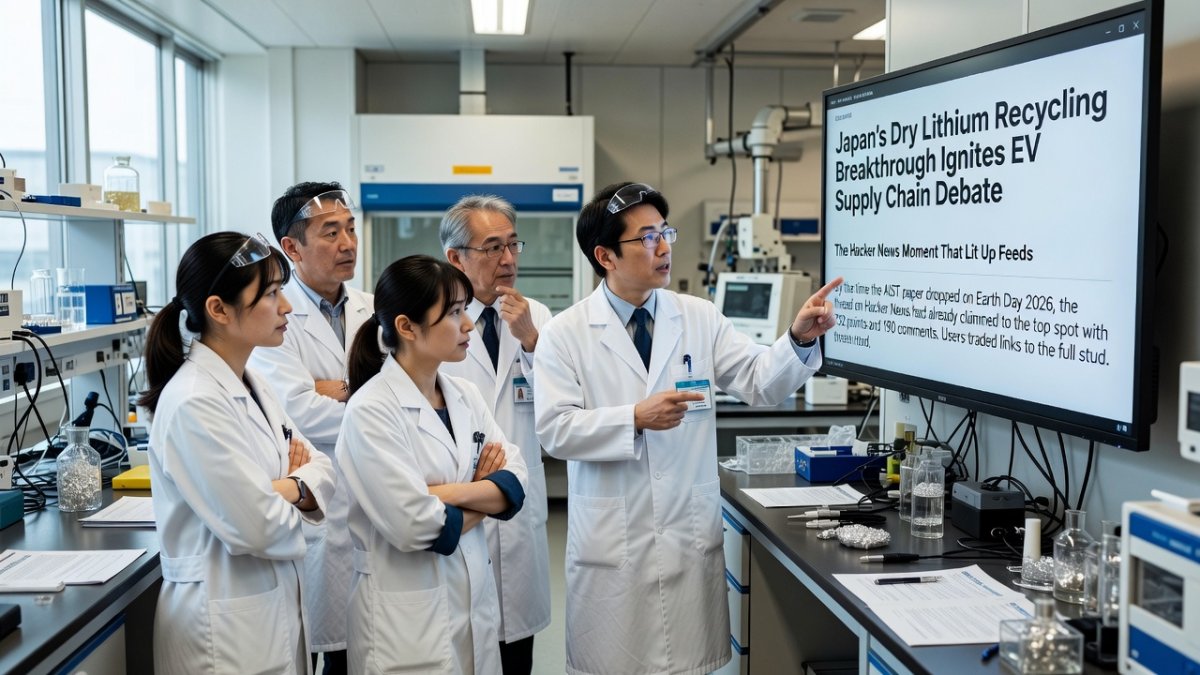
Japan's Dry Lithium Recycling Breakthrough Ignites EV Supply Chain Debate
The Hacker News Moment That Lit Up Feeds
By the time the AIST paper dropped on Earth Day 2026, the thread on Hacker News had already climbed to the top spot with 732 points and 190 comments. Users traded links to the full study while debating whether this was the inflection point for closed-loop battery supply or just another lab-scale headline. The conversation quickly spilled into r/EV and several Discord servers where battery engineers hang out, turning a technical paper into the day's dominant feed topic.
What stood out in the comments was the speed of the technical dissection. One frequent HN contributor broke down the dry process chemistry in plain language, while others flagged the absence of toxic solvents as the real differentiator from legacy hydrometallurgical routes. The thread stayed remarkably civil for a top story, with most participants treating the 90 percent recovery figure as credible rather than marketing spin.
Within hours, screenshots of the paper circulated on X and LinkedIn among cleantech investors. The timing aligned perfectly with ongoing worries about lithium carbonate prices and looming supply shortfalls projected for 2025. Suddenly a Japanese national lab was trending alongside the usual startup drama.
Inside the AIST Dry Recycling Technique
Researchers at Japan's National Institute of Advanced Industrial Science and Technology developed a direct recycling approach that skips the liquid leaching steps entirely. Instead of dissolving battery materials in aggressive acids, the method uses controlled thermal and mechanical separation to isolate lithium compounds. The result is material pure enough for immediate reuse in fresh cathode production without additional refining.
Traditional hydrometallurgical plants still dominate the market but carry steep operational costs between five thousand and ten thousand dollars per ton plus hazardous waste streams. AIST's process sidesteps both problems by staying dry and avoiding those reagents altogether. Early lab data shows recovery rates reaching ninety percent, a figure that caught the attention of anyone tracking metal balance sheets.
The technique also preserves the crystal structure of the recovered lithium salts, which matters for battery performance. Manufacturers hate variability in feedstock, and the AIST samples reportedly meet the same specs as virgin material. That detail alone explains why the paper moved from academic circles to industry inboxes so quickly.
Why Current Methods Are Running Out of Road
Lithium demand forecasts have been flashing red for years, with analysts repeatedly warning that mine output will fall short by 2025. Every incremental improvement in recovery rates therefore carries outsized weight. The AIST numbers suggest that a meaningful slice of future supply could come from the existing fleet rather than new mines.
Most existing recycling infrastructure still relies on energy-intensive pyrometallurgy or chemical-heavy hydrometallurgy. Both routes generate waste that requires expensive handling and regulatory oversight. As environmental rules tighten in Europe and North America, those hidden costs are only going to rise.
The dry method's simplicity could lower the barrier for smaller regional facilities. Instead of building massive centralized plants, operators might site compact lines closer to collection points, cutting transport emissions and logistics overhead at the same time.
Industry Players Already Lining Up
Honda, Toyota, and Panasonic have all signaled interest in licensing discussions according to people familiar with the outreach. These are not speculative startups; they represent the core of Japan's automotive and electronics supply chains. Their involvement suggests the technology has cleared internal technical reviews at companies that rarely move without extensive validation.
Panasonic's battery division in particular has been vocal about securing non-Chinese lithium sources. A domestic recycling stream that feeds directly back into gigafactory lines would reduce exposure to price swings and geopolitical risk. The same logic applies to the automakers looking at extended producer responsibility rules coming into force over the next decade.
Licensing talks are still early, but the speed of the response indicates the paper hit a pain point the industry already recognized. Battery recyclers outside Japan are now running their own modeling to see how the AIST parameters translate to different chemistries and pack formats.
What This Means for the EV Revolution
The EV transition has always been framed as a mining story, yet recycling is quietly becoming the swing variable that determines how fast adoption can scale. If ninety percent of lithium can be pulled back into new cells at competitive cost, the narrative shifts from resource scarcity to circular economics. That reframing matters for policy debates and investor models alike.
Supply chain analysts have long pointed out that the bottleneck is not just raw tonnage but the speed at which new material can be qualified. Direct recycling short-circuits that qualification loop because the output chemistry is already battery-grade. Faster loops mean gigafactories can plan with greater certainty and potentially lower working capital tied up in inventory.
Still, the technology faces the classic scale-up questions. Lab recovery rates rarely survive the messiness of real-world battery packs with varying degradation levels and mixed chemistries. The HN comments correctly flagged the need for pilot data on throughput and consistency before anyone bets production lines on it.
Geopolitically, a viable Japanese recycling route offers another diversification lever away from concentrated processing capacity elsewhere. Automakers and governments tracking critical minerals strategies will watch the licensing negotiations closely for clues about future alliances and technology transfer terms.
Scaling Questions That Remain Open
Even with strong lab results, moving from bench-scale demonstration to commercial volumes introduces variables the paper does not fully address. Feedstock collection logistics, pack disassembly automation, and quality control at tonnage scale all carry their own engineering challenges. The HN community was quick to note that the real test will come at the first pilot plant.
Energy intensity of the dry process also needs transparent benchmarking against existing routes. While the absence of toxic chemicals is a clear win, any hidden electricity or heat demands could shift the overall environmental ledger. Independent lifecycle assessments will be required before regulators or ESG funds sign off.
Intellectual property considerations will shape how widely the method spreads. If licensing terms favor Japanese partners exclusively, global adoption could slow. Conversely, broader access might accelerate standards development and shared infrastructure across regions.
The Road Ahead for Battery Circularity
The AIST development lands at a moment when every part of the battery value chain is under pressure to demonstrate credible sustainability metrics. Investors increasingly ask about end-of-life plans during due diligence, and this kind of technical progress gives them something concrete to point to in decks.
Watch for follow-on announcements around pilot facilities and joint development agreements in the coming quarters. The combination of strong recovery numbers, eliminated toxic reagents, and direct manufacturer interest creates a compelling package that is hard to ignore. Whether it becomes the dominant route or one option among several will depend on execution speed and cost curves over the next three to five years.
For now, the story has moved from academic paper to active industry conversation in record time. That trajectory alone signals how closely the market is tracking any credible path to lithium circularity.
— Nova Chen, Global 1 NewsThis article was produced with AI-assisted research and editorial support. Reporting is based on sources cited in the article.
What's Your Reaction?
 Like
1
Like
1
 Dislike
0
Dislike
0
 Love
0
Love
0
 Funny
0
Funny
0
 Wow
0
Wow
0
 Sad
0
Sad
0
 Angry
0
Angry
0

Trend Reporter at Global1.News. Based in San Francisco, tracking the stories crossing from social platforms, forums, and community discussions into mainstream news — tech breakthroughs, cultural shifts, and world events that real people are engaging with right now.















Comments (0)