
EU-Japan-South Korea Trilateral Cooperation: Strategic Imperative in a Fragmenting Indo-Pacific
The proposal for deeper EU-Japan-South Korea trilateral cooperation, articulated by Stanford University’s Gi-Wook Shin in mid-July 2026, arrives at a moment of unusual diplomatic opportunity and structural necessity. What once appeared as an aspirational alignment of distant partners has become both more feasible and more urgent. For South Korea, this emerging framework offers a means of diversifying strategic partnerships beyond the traditional U.S.
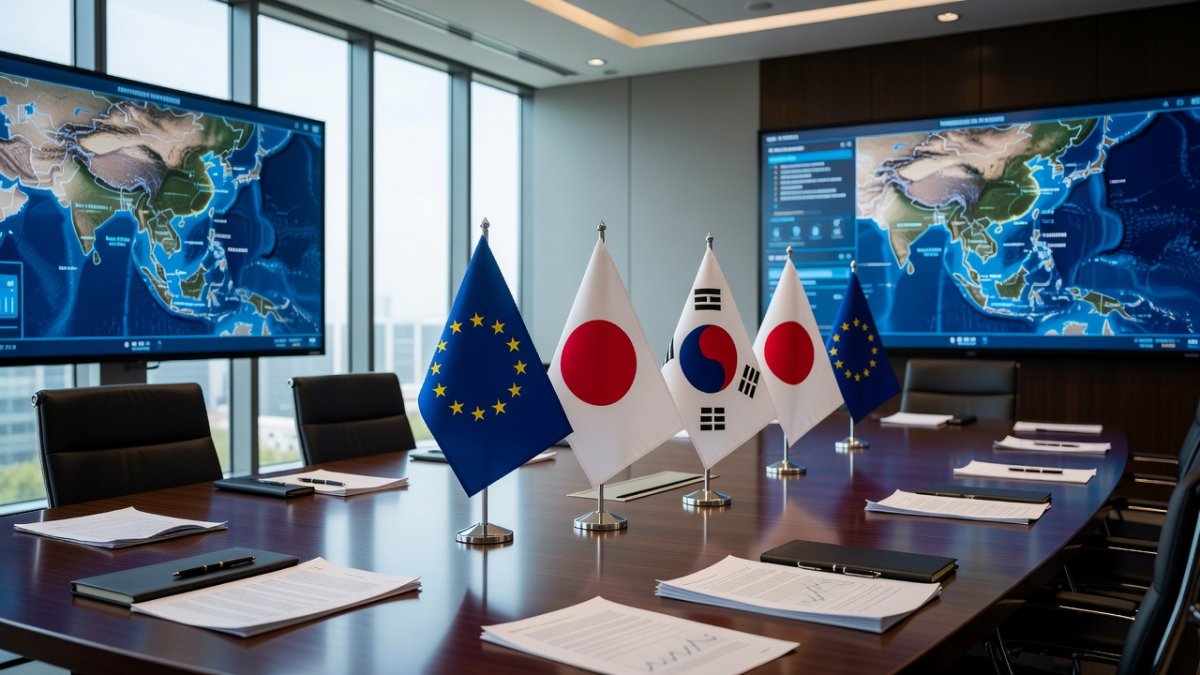
The proposal for deeper EU-Japan-South Korea trilateral cooperation, articulated by Stanford University’s Gi-Wook Shin in mid-July 2026, arrives at a moment of unusual diplomatic opportunity and structural necessity. What once appeared as an aspirational alignment of distant partners has become both more feasible and more urgent. For South Korea, this emerging framework offers a means of diversifying strategic partnerships beyond the traditional U.S. alliance structure while reinforcing its position as a pivotal middle power in Northeast Asia. The convergence of demographic pressures, economic security concerns, technological competition, and supply-chain vulnerabilities creates a compelling rationale for institutionalizing cooperation among three advanced industrial democracies that share both values and material interests.
Four Converging Challenges Reshaping Strategic Calculations
South Korea, Japan, and the European Union confront four interlocking challenges that no single actor can address in isolation. The first is demographic. All three face rapidly aging populations and shrinking workforces, with profound implications for labor markets, fiscal sustainability, and long-term innovation capacity. South Korea’s fertility rate remains among the lowest in the world, while Japan’s demographic decline has already reshaped its industrial base. Europe’s aging societies similarly strain welfare systems and reduce the pool of skilled workers available for high-technology sectors. These parallel trajectories create incentives for coordinated approaches to immigration policy, automation, and human-capital development.
The second challenge is economic security. The weaponization of interdependence—through export controls, investment screening, and industrial subsidies—has become a defining feature of great-power competition. South Korea’s chaebol-dominated economy, heavily reliant on semiconductors, batteries, and advanced manufacturing, is particularly exposed to supply-chain disruptions and coercive economic measures. Japan and the EU face analogous vulnerabilities in critical minerals, rare earths, and intermediate goods. The third challenge is technology competition, especially in artificial intelligence, semiconductors, and cyber security, where standards-setting and dual-use controls increasingly determine commercial and strategic advantage. The fourth is supply-chain resilience itself: the need to map risks, diversify suppliers, and reduce single-point dependencies without sacrificing efficiency.
These four pressures do not merely coexist; they reinforce one another. Demographic decline heightens the premium on technological productivity. Technology competition intensifies the scramble for secure supply chains. Economic security measures, if uncoordinated, risk collateral damage among partners who should be natural allies. Trilateral cooperation offers a mechanism for managing these interdependencies with greater foresight.
Why Trilateral Cooperation Is More Feasible Now Than Ever
Two developments have transformed the political feasibility of EU-Japan-South Korea collaboration. The first is the marked improvement in Japan-South Korea relations since 2023. Historical grievances over wartime labor and territorial issues had long constrained joint initiatives. The diplomatic thaw that followed has created space for broader frameworks that include European partners. Without this bilateral stabilization, any trilateral architecture would have remained hostage to Northeast Asian historical disputes.
The second development is the U.S.-Japan-South Korea trilateral framework established at Camp David in August 2023. That summit institutionalized joint military exercises, intelligence sharing, and regular consultations, embedding South Korea more firmly within a networked security architecture. While the Camp David process is security-focused and U.S.-centric, it has normalized the habit of trilateral coordination and reduced the political costs of multi-party diplomacy for Seoul and Tokyo. The EU-Japan-South Korea initiative can therefore build upon, rather than compete with, existing structures. South Korea’s Foreign Minister Cho Hyun, in office since July 2025, has underscored that commitment to the Korea-U.S.-Japan trilateral remains “firm and undiminished,” while simultaneously pursuing pragmatic diversification rooted in national interest. This dual-track approach creates diplomatic bandwidth for European engagement.
Korea’s Strategic Position as a Bridge Between Alliances
South Korea occupies a unique structural position. It is a core member of the U.S. alliance system in Northeast Asia, a major trading partner of China, and an increasingly sophisticated interlocutor with Europe. This triangulation allows Seoul to function as a bridge between the U.S.-Japan security partnership and European economic and regulatory power. For the European Union, engagement with South Korea provides a high-technology partner that is neither a great power nor a security free-rider, and that shares democratic values while possessing world-class capabilities in semiconductors, shipbuilding, and battery technology.
From a Korean perspective, the trilateral format mitigates the risks of over-reliance on any single partner. Chaebol such as Samsung Electronics and SK Hynix operate global production networks that are sensitive to both U.S. export controls and Chinese market access. Coordinated consultation with Japan and the EU on investment screening and industrial policy can help Korean firms navigate these cross-pressures. At the same time, deeper European ties reinforce South Korea’s identity as a rules-based middle power rather than a pure security client of the United States. In the broader Northeast Asian context, such diversification also signals to Pyongyang and Beijing that Seoul’s foreign policy is not reducible to alliance politics alone.
Building on Recent Diplomatic Milestones
The proposed trilateral rests on a series of concrete bilateral and minilateral advances. The 11th EU-South Korea Summit held in Brussels in June 2026 concluded a landmark Digital Trade Agreement and expanded cooperation on semiconductors, critical technologies, and strategic supply chains. That summit elevated the relationship beyond traditional free-trade parameters into the domain of economic security. Earlier, the Korea-EU Next-Generation Strategic Dialogue at ministerial level in April 2026 had already strengthened coordination on supply chains, critical minerals, and economic security. These steps demonstrate that the institutional infrastructure for deeper collaboration is already being phased in.
Japan-EU relations, long institutionalized through the Economic Partnership Agreement and Strategic Partnership Agreement, provide a complementary foundation. The cumulative effect is a dense web of bilateral channels that can be networked into a trilateral format without requiring the creation of entirely new bureaucracies. The challenge now is to move from parallel bilateralism to genuine three-way coordination on risk assessment, standards, and crisis consultation.
Concrete Early Agenda Items and Operational Requirements
Gi-Wook Shin’s analysis correctly identifies a pragmatic early agenda. Priority items include a joint critical minerals and supply-chain risk assessment; structured consultation on export controls and investment screening; and cooperation on artificial intelligence, cyber security, and critical technologies. These are not abstract aspirations. They address immediate vulnerabilities: South Korea’s dependence on imported lithium, cobalt, and rare earths; Japan’s exposure to similar mineral bottlenecks; and Europe’s efforts to secure battery and semiconductor inputs under the Critical Raw Materials Act framework.
Operationalizing this agenda requires four practical instruments: shared risk maps that identify single points of failure across the three economies; compatible certification regimes that reduce non-tariff barriers for trusted suppliers; co-investment mechanisms in alternative suppliers, particularly in Southeast Asia, Australia, and Latin America; and advance consultation protocols before any partner imposes export controls or industrial subsidies that could inflict collateral damage on the others. Without such guardrails, well-intentioned national security measures risk fragmenting the very supply chains the partners seek to secure. Korean policymakers, acutely aware of how U.S. semiconductor export controls have affected chaebol operations, have particular reason to favor advance consultation over unilateral action.
Historical Evolution of Korea-EU Relations: From Trade to Strategic Partnership
The trajectory of Korea-EU relations provides essential historical context. For decades the relationship was primarily commercial, anchored by the 2011 Free Trade Agreement that eliminated most tariffs and boosted bilateral trade. Strategic dialogue remained secondary. The shift toward a more comprehensive partnership accelerated in the late 2010s and early 2020s as both sides confronted Chinese industrial policy, supply-chain shocks during the pandemic, and the weaponization of technology. The 2026 Digital Trade Agreement and the Next-Generation Strategic Dialogue mark the maturation of this process: economic security and technology governance have moved from the periphery to the center of the agenda.
This evolution mirrors broader changes in South Korean foreign policy. Successive administrations have sought to expand the country’s diplomatic bandwidth beyond the peninsula and the U.S. alliance. Engagement with Europe offers both market access and normative alignment without the historical baggage that sometimes complicates relations with Japan or the strategic weight of the U.S. relationship. For Korean institutions—the Ministry of Foreign Affairs, the Ministry of Trade, Industry and Energy, and the National Security Office—the EU has become a partner of choice for regulatory cooperation and standards-setting in emerging technologies.
Implications for Northeast Asian Diplomacy and Korea’s Foreign Policy Direction
The emergence of an EU-Japan-South Korea trilateral carries significant implications for Northeast Asian diplomacy. It multiplies the number of institutional venues in which Seoul and Tokyo can coordinate without direct U.S. mediation, thereby reducing the risk that bilateral frictions will paralyze regional cooperation. It also signals to China that economic security coordination among advanced democracies is becoming denser and more operational. While the trilateral is not framed as an anti-China coalition, its focus on supply-chain resilience and technology standards inevitably shapes the regional balance of economic power.
For South Korean foreign policy, the initiative reinforces a pragmatic, multi-vector approach. Foreign Minister Cho Hyun’s emphasis on national interest over ideological rigidity provides the conceptual space for such diversification. The trilateral does not dilute the U.S. alliance; rather, it complements it by addressing economic and technological domains where European regulatory power and Japanese industrial capacity add distinctive value. In inter-Korean terms, a more diversified South Korean diplomacy may also strengthen Seoul’s hand by demonstrating that its international standing rests on broad partnerships rather than sole reliance on Washington.
Looking ahead, the success of this framework will depend on disciplined agenda management and realistic expectations. Shared risk maps and consultation mechanisms are achievable near-term goals; ambitious joint industrial policy is not. If the partners maintain focus on the four converging challenges—demographics, economic security, technology competition, and supply-chain resilience—they can construct a durable platform that enhances resilience without overreaching. For South Korea, the strategic payoff is clear: a more networked foreign policy that leverages its technological strengths, manages great-power competition, and consolidates its role as a bridge between the Indo-Pacific and Europe. In an era of strategic fragmentation, such bridging functions are not merely useful; they are indispensable.
By Prof. David Park, Staff WriterThis article was produced with AI-assisted research and editorial support. Reporting is based on sources cited in the article.
What's Your Reaction?
 Like
0
Like
0
 Dislike
0
Dislike
0
 Love
0
Love
0
 Funny
0
Funny
0
 Wow
0
Wow
0
 Sad
0
Sad
0
 Angry
0
Angry
0

East Asia/Technology Correspondent at Global1.News. Seoul-based voice covering Korean politics, technology, business, and culture. Analyzes how technology and geopolitics intersect across East Asia.











Comments (0)