
Jurassic Park's $1.7 Million Control Room: Inside the Real Tech That Powered Spielberg's Vision
Fabien Sanglard's exhaustive analysis of every computer and software interface visible in Jurassic Park has exploded on Hacker News. From the $1.725 million worth of SGI and Apple hardware to the Thinking Machines CM-5 supercomputer - a nostalgic look at 90s computing.
Jurassic Park's $1.7 Million Control Room: Inside the Real Tech That Powered Spielberg's Vision
If you grew up watching Dennis Nedry fumble with his SGI workstations and mutter about being "unappreciated in my time," you're not alone. A deep-dive analysis by software engineer and reverse-engineering legend Fabien Sanglard has blown up Hacker News this week — sitting at #4 with 668 points and 166 comments — as he meticulously catalogs every single computer, monitor, and software interface visible in Steven Spielberg's 1993 masterpiece. The timing is bittersweet: Sanglard's article went up just as news broke that Sam Neill, who played Dr. Alan Grant, has passed away.
Jurassic Park's $1.7 Million Control Room: Inside the Real Tech That Powered Spielberg's Vision
Los Angeles, California — It turns out Jurassic Park's prop department wasn't faking it. According to Cory Faucher, the film's Special Effects Coordinator, the production spent a staggering $1.725 million on real computer hardware — $875,000 worth of Silicon Graphics equipment, $350,000 from Apple, and another $500,000 in supporting hardware and software. Adjusted for inflation, that's roughly $4 million in 2026 dollars. Every screen, every beep, every blinking light on Dennis Nedry's chaotic desk was real, running actual operating systems and software.
The Apple PowerBook 100: A Laptop Before Its Time
The very first computer the audience sees isn't on Isla Nublar at all. It's in Alan Grant and Ellie Sattler's mobile trailer — an Apple PowerBook 100, barely visible on the left side of the frame. Sanglard's research confirms the machine ran a Motorola 68000 processor at 16 MHz, packed 2 to 8 MB of RAM, and featured a 9-inch monochrome passive-matrix LCD with 640 by 400 pixel resolution. It was running System 7.0.1.
"This machine specs reminds me of how awful '90s laptop screens, based on a passive matrix, were," Sanglard writes. "Definitely something I don't miss from that era." The PowerBook 100 launched in 1991 at a price point of $2,500 — roughly $5,600 in today's dollars — and represented Apple's first truly portable computing attempt after the earlier Macintosh Portable.
The Control Room: Two Desks, Eight Machines, One Supercomputer
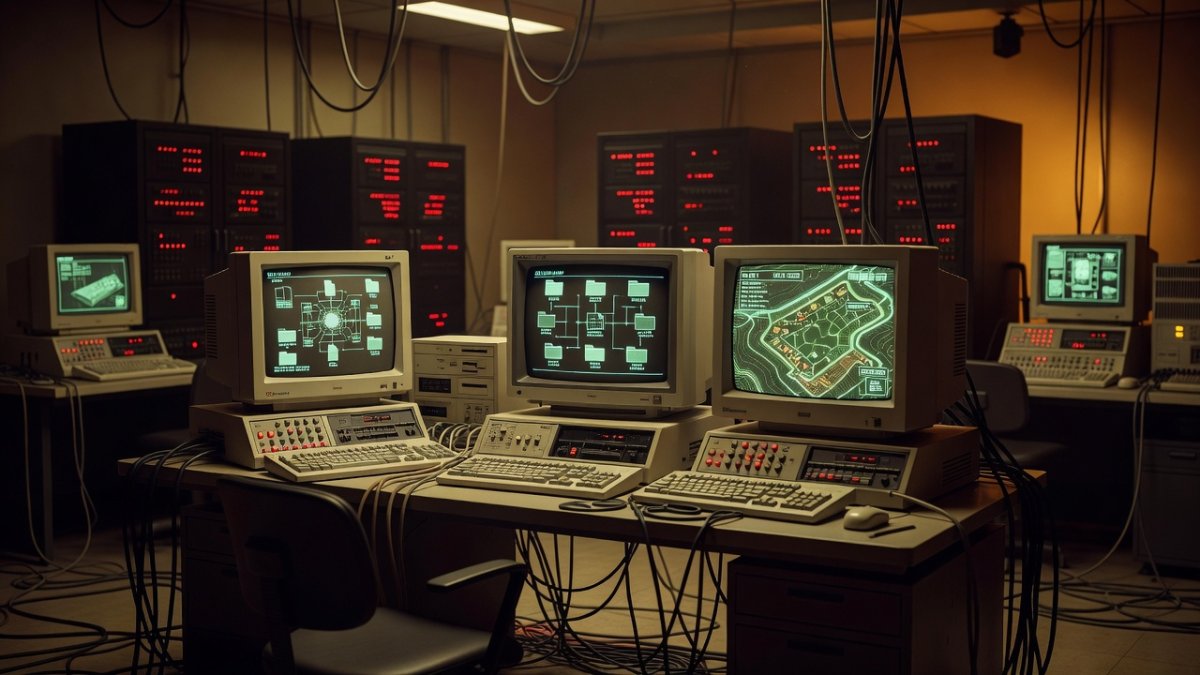
Jurassic Park's control room is the heart of the film's technological mystique, featuring two distinct workspaces. Dennis Nedry's desk is a chaotic sprawl of three machines (two Macs and one SGI), three monitors, a PDA, and storage devices piled everywhere. Ray Arnold's desk, by contrast, is a model of tidy efficiency — CCTV screen, storage devices, two computers (a Mac and an SGI), and two monitors.
The book "The Making Of Jurassic Park" reveals the production's philosophy: "Everything in the set was real. We couldn't fake any of it, because audiences are so sophisticated now in their knowledge of computers." That commitment to authenticity is what makes Sanglard's analysis so compelling — every prop was a real, functioning piece of 1993-era hardware.
The SGI Workstations: Powering Real-Time 3D
Ray Arnold's workstation is an SGI R4000 Indigo, barely visible in two shots — blink and you'll miss it at minute 54:48. Sanglard notes we get a better view later thanks to "a Velociraptor that never skips leg-day." These machines were used to run real-time 3D animations of the hurricane on screen, fed live from an off-stage room equipped with a battery of Silicon Graphics and Apple Macintosh systems.
Dennis Nedry's powerhouse is an SGI IRIS Crimson, a beast so large it won't fit on his desk — it sits on the floor in a red casing. Released in 1992, the Crimson featured a MIPS 100 MHz R4000 or 150 MHz R4400 processor, up to 256 MB of memory, and a choice of seven high-performance 3D graphics subsystems including the Reality Engine. Most of the time, Nedry uses it to display a 3D chess game on his rightmost monitor.
A four-man computer graphics team headed by Michael Backes spent six months generating the animations displayed on these machines. "Responding to cues received via radio from the set, Backes and his team were able to feed their graphics directly to the appropriate monitors on stage," the production team noted, "making it seem as though the actors involved were actually calling up the imagery."
The Thinking Machines CM-5: Nedry's Supercomputer
In the background of the control room sits a towering piece of computing history — the Thinking Machines CM-5, a massively parallel supercomputer with tall panels and blinking red lights. The CM-5 was one of the most powerful supercomputers of its era, capable of sustaining billions of operations per second. Dennis Nedry's famous line "You can run this whole park from this room with minimal staff for up to three days" suddenly carries more weight when you realize the networking and code complexity he's referring to.
As Sanglard's analysis points out, Nedry claims to have "networked eight connection machines and debugged two million lines of code" for his bid on the park's automation system. While the film treats this as self-aggrandizing ego, the hardware shown on screen backs up the claim — the CM-5 and SGI Crimson were legitimate high-performance computing systems that would have been state-of-the-art in 1993.
The 3D File System Navigator: Sci-Fi UX That Was Real
One of the most iconic visual elements from the film is the 3D File System Navigator (FSN) — a real SGI demo application that visualized file systems as towering city blocks. HN users and X threads this week have been flooding nostalgia for this interface, with Sanglard's deep dive revealing the actual SGI Hardware Developer Handbook and IRIX Desktop User's Guide pages that show the real software behind the movie's screens.
The FSN wasn't a Hollywood prop designer's invention. It was a genuine Silicon Graphics demo that came with IRIX 4.0.1 and later versions, designed to showcase the 3D capabilities of SGI workstations. The film's accuracy in depicting real software — from the 3D file system navigator to the classic Mac OS API calls visible on Nedry's screens — is part of what makes Jurassic Park so beloved by technologists. Sanglard even identifies a continuity error where a stack of PLI Mini Arrays mysteriously rotates between shots, a detail only someone obsessively cataloging frames would catch.
A Bittersweet Release: Sam Neill's Passing
Sanglard's article carries an emotional note: "EDIT: Just when I was putting the final touches on this article, I read the sad news that Sam Neill, who played paleontologist Alan Grant in JP, has passed away today. R.I.P Sam." The timing has added a layer of melancholy to an otherwise celebratory deep-dive into film history. Neill's portrayal of Dr. Grant — the skeptical paleontologist who famously hates computers but loves dinosaurs — is one of the film's most memorable performances, and his passing this week has been met with an outpouring of tributes across social media.
"Sam Neill brought a gravitas to Alan Grant that grounded the film's sci-fi premise," one HN commenter noted. "His 'Dinosaurs eat man... woman inherits the earth' speech is one of the best-delivered monologues in cinema." The intersection of Jurassic Park's 30+ year legacy, its iconic computer props, and Neill's passing has created a rare moment where tech nostalgia and film history converge.
What This Means: Why We Can't Stop Looking Back
The overwhelming response to Sanglard's article — 668 points on HN in under a day, trending on X, shared across retro-computing communities — says something about where we are in tech culture right now. In an era of AI-generated everything, cloud-native abstractions, and devices that hide their complexity behind glass slabs, there's a hunger for the tactile, visible computing of the 1990s. The SGI Crimson's red casing, the blinking LEDs on the CM-5, the satisfying click of an SGI Granite keyboard — these are artifacts of a time when computers were exotic, powerful, and visually distinctive.
There's also a deeper lesson here about film production and authenticity. Jurassic Park's commitment to using real, functioning computers — at a cost of $1.725 million in 1993 — created a level of verisimilitude that holds up decades later. Modern films often rely on post-production VFX to fake computer screens, but Sanglard's analysis proves that the old-school approach of putting real hardware in front of the camera pays dividends in lasting authenticity.
For the tech historians, developers, and film buffs flooding the discussion this week, Sanglard's article is more than a nostalgia trip. It's a documented time capsule of an era when Silicon Graphics was king, when 3D file system navigators were bleeding-edge, and when the most advanced supercomputer on the planet sat behind a glass window in a movie about cloned dinosaurs. As one X user put it: "We didn't know how good we had it. Jurassic Park's control room was every developer's dream workspace."
— Nova Chen, Global 1 News
This article was produced with AI-assisted research and editorial support. Reporting is based on sources cited in the article.
What's Your Reaction?
 Like
1
Like
1
 Dislike
0
Dislike
0
 Love
0
Love
0
 Funny
0
Funny
0
 Wow
0
Wow
0
 Sad
0
Sad
0
 Angry
0
Angry
0

Trend Reporter at Global1.News. Based in San Francisco, tracking the stories crossing from social platforms, forums, and community discussions into mainstream news — tech breakthroughs, cultural shifts, and world events that real people are engaging with right now.















Comments (0)