
Train Crew Trapped in Flames: Wildfire Engulfs CN Rail
A CN Rail freight train was surrounded by wildfire near Armstrong, Ontario on July 13, trapping the crew in flames. All escaped safely. The viral video shared by MPP Sol Mamakwa sparked urgent calls for rail safety reform as wildfire smoke drifted into the U.S.
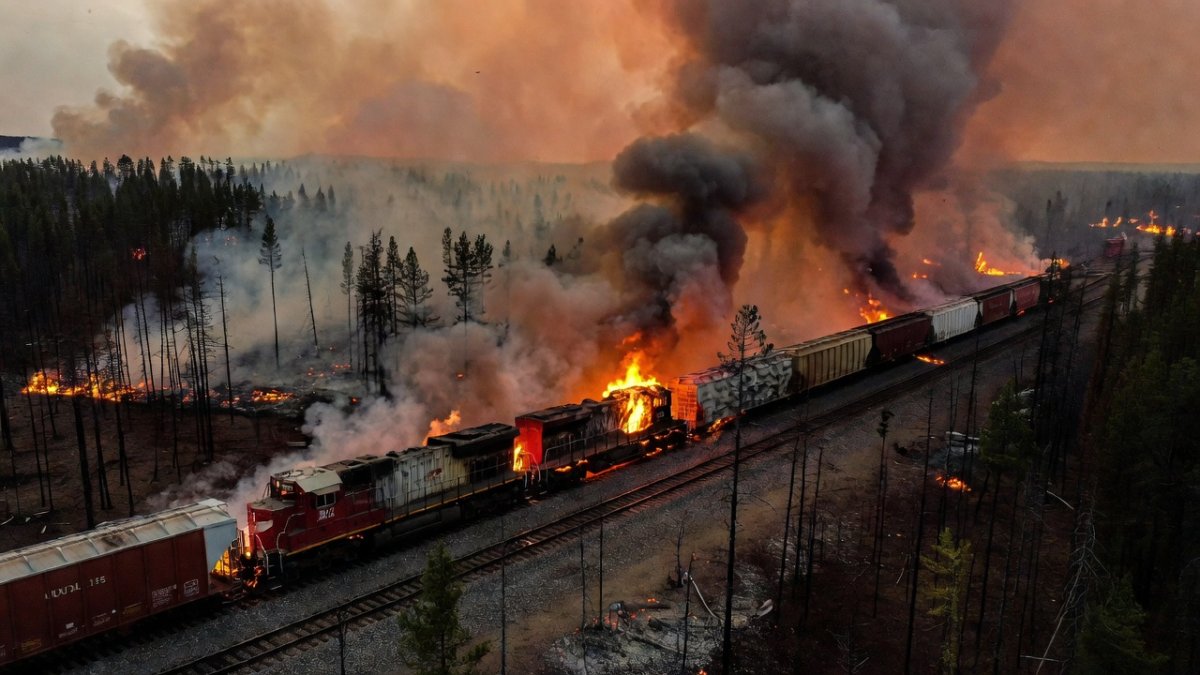
A CN Rail freight train hauling flammable cargo was swallowed by a raging wildfire near Armstrong, Ontario, forcing its crew to radio desperate pleas for help as flames battered the locomotive windows. Video footage captured the terrifying orange inferno and thick smoke, with crew transmissions revealing the raw fear: “This could potentially overtake us here, this has gotten a little scary.” All crew escaped unharmed, but the incident lays bare the lethal cocktail of reckless rail operations and out-of-control wildfires fueled by climate reality. This is not an anomaly—it’s a warning shot Canada cannot afford to ignore.
Train Crew Trapped in Flames: Viral Video Exposes Rail Wildfire Peril
Armstrong, Ontario – July 15, 2026 — A fast-moving wildfire encircled a Canadian National Railway freight train carrying combustible materials on July 13, 2026, trapping the crew in a nightmare scenario just 250 kilometres north of Thunder Bay. Video from inside the locomotive, which went viral on July 14 and 15, shows flames whipping violently against the windows under an apocalyptic orange sky filled with dense smoke. Three CN trains were halted in the area as the fire closed in, prompting urgent radio calls: “Y’all need to hurry up here. We’re encased in flames now.” Miraculously, every crew member was evacuated safely with zero injuries reported, but the episode demands immediate accountability from both rail giant CN and provincial authorities who have failed to get ahead of this escalating crisis.
The Incident
On Monday, July 13, 2026, a CN Rail freight train loaded with flammable and combustible materials ground to a halt on the tracks near the remote community of Armstrong, Ontario. A fast-moving wildfire, part of dozens burning across northwestern Ontario, rapidly surrounded the locomotive and at least two other stopped trains in the vicinity. Video footage recorded from inside the lead engine reveals hellish conditions: bright orange flames lashing directly against the windows, zero visibility due to thick black smoke, and an eerie glowing sky that turned day into something resembling dusk at noon.
Crew radio communications, later shared publicly, capture the escalating terror in real time. One transmission states plainly, “This could potentially overtake us here, this has gotten a little scary.” Minutes later, the urgency spikes with the plea, “Y’all need to hurry up here. We’re encased in flames now.” These are not scripted lines—they are the voices of professional railroaders staring down death while surrounded by their own flammable cargo. The fact that the train was hauling materials that could have turned the scene into a catastrophic explosion makes the narrow escape even more chilling. No one should have to broadcast their potential funeral pyre over open radio channels in 2026.
The Response
CN Rail acted swiftly once the danger became obvious, temporarily suspending all operations in the Armstrong area and ordering the full evacuation of its employees from the town. The company confirmed that all crew members from the affected trains were removed safely, with no injuries. Ontario Provincial Police (OPP) were on scene and stated there was no immediate threat to public safety beyond the already declared evacuation zones. Armstrong, a town of roughly 250 residents, was placed under mandatory evacuation orders alongside approximately five other communities in the fire zone.
Emergency responders worked to extract the rail workers while fire crews battled the blaze that had already jumped natural barriers and infrastructure. CN’s decision to shut down operations was the correct call but reeks of too-little-too-late thinking. When your freight trains are literally parked inside active wildfire perimeters while carrying flammable loads, the time for “precautionary” suspensions was days earlier. The OPP’s reassurance about public safety feels hollow when entire towns are being emptied and rail crews are sending mayday messages from inside fireballs.
Political Fallout
Ontario NDP MPP Sol Mamakwa, who represents the vast northern riding of Kiiwetinoong, did not mince words. He personally shared the viral video footage and has demanded full accountability from CN Rail and the provincial government. Mamakwa is calling for an immediate independent safety review of rail operations in wildfire-prone regions of northern Ontario. His office highlighted the obvious: crews should never be placed in positions where they must radio for urgent extraction while literally encased in flames.
This political pressure is overdue. For years, northern Ontario MPPs have warned that rail corridors cutting through remote, fire-vulnerable boreal forest represent a catastrophic accident waiting to happen. Mamakwa’s intervention turns this from a mere operational footnote into a political firestorm. CN Rail executives in Montreal and Ottawa bureaucrats who set transport policy now face uncomfortable questions about risk assessments, crew training for wildfire entrapment, and whether profit margins continue to outweigh human safety in Canada’s northern transportation network.
Wildfire Crisis Context
The Armstrong incident did not occur in isolation. As of July 15, 2026, dozens of wildfires continue to burn across northwestern Ontario, stretching emergency resources to the breaking point. Fire officials report that dry lightning, record heat, and tinder-dry forest floors have created conditions where fires spread with terrifying speed. The blaze that trapped the CN trains was described as “fast-moving,” jumping across tracks and roads with ease. Climate scientists have repeatedly warned that Ontario’s wildfire season is starting earlier, lasting longer, and burning hotter—patterns directly linked to anthropogenic warming.
Provincial fire management teams are stretched thin. Resources that should be focused on containment are instead being diverted to protect rail lines, mining operations, and remote Indigenous communities. The decision to halt three freight trains simultaneously illustrates how wildfires are now dictating industrial activity rather than the other way around. This inversion of control should alarm every Canadian who relies on rail for goods movement. When fire seasons become rail-operating seasons, the entire supply chain is one spark away from paralysis.
Crew Safety and Training
Teamsters Canada Rail Conference issued a strong statement commending the trapped crew for their quick, calm, and professional response under extreme duress. Union leaders emphasized that the workers followed protocols precisely, which is the only reason everyone escaped without injury. However, the union also used the moment to reiterate long-standing demands for better wildfire-specific training, improved communication equipment for remote operations, and stricter rules preventing trains from entering known high-risk fire zones.
Let’s be brutally honest: commending workers for not dying is not a safety program. These men and women are highly trained professionals who operate billion-dollar locomotives across some of Canada’s most unforgiving terrain. They should not have to rely on personal composure to survive predictable environmental hazards. The fact that Teamsters felt it necessary to publicly praise basic survival instincts reveals how normalized these near-miss incidents have become in Canadian railroading. Enhanced training is essential, but preventing the need for such heroics through smarter routing and real-time fire intelligence must be the priority.
Cross-Border Smoke Impact
The environmental consequences of Ontario’s wildfire outbreak are not confined by national borders. A massive smoke plume from the northwestern fires has drifted southeast across the Great Lakes and into the US Northeast, triggering air quality alerts from Minnesota to New York. Ground-level ozone and fine particulate matter have reached unhealthy levels, forcing vulnerable populations indoors and closing some outdoor events. American officials have publicly noted the Canadian fire smoke as a significant contributor to this summer’s degraded air quality.
This cross-border pollution exposes the absurdity of treating wildfires as purely provincial matters. When Ontario’s fires foul the air over Detroit, Buffalo, and Boston, the issue becomes continental. Canadian officials love lecturing the world about climate leadership, yet they cannot keep their own rail operations and forests from exporting toxic smoke to their largest trading partner. The economic cost of these air quality events—lost workdays, increased hospital visits, suppressed tourism—should be added to the growing bill that taxpayers on both sides of the border are forced to pay for political inaction.
What This Means
This terrifying entrapment of a CN Rail crew near Armstrong is a five-alarm indictment of Canada’s current approach to rail safety, wildfire management, and climate adaptation. The fact that trained professionals were reduced to pleading over the radio while flames attacked their windows proves that existing protocols are insufficient for the new reality of longer, more intense fire seasons. CN Rail must immediately implement dynamic rerouting systems that treat active fire perimeters as hard no-go zones for trains carrying flammable cargo. Provincial and federal governments need to integrate real-time satellite fire detection with rail traffic control systems rather than treating them as separate bureaucracies.
The political fallout led by MPP Sol Mamakwa could finally force the independent safety review this situation has screamed for years. Teamsters Canada’s measured response should not be allowed to paper over the fact that “professionalism under fire” is not an acceptable long-term strategy. Lessons must be learned: invest in fire-resistant locomotive designs, mandate wildfire-specific emergency breathing apparatus on all northern trains, and stop pretending that 20th-century rail infrastructure can operate unchanged through 21st-century climate conditions.
Most importantly, this incident should shatter any remaining complacency in Ottawa and Queen’s Park. When rail crews are broadcasting “we’re encased in flames,” the system has already failed. Canada cannot continue exporting smoke to the United States while importing global criticism for climate hypocrisy. The lives of rail workers, the economic lifeline of northern communities, and the respiratory health of millions across two countries depend on treating this Armstrong scare as the turning point it must become. Anything less is playing Russian roulette with locomotives and climate-amplified wildfires.
By Jessica Ali, Staff Writer
This article was produced with AI-assisted research and editorial support. Reporting is based on sources cited in the article.
What's Your Reaction?
 Like
0
Like
0
 Dislike
0
Dislike
0
 Love
0
Love
0
 Funny
0
Funny
0
 Wow
0
Wow
0
 Sad
0
Sad
0
 Angry
0
Angry
0

Editor-in-Chief at Global1.News. Atlanta-based journalist who cuts through the BS and tells it like it is. Lead anchor, host, and the voice you hear when the spin stops and the truth starts.














Comments (0)