
Apple's $14 Billion AI Move Just Exposed the $700 Billion Hyperscaler Lie
Apple's $14 Billion AI Move Just Exposed the $700 Billion Hyperscaler Lie Ten Years Running Servers Taught Me One Thing About Capex I've been provisioning racks and negotiating power contracts since 2013.
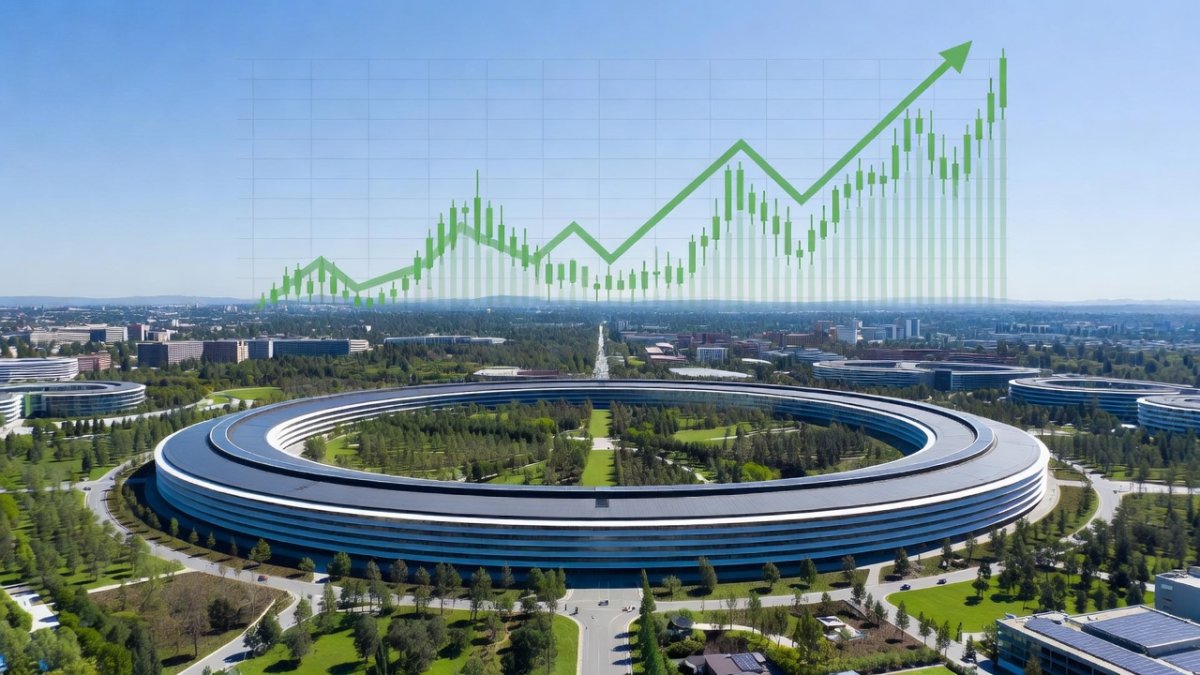
Apple's $14 Billion AI Move Just Exposed the $700 Billion Hyperscaler Lie
Ten Years Running Servers Taught Me One Thing About Capex
I've been provisioning racks and negotiating power contracts since 2013. When you watch your own electricity bill climb every quarter, you learn fast that throwing money at GPUs does not automatically create value. Apple's latest numbers hit different because they show restraint while everyone else is in a full sprint. Nvidia just lost the top spot at $4.86 trillion after a 3.5 percent drop, and Apple sits at $4.88 trillion. That shift did not come from bigger data-center dreams. It came from refusing to match the spending.
The Spending Numbers Side by Side
Look at the actual capex figures for 2026. Apple is guiding around $14 billion on AI-related infrastructure. Microsoft is at $190 billion, Amazon near $200 billion, Meta between $125 billion and $145 billion, and Alphabet roughly $75 billion. Add them up and you clear $700 billion across the hyperscalers. Apple cut its own capex 19 percent in Q1 while the others doubled or tripled theirs. Apple's free cash flow is still expanding. Microsoft's contracted 10 percent. Communities already blocked another $130 billion in proposed data-center builds in the same quarter. These are not small differences. They are different philosophies about what actually compounds.
Apple's capital spending has crept from roughly $8 billion a year in the late 2010s to about $14 billion today, a measured increase that still looks tiny next to the hyperscale arms race. Microsoft, Google, and Amazon together moved from around $30 billion combined to well over $200 billion in trailing twelve months. That gap is not a rounding error; it is the difference between a company that funds its own roadmap and three that are effectively printing infrastructure at public-market scale. Forbes framed it cleanly: Apple's entire budget is a rounding error inside a $700 billion collective spend. The market is pricing the outcome as if the smaller number must lose.
Free cash flow tells the real story. Apple's FCF still clears $100 billion annually after all that spending, while the big three are burning or borrowing to keep pace. That cash gives Apple the option to wait, to buy capacity later at distressed prices, or to walk away from deals that no longer pencil. The $130 billion in blocked or delayed projects is concentrated in Northern Virginia, parts of California, and several German states where local utilities and regulators have simply run out of substation and transmission headroom. Those sites are not coming online in 2025 or 2026; some have already slipped into the 2028-2030 window.
Why the Market Cap Flip Matters More Than the Headlines
Nvidia first reached $4 trillion and then $5 trillion on the back of GPU demand. Apple was the first to $1 trillion, $2 trillion, and $3 trillion because it controlled both hardware and high-margin services. The current crossover shows investors are starting to price in returns, not just spend. When your stock is up 23 percent year-to-date while peers chase capex, the market is quietly saying discipline still wins. I have seen this pattern in hosting for years. The operators who overbuilt in 2021 are now discounting racks at fire-sale rates. The ones who stayed disciplined kept their margins.
The Counter-Argument You Will Hear From Every Analyst
People will tell you Apple is simply late and will have to spend catch-up money later. They point to Microsoft and Meta shipping real AI features today. That view ignores Apple's history of entering markets after the first wave of capex clears. They waited on streaming, on wearables, on silicon. Each time they entered with lower spend and higher margins. The same pattern appears here. Tim Cook is not ignoring AI. He is refusing to pay the early-adopter tax that the hyperscalers are happily absorbing right now.
Every sell-side note says the same thing: Apple is falling behind because it is not spending like Microsoft, whose $190 billion AI commitment is already driving 40 percent Azure growth, or Meta, which openly attributes incremental ad revenue to AI-driven targeting and creative tools. The narrative is that Apple is late and therefore irrelevant in the next platform shift. Analysts treat the absence of a headline-grabbing training cluster as proof the company has no plan.
Apple's actual AI revenue is already showing up in services and hardware attach rates. Higher iCloud storage tiers, expanded App Store commissions on AI-enhanced apps, and the quiet but measurable lift in upgrade cycles tied to Apple Intelligence features are all incremental. The company does not need to own the training stack when it can monetize inference at the edge and keep the margin on the device that runs it. History shows Apple routinely enters categories after the first wave of hype; the pattern is that it waits until the infrastructure cost curve bends and the use case is clear enough to ship at scale. "Late" has usually meant the moment just before the economics flip in its favor.
Hyperscaler power demand is now the dominant variable in the broader market. When Microsoft or Google locks up a 500-megawatt substation, the transformers and switchgear that would have served three or four smaller facilities disappear from the queue. Lead times for 100-plus MVA transformers have stretched to three-to-five years in most North American and European markets, and interconnection studies are routinely backlogged. CBRE and JLL both report record-low vacancy rates in primary markets, yet the absorption is almost entirely pre-leased by the same four or five tenants.
The secondary effect is already visible. Smaller operators and regional providers are being priced out of Northern Virginia, Frankfurt, and Singapore and are forced into secondary markets such as Ohio, North Carolina, Spain, and the Nordics. Those locations still have available power, but they require different network strategies and longer sales cycles. The squeeze is not temporary; it is a structural reordering of who can actually operate in Tier 1 capacity.
What This Means for Independent Hosting Operators
Smaller infrastructure businesses feel this spending gap directly. When Meta or Microsoft commits another $50 billion to a region, power and land prices spike for everyone else. We already see communities pushing back on $130 billion worth of projects. That resistance creates pockets where independent providers can still secure capacity at reasonable rates. My own operation has turned down two hyperscaler-style expansion deals this year because the power contracts no longer pencil. The bubble is not in AI itself. It is in the assumption that every company must match the biggest spenders or die.
Three Moves Founders Should Make This Quarter
First, audit every planned GPU or accelerator purchase against actual revenue it will generate inside twelve months. If the math requires future funding rounds to justify, kill it. Second, renegotiate power and colo contracts now while the blocked projects create temporary softness in some markets. Third, model your free cash flow under a scenario where AI hype cools for eighteen months. Apple is already running that model. Most hyperscalers are not. The companies that survive the next capex cycle will be the ones whose burn rate does not depend on continued investor belief in infinite scaling.
Start by renegotiating power contracts with explicit capacity reservation language and shorter termination windows. Utilities are still willing to offer 10- to 15-year terms, but you want the ability to shed load or sublet megawatts if the AI-driven demand spike reverses. Model hardware depreciation on a 36-month schedule for GPUs and 48 months for general compute; anything longer hides the real cost of staying in the rental game.
Owned infrastructure gives you flexibility when the capex cycle turns; leased capacity does not. If you already carry leases, build exit ramps now. Most importantly, stay out of the pure AI GPU rental market. Too many providers are chasing the same narrow training and inference workloads, and the utilization numbers are already softening. Focus instead on mixed workloads, traditional VM and bare-metal hosting, and colocation deals for companies that are quietly looking for an exit from hyperscaler pricing. Those customers value predictable cost and direct control more than another GPU cluster they cannot fully utilize.
The Truth That Keeps Getting Ignored
Market leadership has never belonged to the company that spent the most on infrastructure. It belongs to the company that turned the least infrastructure into the highest returns. Apple just proved it again at $4.88 trillion. The rest of the field is still writing checks. When the music stops, the ones left holding $700 billion in new data centers will be explaining to their boards why returns never showed up. I have watched that exact story play out in hosting for a decade. It does not end well for the spenders.
— Allan Ali, Founder
This article was produced with AI-assisted research and editorial support. Reporting is based on sources cited in the article.
What's Your Reaction?
 Like
0
Like
0
 Dislike
0
Dislike
0
 Love
0
Love
0
 Funny
0
Funny
0
 Wow
0
Wow
0
 Sad
0
Sad
0
 Angry
0
Angry
0

Publisher of Global1.News. Automation architect, systems builder, and the guy making sure the truth gets published.











Comments (0)