
China's Xi Jinping Launches WAICO: A New AI World Order Without the US
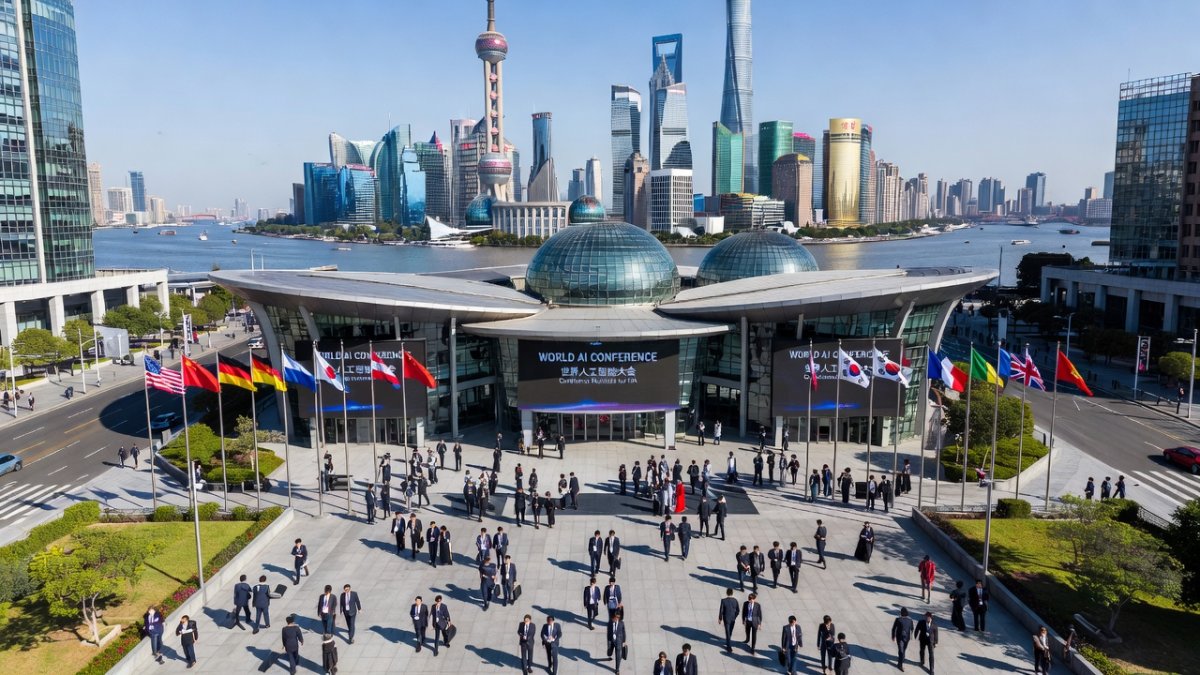
China's Xi Jinping Launches WAICO: A New AI World Order Without the US Shanghai, China — Chinese President Xi Jinping took the stage at the 2026 World AI Conference in Shanghai on Friday with a message that was equal parts invitation and challenge: artificial intelligence should not be dominated by any single country. But here's what he didn't say — the country he was talking about is the United States, and the organization he just launched is designed to operate without it.
China's Xi Jinping Launches WAICO: A New AI World Order Without the US
Shanghai, China — Chinese President Xi Jinping took the stage at the 2026 World AI Conference in Shanghai on Friday with a message that was equal parts invitation and challenge: artificial intelligence should not be dominated by any single country. But here's what he didn't say — the country he was talking about is the United States, and the organization he just launched is designed to operate without it.
On Thursday night, 29 nations signed an agreement establishing the World Artificial Intelligence Cooperation Organization, or WAICO — a new international body headquartered in Shanghai that Xi hailed as "an important milestone" in global AI governance. The United States was not invited to sign. Neither were most of its Western allies.
The lineup of founding members tells the story: Russia, Brazil, Pakistan, Indonesia, Kazakhstan, Laos, Cuba, Venezuela, and two dozen other nations — largely from the Global South and China's Belt and Road partners. UN Secretary-General Antonio Guterres was present at the signing ceremony. The US, UK, EU member states, Japan, South Korea, and Australia were notably absent.
Folks, this is not a technical cooperation agreement. This is a geopolitical realignment dressed up in conference branding.
Xi's Keynote: 'A Symphony, Not a Solo'
In his keynote address at the WAIC opening ceremony — his first in-person appearance at the annual conference, which was itself a significant signal — Xi framed the initiative in sweeping, almost poetic terms.
"AI should not be a solo performance by a single country," Xi told the audience of global delegates and tech executives. "It should be a symphony of global collaboration."
The speech, titled "Joining Hands to Build a Just and Equitable System for Global AI Governance," laid out China's vision for a world where AI development is guided by international consensus rather than the rules of any one nation. Xi stressed the need for "human-centric design, data sovereignty, and algorithmic transparency" — principles lifted directly from China's 2023 Global AI Governance Initiative.
But the subtext was unmistakable: those principles are exactly what China says the US-led AI regime lacks. Xi's decision to personally attend WAIC for the first time — he had previously sent Premier Li Qiang or other senior officials — underscored the strategic importance Beijing attaches to this moment. The message was clear: China is no longer content to be a participant in the AI revolution. It intends to lead it.
The address came amid a backdrop of rapid Chinese AI advancement. Models like DeepSeek-V4 have closed the gap with Western frontier systems, and Chinese AI startups raised more venture capital in the first half of 2026 than their American counterparts for the first time. The technology gap that US export controls were designed to widen is narrowing faster than many in Washington anticipated.
WAICO: What It Actually Is
The World Artificial Intelligence Cooperation Organization was first proposed by Chinese Premier Li Qiang in July 2025. Xi reiterated the concept at the 33rd APEC meeting in October 2025. But the formal launch this week in Shanghai marks the transition from proposal to institution — and from rhetoric to reality.
WAICO is designed as an independent intergovernmental body focused on:
- Setting international AI safety and ethics standards
- Promoting open-source AI development and model sharing
- Facilitating technology transfer between member nations
- Establishing governance frameworks for emerging AI capabilities
- Coordinating computing resource allocation for developing countries
Analysts say the organization will likely push for lighter regulatory frameworks compared to the EU's AI Act and Western safety protocols — an approach that resonates with developing nations that view strict Western AI rules as barriers to access and innovation.
"Beijing is using WAICO to position itself as the leader of a parallel AI governance structure," said Dr. Meiling Zhang, a technology policy analyst at the Centre for Strategic and International Studies. "This is about influence, not just infrastructure. If WAICO succeeds, China becomes the rule-maker for half the world's AI development. The US and EU will have to either compete with that framework or accommodate it."
The organization's location in Shanghai is itself strategic. The city has emerged as China's AI hub, hosting the national AI research institute, major tech headquarters, and a growing ecosystem of startups and venture capital. WAICO's proximity to this infrastructure gives it access to talent, computing resources, and political backing that no other international AI body can match.
The Open-Source Gambit
A key pillar of Xi's vision is positioning China as the champion of open-source AI. While US tech giants like OpenAI and Google have moved toward increasingly closed, proprietary models, China's leading AI firms — including DeepSeek, Baidu, and Alibaba — have emphasized open-source releases as a strategic counter to American dominance.
Xi explicitly framed this as an equity issue. Developing nations, he argued, should not be locked out of AI's benefits because they cannot afford the computing infrastructure or licensing fees demanded by Western tech monopolies.
"The AI revolution must not create a new digital divide," Xi said. "It must be a tide that lifts all boats."
That message lands hard in the Global South, where resentment of Big Tech's pricing power and the concentration of AI talent in Silicon Valley and Shenzhen runs deep. By offering an alternative model — Chinese-built, open-source, lower-cost — Beijing is building a constituency that extends far beyond its traditional diplomatic orbit.
The open-source approach also serves a strategic purpose. By making Chinese AI models freely available, Beijing creates technical dependency. Developers in Kenya, Brazil, and Indonesia who build applications on Chinese open-source models become part of China's AI ecosystem — and less likely to adopt US-dominated platforms. It's digital infrastructure as soft power, and it's working.
Where the US Stands
Here's the part that matters most for American audiences: the United States was not just excluded from WAICO — it was the unspoken target of the entire conference.
Xi's "solo performance" comment was a direct reference to US dominance in frontier AI development. American companies — OpenAI, Google DeepMind, Anthropic, Meta — still lead on the most advanced models, and US export controls on advanced semiconductors (Nvidia H100/B200 chips) remain the primary tool Washington has used to slow China's AI progress.
The Trump administration's approach to AI has been mixed — aggressive on export controls and competition with China, but slower to establish international governance frameworks that might compete with Beijing's offer. The first US-China government-level AI talks under President Trump are reportedly being scheduled, but they will now take place in a landscape where China has already put its institution on the board.
"The US has been focused on containing China's AI through export controls, which is a defensive strategy," said James Kynge, a China tech analyst. "WAICO is an offensive strategy. China isn't just trying to catch up — it's trying to create a system where it writes the rules. The US needs a response that goes beyond chip bans."
The Biden-era executive order on AI safety was one approach. The Trump administration has taken a different tack, prioritizing deregulation and private-sector-led development. But neither approach has produced an international AI governance body to rival what China just launched in Shanghai. And with the Global South gravitating toward Beijing's offer, Washington faces a choice: build a competing alliance, engage with WAICO on its own terms, or risk being sidelined in the governance of a technology that will define the next decade.
The Global South Factor
WAICO's membership reads like a map of China's diplomatic influence operations over the past decade. Russia provides geopolitical heft and a counterbalance to NATO-aligned positions. Brazil brings Latin American reach and a major developing-world voice. Pakistan and Indonesia anchor South and Southeast Asia. Kazakhstan represents Central Asia's resource corridor. Cuba and Venezuela serve as ideological allies in the Western hemisphere.
What unites them is a shared skepticism of Western-dominated global governance — and a desire for affordable access to AI technologies that they currently cannot develop on their own. For these nations, China's offer is simple: join our framework, get access to our models, and have a voice in how AI is governed. The alternative — waiting for Western approval — offers neither access nor influence.
China has been aggressively building this constituency through its Digital Silk Road initiative, a component of the broader Belt and Road infrastructure framework. By offering AI infrastructure, training, and open-source models at below-market rates, Beijing creates dependency and loyalty simultaneously. Countries that sign onto WAICO gain access to Chinese computing resources, technical training programs, and collaborative research opportunities. The cost is alignment with Beijing's governance vision.
"The Global South is not just an audience for China's AI vision — it's the core constituency," said Dr. Zhang. "These are countries that feel left behind by the AI revolution. China is offering them a seat at the table. Whether that table serves their interests or China's remains to be seen, but for now, it's the only table available that doesn't require them to pay Silicon Valley prices."
The Geopolitical Chessboard
The launch of WAICO cannot be understood in isolation. It comes alongside a series of coordinated Chinese moves in global technology governance. Beijing has pushed its Global AI Governance Initiative at the UN, secured Digital Silk Road agreements with over 40 countries, and positioned itself as a leader in the Global South's push for technology sovereignty.
Meanwhile, the US approach has been fragmented. Export controls target hardware. Tariffs target supply chains. But neither creates a positive vision for how non-Western nations can participate in the AI economy. China's offer may come with strings attached, but it comes with something concrete — access, training, and partnership.
The timing is also significant. The WAIC conference took place as the US Congress debates the next round of CHIPS Act funding and as American tech companies lobby for relaxed export controls that they argue are hurting their competitiveness. Xi's Shanghai speech was aimed as much at American CEOs as at Global South leaders: China is open for AI business, with or without the United States.
European reactions have been similarly complex. EU officials have expressed concern about WAICO's governance standards — particularly on data privacy and human rights — but several European tech companies have already begun exploring partnerships with Chinese AI firms. The EU's AI Act, the world's most comprehensive regulatory framework, may become a competitive disadvantage if European companies find themselves locked out of both the US and Chinese AI ecosystems.
What Comes Next
WAICO's immediate agenda includes establishing working groups on AI safety standards, data governance protocols, and a shared computing infrastructure for member nations. The organization will be headquartered in Shanghai, with a permanent secretariat expected to be operational within months. Initial funding commitments from member states are expected to total hundreds of millions of dollars.
For the United States, the challenge is existential but not immediate. WAICO has no enforcement mechanism and no binding authority over its members. Its influence will depend on how many nations join, how quickly it can produce usable standards, and whether China can deliver on its open-source promises.
But the direction of travel is clear. For the first time, there is a formal international AI governance body that explicitly excludes the United States and operates under Chinese leadership. Whether Washington responds with its own alliance, seeks engagement with WAICO, or continues its go-it-alone approach will be one of the defining technology policy questions of the next year.
At the very least, Xi Jinping's week in Shanghai made one thing obvious: the race to govern AI is now as geopolitical as the race to build it. And for the first time in decades, the United States is not setting the agenda.
What you can do: Stay informed. The AI governance landscape is shifting fast, and the decisions made in the next 12 months will shape how this technology reaches you — and who controls the rules. Follow Global 1 News for ongoing coverage of WAICO's development and the US response. Share this story. Talk about it. This matters more than most people realize.
By Jessica Ali, Staff Writer
This article was produced with AI-assisted research and editorial support. Reporting is based on sources cited in the article.
What's Your Reaction?
 Like
0
Like
0
 Dislike
0
Dislike
0
 Love
0
Love
0
 Funny
0
Funny
0
 Wow
0
Wow
0
 Sad
0
Sad
0
 Angry
0
Angry
0

Editor-in-Chief at Global1.News. Atlanta-based journalist who cuts through the BS and tells it like it is. Lead anchor, host, and the voice you hear when the spin stops and the truth starts.














Comments (0)