
Tnuva: Cottage Cheese Crisis Expands to White Cheese as Warehouse Malfunction Paralyzes Supply
A computer malfunction at Tnuva warehouse in Alon Tavor has expanded from cottage cheese to white cheese, with German technicians refusing to travel due to security concerns. Israeli supermarkets face empty shelves as panic buying intensifies across the country.
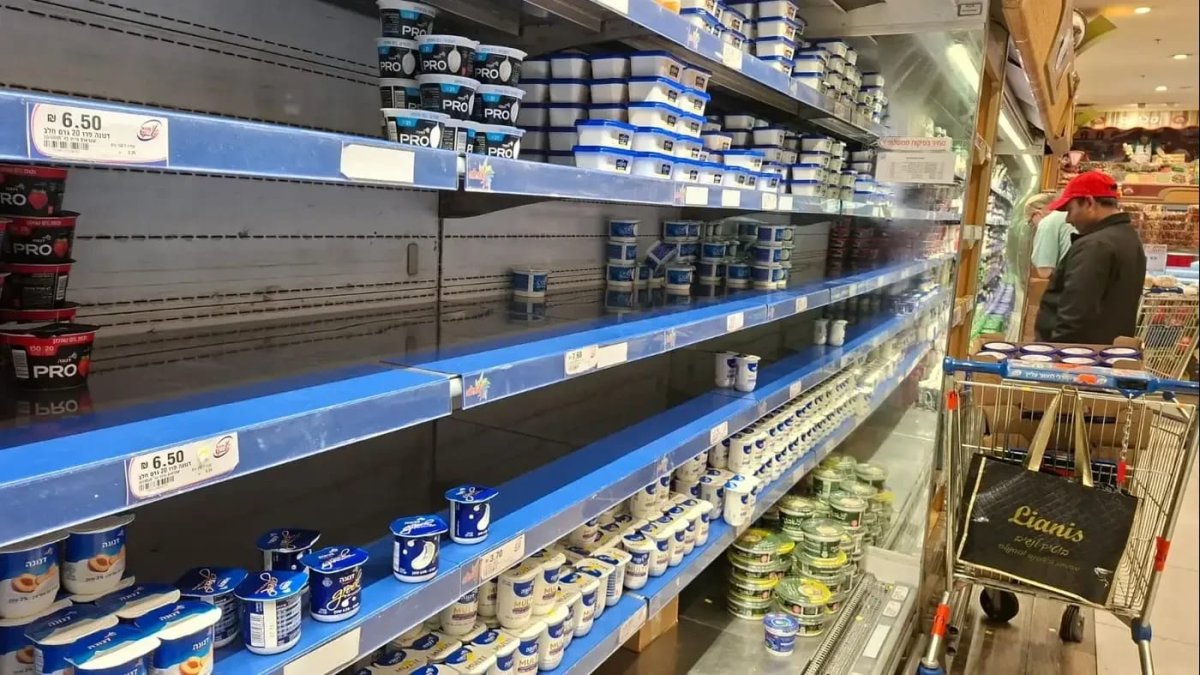
White Cheese Joins Cottage Cheese on Empty Shelves as Tnuva Crisis Widens
Israel's dairy aisles are facing a deepening shortage this week as the long-running supply disruption at Tnuva has expanded beyond cottage cheese into white cheese and other refrigerated products. Shoppers across the country, from Tel Aviv supermarkets to stores in the Jezreel Valley, have been confronting bare shelves and limited options, prompting waves of panic buying that further strain remaining stocks. Tnuva, the country's dominant dairy producer, continues to grapple with a complex automation failure that has left finished goods trapped inside its warehouse system even as production lines keep operating.
The expansion of the crisis into white cheese marks a significant escalation for Israeli households that rely on these staples for everyday meals. Larger containers have begun appearing in greater numbers as a temporary measure, yet the familiar 250-gram packs remain scarce in many locations. Consumers report that yogurt and sour cream from Tnuva are also harder to find in recent days, turning a single-product glitch into a broader refrigerated dairy headache.
Root Cause Traced to Automated Warehouse at Alon Tavor Plant
At the heart of the disruption sits a severe computer malfunction inside the automated warehouse at Tnuva's cottage cheese production plant in Alon Tavor, located in the Jezreel Valley. The facility relies on sophisticated automation to move, store, and retrieve containers efficiently. When the system failed, finished products began accumulating inside the warehouse rather than flowing out to distribution centers and supermarket chains.
Production itself has not stopped. Lines at the Alon Tavor site continue to manufacture cottage cheese and related items, and demand has remained high. The bottleneck is purely logistical: containers are stuck within the automated storage and retrieval system, unable to exit in the volumes required to restock shelves nationwide. Tnuva operates nine production plants across Israel, yet the concentration of cottage cheese and white cheese output at Alon Tavor has amplified the impact of this single-point failure.
Industry observers note that modern dairy logistics in Israel depend heavily on such automated systems to handle high volumes under tight cold-chain requirements. A glitch of this complexity quickly cascades through the supply network, especially when the company controls such a large share of the market.
Timeline: From Cottage Cheese Shortages to Wider Dairy Disruption
The problems first surfaced months ago when cottage cheese supplies began thinning out in stores. What initially appeared as a temporary hiccup stretched into a prolonged shortage as technicians struggled to restore full warehouse functionality. In recent weeks the effects have spilled over into white cheese, with shoppers noticing empty spots where the popular soft cheese usually sits.
By early this week, reports from multiple supermarket chains confirmed that white cheese had joined cottage cheese on the list of hard-to-find items. Some outlets also flagged reduced availability of Tnuva yogurt and sour cream. The company responded by ramping up production of larger white cheese formats—500-gram and 750-gram containers—in an effort to put more product into the market while the core warehouse issue persists.
Tnuva has indicated that supplies of the standard 250-gram white cheese containers are expected to return to more normal distribution patterns during the course of this week. Whether that timeline holds depends on progress in clearing the automated backlog and restoring reliable outbound flows from Alon Tavor.
Consumers Empty Shelves Amid Panic Buying
Israeli shoppers have reacted with familiar urgency. In cities and towns alike, supermarket dairy sections have been stripped of remaining Tnuva cottage cheese and white cheese packs almost as soon as they appear. Social media feeds and neighborhood WhatsApp groups fill with photos of empty refrigerators and tips on which branches still have stock.
The behavior echoes earlier episodes of scarcity, when uncertainty itself becomes a driver of demand. Families stock up beyond immediate needs, accelerating the depletion of whatever limited quantities reach the stores. Retail staff in the greater Tel Aviv area and northern communities near the Jezreel Valley describe daily restocking efforts that fail to keep pace with customer traffic.
Daily life adjustments are already visible. Some households are switching to alternative brands where available, while others stretch remaining tubs or substitute with different dairy products. For a population that treats cottage cheese and white cheese as kitchen essentials, the prolonged absence has become a tangible reminder of how fragile even basic supply chains can become.
Tnuva Adjusts Production and Distribution Strategies
Facing mounting pressure, Tnuva has shifted production emphasis toward larger white cheese containers. The 500-gram and 750-gram sizes are intended to deliver more product volume per unit that successfully exits the warehouse, thereby easing the shortage for consumers who can adapt to bigger packs. Company sources emphasize that manufacturing capacity itself is not the constraint; the automated storage system remains the choke point.
A source familiar with the details pushed back against any suggestion of deliberate withholding: "What interest could Tnuva have in not selling cottage cheese? After all, she makes money on every tub, and when the cottage cheese isn't sold, she loses." The comment underscores the straightforward commercial incentive for the company to resolve the glitch as quickly as possible.
Distribution teams are working to prioritize high-demand channels and to clear whatever containers can be manually extracted or rerouted. Yet the scale of Tnuva's operations means that partial workarounds only partially mitigate the shortfall. With nine plants in its network, the firm is exploring ways to shift some volume, though specialized cottage and white cheese lines are concentrated at the affected Alon Tavor site.
German Technicians Stay Away as Security Concerns Block Travel
Resolution of the warehouse malfunction hinges on specialized expertise that currently cannot reach Israel. The automated system was built by a German company, and its technicians possess the deep knowledge required to diagnose and repair the complex software and hardware interactions. Those experts have refused to travel to Israel because of the ongoing security situation.
In their place, remote assistance via Zoom has become the primary channel. German engineers review diagnostic data, guide local teams through procedures, and attempt to isolate the root software fault from afar. While video calls and screen sharing allow some progress, the physical nature of an automated warehouse—conveyors, cranes, sensors, and tightly integrated control software—limits what can be achieved without on-site presence.
This episode highlights a recurring vulnerability in Israel's advanced industrial base. Highly automated facilities in the food, logistics, and manufacturing sectors often depend on foreign specialists for major system interventions. When security conditions deter travel, even sophisticated remote tools prove insufficient for certain classes of failure. The Alon Tavor case has become a live demonstration of how geopolitical realities intersect with everyday technology infrastructure.
Echoes of 2011 and Parallel Pressures on Retail Logistics
The current dairy shortage inevitably recalls the 2011 cottage cheese boycott, when sharp price increases ignited a nationwide social protest movement that extended far beyond dairy. Although today's crisis stems from a technical malfunction rather than pricing decisions, the cultural resonance remains strong. Cottage cheese occupies a symbolic place in Israeli consumer consciousness, and any prolonged absence quickly draws public attention and political commentary.
At the same time, broader retail logistics face their own strains. Shufersal, Israel's largest supermarket chain, recently raised delivery fees by 20 percent, citing a shortage of drivers and rising operational costs. The fee increase arrives just as physical store shelves struggle with dairy gaps, compounding the sense that supply chains are under multiple simultaneous pressures.
Security-related disruptions, labor constraints, and the high cost of maintaining cold-chain integrity all feed into the same narrative: Israel's sophisticated consumer economy remains exposed to both technical single points of failure and the wider regional environment. The Tnuva episode sits at the intersection of these forces.
Market Dominance Magnifies Every Disruption
Tnuva's position as Israel's largest dairy company, controlling approximately 70 percent of the country's dairy market, turns any operational problem into a national issue. When a firm of that scale experiences a warehouse paralysis, alternative suppliers cannot instantly fill the void. Competitors such as Strauss maintain significant presence, yet the sheer volume of Tnuva products means that gaps appear quickly and widely.
This market structure delivers efficiencies in normal times—standardized quality, broad distribution, and investment in automation—but it also concentrates risk. A computer malfunction at one plant in the Jezreel Valley can empty refrigerators from Eilat to Kiryat Shmona. Regulators and industry analysts have long noted the trade-offs inherent in such concentration, particularly for staple foods.
From an economic perspective, the lost sales represent pure leakage for Tnuva. Every unsold tub of cottage cheese or white cheese is revenue that never materializes, while fixed costs of production and plant operations continue. The commercial logic therefore aligns with rapid resolution, even if the technical path remains blocked by the absence of on-site German specialists.
Israeli Tech Ecosystem Meets Security Realities
The Alon Tavor warehouse is itself a product of Israel's embrace of industrial automation and advanced logistics technology. High-tech storage and retrieval systems allow dairy plants to handle massive throughput with reduced labor and tighter temperature control. Yet the same sophistication creates dependencies on proprietary software, specialized spare parts, and the engineers who designed the original installation.
In recent years, Israeli companies across sectors have invested heavily in Industry 4.0 solutions, often in partnership with European and American technology providers. The current episode serves as a cautionary case study: remote diagnostics and Zoom troubleshooting can bridge many gaps, but not all. When physical intervention is required and security conditions prevent travel, even the most advanced facilities can stall.
Supply-chain resilience has become a growing topic within the Israel Innovation Authority and the Ministry of Economy. Discussions increasingly focus on dual sourcing of critical expertise, greater local training for complex automation systems, and contingency protocols that do not rely solely on foreign technicians. The Tnuva experience is likely to accelerate those conversations.
Outlook: Gradual Recovery Expected, Structural Lessons Remain
Looking ahead, Tnuva anticipates that 250-gram white cheese containers will resume more regular distribution during the course of this week. Larger formats should continue to help bridge remaining gaps. Cottage cheese availability will improve in parallel as warehouse throughput slowly recovers through a combination of remote guidance and local workarounds.
Full restoration, however, may still require the eventual arrival of German experts once security conditions allow, or the successful transfer of deeper diagnostic capabilities to Israeli teams. Until then, consumers can expect intermittent shortages and the continued need to check multiple stores or accept larger package sizes.
Beyond the immediate dairy aisle, the episode underscores enduring challenges for Israel's food security and industrial base. Automated systems deliver efficiency but introduce new forms of fragility. Foreign technical dependencies collide with regional security realities. Market concentration amplifies every disruption. And Israeli shoppers, long accustomed to reliable supermarket abundance, are reminded that even the most ordinary products rest on complex technological and geopolitical foundations.
As shelves gradually refill in the coming days, the deeper questions about resilience, expertise localization, and supply-chain design will linger well after the last missing tub of white cheese reappears.
By Hannah Berg, Staff WriterThis article was produced with AI-assisted research and editorial support. Reporting is based on sources cited in the article.
What's Your Reaction?
 Like
0
Like
0
 Dislike
0
Dislike
0
 Love
0
Love
0
 Funny
0
Funny
0
 Wow
0
Wow
0
 Sad
0
Sad
0
 Angry
0
Angry
0

Israel Correspondent at Global1.News. Based in Tel Aviv, covering Israeli politics, security, technology, and society. Provides balanced, deeply-sourced reporting on one of the most closely-watched regions in the world.














Comments (0)