
Nova Scotia Wildfire Forces Eastern Shore Evacuations
Halifax, Nova Scotia — July 18, 2026 A rapidly expanding wildfire along Nova Scotia's Eastern Shore has forced the evacuation of residents in Halifax County as flames crossed Mooseland Road near Jacket Lake. The fire, which has grown significantly under dry conditions, poses ongoing challenges for containment. This incident reflects broader issues with wildfires across Canada amid changing climate patterns. Fire Behaviour and Expansion The wildfire on Mooseland Road in the Ja
Nova Scotia Wildfire Forces Eastern Shore Evacuations
Halifax, Nova Scotia — July 18, 2026
A rapidly expanding wildfire along Nova Scotia's Eastern Shore has forced the evacuation of residents in Halifax County as flames crossed Mooseland Road near Jacket Lake. The fire, which has grown significantly under dry conditions, poses ongoing challenges for containment. This incident reflects broader issues with wildfires across Canada amid changing climate patterns.
Fire Behaviour and Expansion
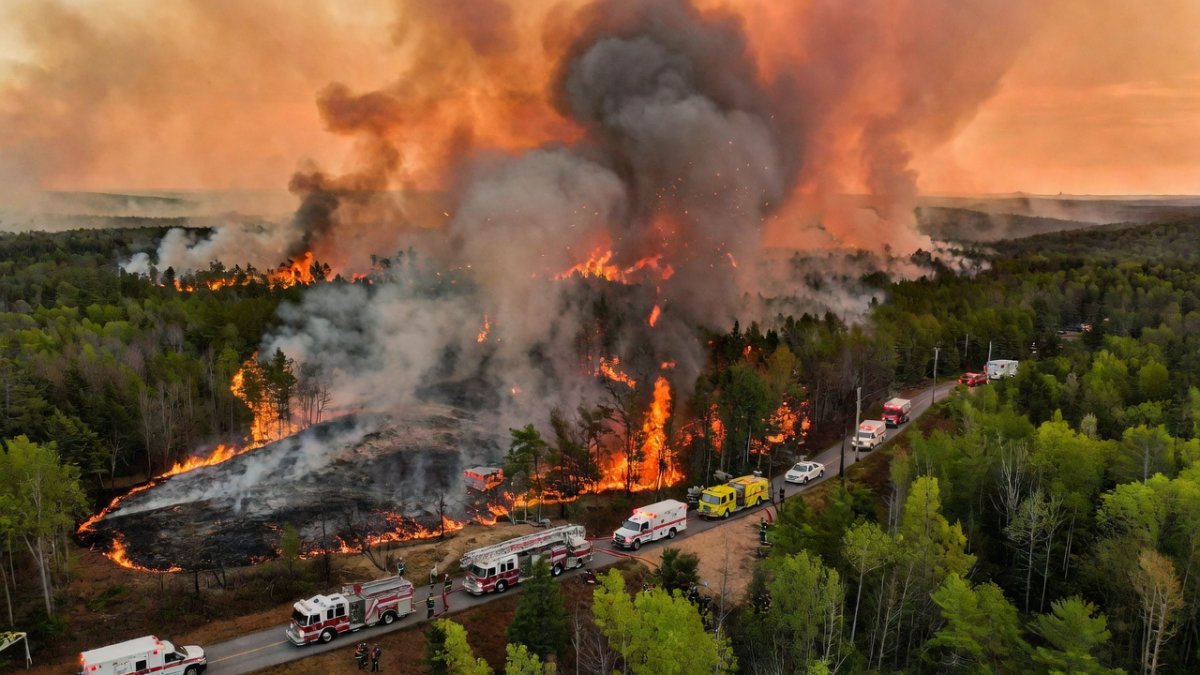
The wildfire on Mooseland Road in the Jacket Lake area of Halifax County grew from 300 hectares on Thursday, July 16, 2026, evening to 1,700 hectares by Friday, July 17, 2026, afternoon. This increase occurred under continued dry conditions that limited containment efforts by ground crews. Nova Scotia Department of Natural Resources officials confirmed the fire crossed Mooseland Road, directly prompting the mandatory evacuation order. No structural losses were reported as of the Friday update from provincial authorities.
Fire behaviour in the Jacket Lake area has proven particularly challenging due to the dense mixed forest and rocky terrain typical of Halifax County's Eastern Shore. Steep slopes and limited access roads have hindered ground crews from establishing effective firebreaks, allowing flames to advance rapidly through crown fire activity. Officials noted that embers carried by gusts have ignited spot fires hundreds of metres ahead of the main front, complicating efforts to predict spread patterns. Dry conditions across the Eastern Shore continued to challenge firefighters throughout Friday. Low humidity and gusty winds allowed the fire to spread beyond initial containment lines established on Thursday evening. Provincial meteorologists noted that similar dry patterns have affected multiple regions of Nova Scotia this summer, increasing the workload on the Department of Natural Resources wildfire management teams.
Provincial authorities have deployed air tankers alongside helicopters equipped with bambi buckets to drop retardant and water on hotspots. Ground teams from the Department of Natural Resources are using bulldozers and skidders to create containment lines where terrain permits, though the dry forest floor has increased the risk of flare-ups. Local residents described the smoke plume as towering and shifting direction abruptly, forcing crews to reposition equipment frequently throughout the day. These conditions highlight the labour-intensive nature of wildfire suppression in remote Nova Scotia landscapes, where fibre-rich undergrowth fuels intense burns. Continued monitoring of wind shifts remains essential as crews endeavour to protect neighbouring communities.

Evacuation Order and Resident Impact
The mandatory evacuation order covers a 22-kilometre stretch of Mooseland Road in Halifax County. Between 100 and 150 residents received notices to leave their homes immediately due to the advancing flames. Halifax Regional Fire and Emergency coordinated with local RCMP detachments to enforce the order and establish traffic control points along the affected roadway. Residents were directed to designated reception centres operated by the Halifax Regional Municipality.
Residents forced from the 22-kilometre stretch along Mooseland Road have been directed to reception centres in nearby communities such as Sheet Harbour and Musquodoboit Harbour. These facilities, operated by Halifax Regional Municipality staff, provide temporary shelter, meals, and access to social services. Families have reported arriving with minimal belongings, often after receiving only a few hours' notice, and many expressed concern about the duration of their displacement. Halifax Regional Fire and Emergency officials emphasised that pets are welcome at the centres, with arrangements made for crates and basic supplies, while livestock owners have been advised to contact the Nova Scotia Department of Agriculture for relocation assistance. One HRFE spokesperson stated that coordination with local veterinarians has ensured animals receive necessary care during the emergency. The sudden move has disrupted work schedules and school routines for dozens of households, underscoring the broader social strain placed on rural families when wildfire threats escalate without warning.
Provincial and Municipal Response
Nova Scotia Department of Natural Resources deployed additional firefighters and heavy equipment to the Jacket Lake area on Friday. Halifax Regional Fire and Emergency provided structural protection units to safeguard properties near the fire perimeter. Nova Scotia Power crews cut electricity to active power lines in the evacuation zone to reduce ignition risks from fallen lines. This measure affected service to homes already under the mandatory order.
National Wildfire Context and Resource Sharing
This Nova Scotia incident forms part of a broader Canadian wildfire crisis that includes active fires burning in Ontario. Federal resources through Natural Resources Canada have been placed on standby to support provincial operations when requested. The simultaneous outbreaks underscore jurisdictional challenges between federal and provincial governments in coordinating aerial support and interprovincial equipment sharing during peak fire season.
Ontario currently contends with more than 40 active wildfires, several of which have prompted evacuations in northern regions and required mutual aid agreements. Through the Canadian Interagency Forest Fire Centre, Nova Scotia has requested additional air tankers and trained personnel that can be redirected from provinces experiencing lower fire activity. This interprovincial resource sharing helps balance demands during peak season when multiple jurisdictions face simultaneous threats. Federal support mechanisms include standby contracts with private aviation firms and access to military assets if provincial capacities are exceeded. CIFFC coordinators have facilitated daily briefings to track equipment movements and forecast needs, ensuring that Atlantic provinces can draw on western expertise when local crews become stretched. Such collaboration reduces duplication of effort and strengthens national resilience, though it also reveals ongoing gaps in long-term planning for increasingly frequent cross-country fire events.
Climate Policy and Adaptation Measures
Nova Scotia's carbon pricing system, aligned with federal benchmarks, aims to reduce emissions that contribute to hotter and drier summers. The current wildfire activity highlights the urgency of meeting Canada's 2030 emissions targets set under the Paris Agreement. Provincial officials have linked increased fire risk to changing climate patterns, prompting renewed discussions in the House of Commons about enhanced federal funding for adaptation measures in Atlantic Canada.
The current outbreak echoes the destructive 2023 season, when the Tantallon and Barrington Lake fires together scorched tens of thousands of hectares and displaced thousands of residents. Those events prompted the first widespread use of the federal Disaster Mitigation and Adaptation Fund in Nova Scotia, financing improved early-warning systems and community firebreaks. Parliament is now debating expanded eligibility criteria for the fund to cover more rural infrastructure projects. Adaptation measures under discussion include increased funding for prescribed burns, enhanced forest management training, and support for Indigenous-led stewardship programs that have proven effective in reducing fuel loads. Federal officials have acknowledged that carbon pricing alone cannot address immediate risks and must be paired with targeted investments in resilience. These policy conversations reflect a growing recognition that Atlantic Canada requires sustained federal-provincial partnerships to manage the escalating costs of climate-driven wildfires while meeting 2030 emissions commitments.
Community and Economic Effects
Evacuated residents from the 22-kilometre Mooseland Road corridor face immediate disruptions to daily routines and potential income losses from halted local tourism and forestry activities. Halifax County businesses near the fire zone reported temporary closures. The absence of reported structural damage so far offers some relief, yet prolonged evacuations could strain provincial health authorities responsible for supporting displaced individuals through Nova Scotia's medicare system.
Containment Efforts and Outlook
Fire crews will continue operations through the weekend, with Nova Scotia Department of Natural Resources monitoring weather forecasts for any relief from dry conditions. Containment success depends on reduced wind speeds and increased humidity levels. Provincial emergency management teams remain in contact with federal counterparts to prepare for possible requests for additional support if the fire continues its rapid growth beyond the current 1,700 hectares.
By Alex Thompson, Staff WriterThis article was produced with AI-assisted research and editorial support. Reporting is based on sources cited in the article.
What's Your Reaction?
 Like
0
Like
0
 Dislike
0
Dislike
0
 Love
0
Love
0
 Funny
0
Funny
0
 Wow
0
Wow
0
 Sad
0
Sad
0
 Angry
0
Angry
0

Canada Correspondent at Global1.News. Based in Toronto, covering Canadian politics, energy, trade, and US-Canada relations. Provides the Canadian perspective on North American and global affairs.















Comments (0)