
China's AI Rise Puts Xi on World Stage While Deepening Security Dilemma
Xi Jinping personally opened WAIC 2026 as 29 nations signed China's rival AI governance body WAICO. With the US-China AI performance gap narrowing to just 2.7 points and Huawei debuting a domestically-built supercomputing cluster, Japan faces deepening strategic pressure caught between alliance o...
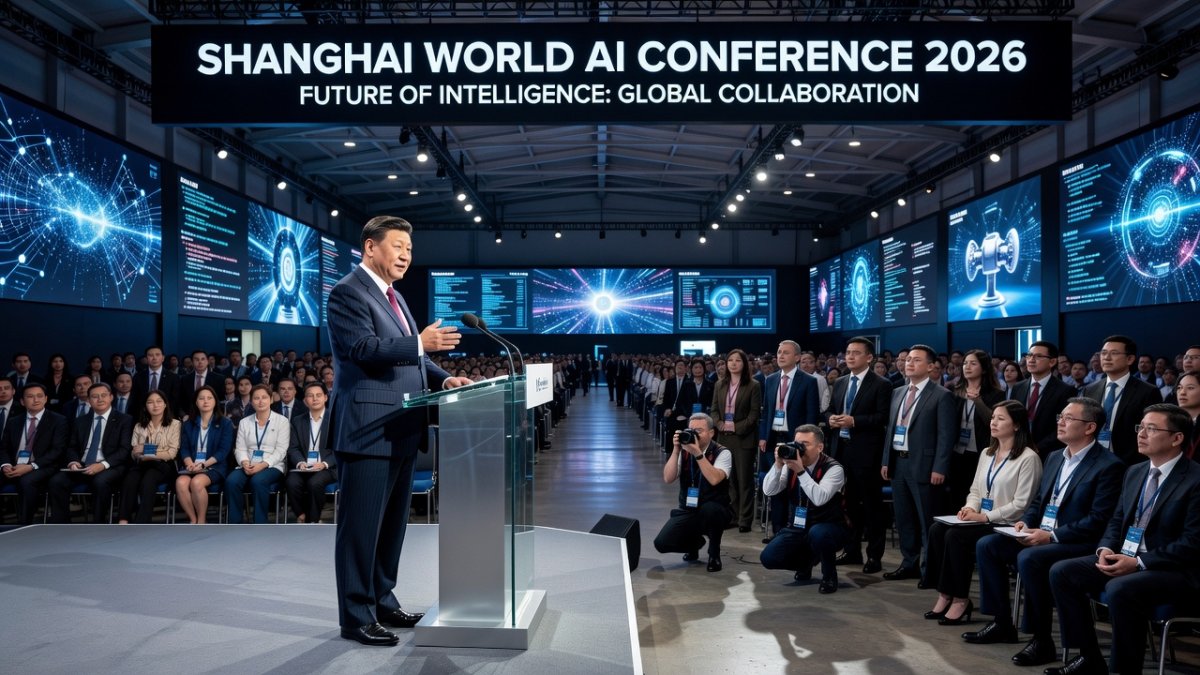
China's AI Ascendance Gives Xi a Stage and a Security Dilemma
SHANGHAI — Xi Jinping took the stage at the World Artificial Intelligence Conference in Shanghai on Thursday in a first for a Chinese president, personally opening the event as Beijing formalized a rival AI governance body with 29 founding nations. The move marks a watershed moment in the technology rivalry between the United States and China — one that presents both opportunity and acute strategic risk for Japan.
The four-day conference, the largest WAIC on record with more than 1,100 exhibitors across 100,000 square meters of floor space, served as the launchpad for the World Artificial Intelligence Cooperation Organization (WAICO), an intergovernmental body headquartered in Shanghai that China first proposed in July 2025. Chinese Foreign Minister Wang Yi signed the agreement alongside representatives from Russia, Kazakhstan, Pakistan, Indonesia, Laos, and two dozen other nations, cementing what analysts describe as a direct challenge to the Western-led AI governance architecture.
Tags: China, AI, Xi Jinping, WAICO, World AI Cooperation Organization, Huawei, Atlas 950, Japan semiconductor, US China competition
Xi's Personal Stamp on AI Diplomacy
Xi's decision to personally open WAIC 2026 represents a significant escalation in Beijing's AI diplomacy. Previous editions of the conference, including the 2024 and 2025 gatherings, featured Xi's congratulatory letters read aloud by Premier Li Qiang. This year, Xi delivered the keynote himself, using the platform to "systematically elaborate on China's policies, position, visions and propositions on AI development and governance," according to the Chinese Foreign Ministry.
Analysts tracking Chinese technology policy read the move as a formal declaration: China intends to be a rule-maker in artificial intelligence, not a rule-taker. Xi has been building toward this moment since 2023, when he first proposed China's Global AI Governance Initiative. In January of this year, he compared AI to the steam engine as an "epoch-making technological transformation," signaling the level of political priority Beijing now assigns to the sector.
The conference theme — "AI Partnership for a Brighter Future" — underscores Beijing's framing of its AI push as a public good. Joining Xi on stage was UN Secretary-General António Guterres, alongside Kazakh President Kassym-Jomart Tokayev and Thai Prime Minister Anutin Charnvirakul, lending the event a multilateral veneer that Beijing has increasingly sought to cultivate through institutions like the Shanghai Cooperation Organization and the Asian Infrastructure Investment Bank.
WAICO: A Parallel AI Governance Architecture
The most consequential institutional development at WAIC 2026 is the formalization of the World Artificial Intelligence Cooperation Organization. WAICO, as it is being called, is structured as an independent intergovernmental body guided by United Nations Charter principles, with a stated mission to promote "beneficial, safe, and fair" AI development.
Its founding membership of 29 countries — drawn overwhelmingly from the Global South — signals Beijing's strategic bet: offer developing nations a seat at an AI governance table that existing Western-led frameworks have not provided. The pitch is direct — open-weight AI models, cheaper inference costs, and a formal governance role in shaping the rules of the technology — a combination that neither the OECD's AI Principles, the European Union's AI Act, nor the G7's Hiroshima Process has replicated for most of the world's countries.
The institutional playbook mirrors the Shanghai Cooperation Organization: a multilateral body China co-founded and shaped, focused this time on technology governance rather than security, designed to give Beijing norm-setting authority over AI standards for a significant portion of the world's nations. If WAICO gains traction, the result would be a bifurcated global AI governance landscape — one set of rules for countries aligned with the Western framework and a separate set for those adopting Beijing's model.
Notable by their absence from the signing ceremony were Japan, South Korea, Australia, and virtually all of the United States' treaty allies in the Indo-Pacific region.
The Numbers Behind the Narrative: How Close Is China Really?
Stanford University's 2026 AI Index, released in April, provides the most credible publicly available measure of where the two AI superpowers stand. As of March 2026, the leading American model held a 2.7-percentage-point performance advantage over the best Chinese model on the Arena Leaderboard benchmarks tracked by the report — down from a gap of 17.5 to 31.6 percentage points across major benchmarks in 2023.
The compression happened in roughly two years. US and Chinese models have traded the top spot multiple times since early 2025; DeepSeek's R1 briefly matched the leading American model in February of that year before being surpassed. On OpenRouter, a platform tracking model usage by token volume, DeepSeek's share of processed tokens nearly doubled from approximately 9% at the start of 2026 to roughly 18% by June.
The investment picture tells a different story. The United States spent $285.9 billion on private AI investment in 2025, compared to China's $12.4 billion — a ratio of roughly 23 to 1. China leads on AI publication volume (23.2% of global papers), patent grants (69.7% of global filings), and industrial robot installations. The performance gap is at near-parity and still narrowing, but the resource and infrastructure gap remains substantial.
Huawei's Atlas 950: The Hardware Story Behind the Politics
On the exhibition floor, Huawei publicly debuted the Atlas 950 SuperPoD — a computing system representing China's most advanced attempt to build a complete, domestically controlled AI infrastructure stack without US components. The system integrates 8,192 Ascend 950DT AI processors connected through Huawei's proprietary UnifiedBus 2.0 all-optical interconnect protocol, delivering 8 exaflops of FP8 compute performance with an interconnect bandwidth of 16 petabytes per second.
The technical architecture is distinctive. UnifiedBus 2.0 functions as a memory fabric rather than a conventional networking protocol, allowing all 8,192 chips to share a unified memory pool and operate as a single logical machine. Huawei's entire software stack — the CANN compiler, the torch_npu PyTorch backend, and the openPangu model family — is domestically developed and has been open-sourced to encourage ecosystem adoption.
DeepSeek's latest generation of models has already been adapted to run on clusters of Huawei's Ascend chips, signaling that at least one well-resourced AI lab has moved beyond testing into production-scale deployment on domestic hardware. For Japanese technology observers, the Atlas 950 serves as a reminder that export controls on advanced semiconductors, which Tokyo has coordinated with Washington since 2023, may be accelerating China's drive for self-sufficiency rather than halting it.
What This Means for Japan
Japan finds itself in a uniquely exposed position in the emerging AI governance landscape. As a G7 member and a signatory to the Hiroshima Process, Tokyo is institutionally aligned with the Western AI governance framework that WAICO is designed to counter. But Japan's economic ties to China — and its technology supply chain dependencies — make a clean break impractical.
Japanese semiconductor equipment manufacturers, including Tokyo Electron, have already seen approximately a 10% decline in sales to China as a result of the export control regime Tokyo has enforced in coordination with Washington since 2023. While AI-driven demand has partially offset these losses, the structural trajectory is clear: Japan's semiconductor industry is being reshaped by geopolitical pressures that show no signs of abating.
For Japanese companies evaluating whether to adopt Chinese AI infrastructure — whether Huawei's hardware, DeepSeek's models, or cloud services from Alibaba and Baidu — the legal landscape presents a separate set of challenges. China's National Intelligence Law (2017), Article 7, requires that "all organizations and citizens shall support, assist, and cooperate with national intelligence efforts in accordance with law," a legal obligation that applies regardless of where servers are physically located or what privacy policies a company may publish. Japanese enterprises with operations in China, or those considering Chinese AI services, must factor this legal structure into procurement and data governance decisions.
On the diplomatic front, Japan's Ministry of Foreign Affairs has not issued a formal response to WAICO's creation, but diplomatic sources indicate Tokyo is closely monitoring the organization's development. Japan has invested heavily in its own AI strategy, including the establishment of the AI Safety Institute in 2024 and a ¥200 billion commitment to domestic supercomputing infrastructure. The emergence of a parallel AI governance framework complicates Tokyo's vision of a rules-based international order for emerging technologies.
Security Dilemmas on Both Sides
The same AI advances that give Xi a diplomatic stage also generate security concerns within Beijing's own policymaking apparatus. China's rapid AI progress raises difficult questions about control, safety, and the military applications of dual-use technologies. The People's Liberation Army has invested heavily in AI-powered command-and-control systems, autonomous platforms, and intelligence analysis tools — capabilities that Washington views with growing alarm.
For Japan's National Security Secretariat, the calculus is particularly acute. China's AI-enabled surveillance and intelligence capabilities could be directed against Japanese interests in the East China Sea and beyond. At the same time, Japanese companies contribute critical components to the global AI supply chain — from Tokyo Electron's semiconductor manufacturing equipment to Shin-Etsu Chemical's silicon wafers — making Japan both a participant in and a potential target of the US-China technology competition.
The security dilemma extends to the hardware itself. Huawei's Atlas 950, while a technical achievement, operates under the same legal framework that grants Chinese intelligence agencies access to data processed on its systems. For Japanese enterprises considering the system, the practical question is not whether China's intelligence apparatus could access data on Ascend-powered infrastructure — under Chinese law, it can — but whether the business case for lower-cost AI compute outweighs the governance risk.
What to Watch For
The immediate question is whether WAICO will attract additional members beyond its founding 29. Japan, South Korea, and Australia have not indicated interest, but several Southeast Asian nations — including Thailand and Vietnam, which sent senior representatives to WAIC 2026 — could be targets for Beijing's diplomatic outreach. The Chinese Foreign Ministry is expected to announce a formal WAICO charter and membership structure in the coming months.
For Japan, the strategic path forward involves deepening the US-Japan technology partnership while preserving enough economic engagement with China to protect Japanese commercial interests. Tokyo has signaled its intent to invest more aggressively in domestic AI capabilities, including through the Rapidus semiconductor project in Hokkaido and expanded supercomputing resources at RIKEN. Whether these investments can keep pace with the accelerating US-China AI race — and whether Japan can carve out meaningful influence in either governance framework — will be among the defining questions of Tokyo's technology policy for the remainder of the decade.
Xi's address at WAIC 2026 made one thing unambiguous: China believes AI leadership is not just about building better models but about writing the rules that govern them. For Japan, caught between its alliance obligations and its economic geography, navigating that reality will require strategic clarity that has often proven elusive.
By Kenji Tanaka, Staff Writer
This article was produced with AI-assisted research and editorial support. Reporting is based on sources cited in the article.
What's Your Reaction?
 Like
0
Like
0
 Dislike
0
Dislike
0
 Love
0
Love
0
 Funny
0
Funny
0
 Wow
0
Wow
0
 Sad
0
Sad
0
 Angry
0
Angry
0

Japan Correspondent at Global1.News. Tokyo-based voice covering Japanese politics, technology, economy, and culture. Tracks the intersection of tradition and innovation in one of the world's most dynamic societies.









Comments (0)