
China Deploys 10,000 Humanoid Robots in Race to Industrialize Embodied AI
China has launched a nationwide push to deploy 10,000 humanoid robots in real-world industries by end-2026, shifting from demonstrations to operational work mode across manufacturing, logistics, and healthcare.
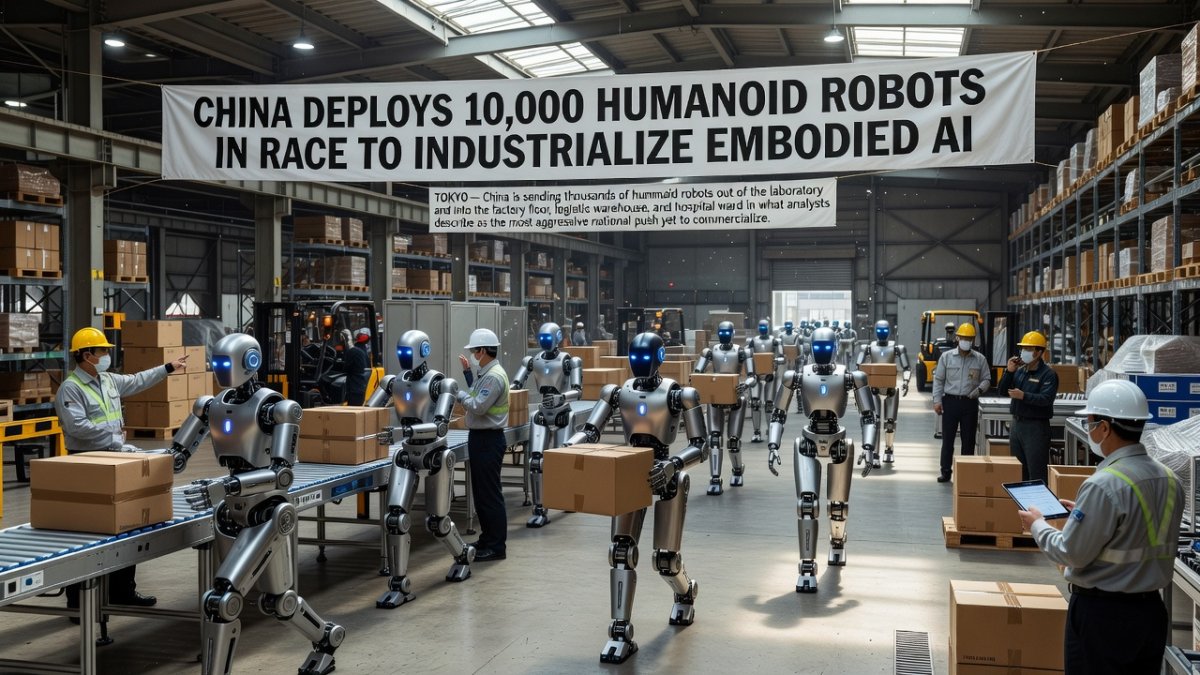
China Deploys 10,000 Humanoid Robots in Race to Industrialize Embodied AI
Tokyo — China is sending thousands of humanoid robots out of the laboratory and into the factory floor, logistics warehouse, and hospital ward in what analysts describe as the most aggressive national push yet to commercialize embodied artificial intelligence.
The Ministry of Industry and Information Technology, together with the State-owned Assets Supervision and Administration Commission, has launched a nationwide program directing local governments and state-owned enterprises to deploy humanoid robots in real-world industrial environments at an unprecedented scale, according to a policy document cited by the South China Morning Post.
Tags: China, humanoid robots, embodied AI, robotics, manufacturing automation, MIIT, SASAC, Robotera, AgiBot, Unitree, Japan robotics, labor shortage, industrial policy, supply chain, Asia technology
Government Mandates "Work Mode" by Year-End
Under the new initiative, local authorities were required to submit implementation plans by the end of June and must report progress by the end of November. The explicit goal: "By the end of 2026, key humanoid robot products will complete application verification and regular deployment in a number of representative scenarios, entering 'work mode,'" the official document states.
The government is targeting the creation of more than 100 high-value application scenarios and the deployment of over 10,000 humanoid robots across industries including manufacturing, warehousing, logistics, retail, healthcare, workplace safety, equipment inspection, maintenance, emergency response, and disaster relief.
Officials have emphasized that real-world deployment will generate higher-quality operational data that can refine both the software and hardware performance of embodied AI systems, creating a feedback loop between commercial application and technological improvement.
China's Humanoid Robot Industry Already Dominates Global Supply
China's push into humanoid robotics is not starting from scratch. According to industry data, Chinese manufacturers captured approximately 87 percent of global humanoid robot shipments in 2025, with Shanghai-based AgiBot leading the market at 5,168 units shipped — a 39 percent share. Unitree Robotics, another major Chinese player, recently cleared a key initial public offering hurdle as it scales production capacity.
A Morgan Stanley report in June upgraded its China humanoid robot market forecast, citing the country's "complete industrial ecosystem, strong manufacturing capacity, and rapid iteration from pilot applications to large-scale deployment." The investment bank's upgrade reflects growing institutional confidence that China's robotics sector is positioned to outpace competitors in both production volume and cost efficiency.
Robotera and Other Startups Already Scaling Commercial Operations
Beijing-based Robotera has emerged as a bellwether for China's commercial humanoid robotics push. The startup has deployed humanoid robots in more than 10 logistics centers operated by China Post and SF Holding, two of China's largest logistics companies, spanning multiple regions across the country.
During a public demonstration this week, one of Robotera's humanoid robots was shown packing products into shipping boxes and autonomously correcting errors when an item was deliberately removed from the workflow — a level of adaptability previously confined to research settings. Robotera co-founder Xi Yue said the company is delivering orders "in the thousands" this year as client demand accelerates.
Xiaomi has also reported significant progress, with its humanoid robot achieving 98 percent task accuracy in the latest trial at the company's electric vehicle factory, suggesting that the technology is crossing the threshold from experimental to operationally viable in controlled industrial settings.
Japan's Robotics Sector Faces Intensifying Competitive Pressure
For Japan — a nation with deep historical roots in robotics innovation and a severe labor shortage driving automation demand — China's rapid advance presents both challenge and opportunity. Japan's humanoid robotics sector, long regarded as a global leader in engineering quality and precision, now finds itself competing against Chinese companies that have mastered cost-effective mass production while leveraging many of the same fundamental research breakthroughs.
The Humanoids Summit Tokyo 2026, held in May, showcased both nations' capabilities side by side, with Chinese companies demonstrating aggressive commercialization timelines while Japanese firms emphasized reliability and task precision. The summit underscored a growing divide: Chinese firms are prioritizing deployment speed and volume, while their Japanese counterparts focus on specialized, high-reliability applications.
Japan Airlines this year began trialing humanoid robots from Chinese manufacturer Unitree at Tokyo's Haneda Airport for baggage handling and tarmac cargo movement — a striking example of a Japanese flag carrier turning to Chinese robotics technology to address its own labor shortages. The trial, conducted in partnership with GMO Internet Group, runs through 2028 and could see broader deployment across Japanese airports.
What This Means — The Data Advantage and the Path to General Purpose Robotics
The strategic logic behind China's mass-deployment approach is rooted in data economics. Every humanoid robot operating in a real-world environment generates thousands of hours of operational data — how to navigate crowded factory floors, how to grip objects of varying shapes and weights, how to recover from errors. This data is the critical input that makes embodied AI systems smarter, more reliable, and more adaptable over time.
China's approach contrasts sharply with that of American firms, which according to Bloomberg are increasingly relying on lab simulations and human workers in lower-cost markets such as India and Vietnam for their training data needs. While simulations are cheaper upfront, they may produce systems that struggle with the unpredictability of real-world environments — precisely the gap that China's real-world deployment strategy is designed to close.
Shao Hao, senior director of the robotics lab at smartphone maker Vivo, explained the strategic significance: "The core purpose of the policy is to push the industry from a demonstration-driven logic to a task-oriented logic, and from showcasing individual capabilities to building integrated systems that can perform real-world tasks." He added that while "six months is not a long time," a concentrated national effort can help the industry "converge more quickly on viable technology paths and engineering solutions."
"In the longer term," Shao said, "this phase could determine whether embodied AI can achieve large-scale commercial deployment."
Implications for Global Supply Chains and Asia Pacific Industry
China's humanoid robot push has direct implications for manufacturers across the Asia Pacific region. As Chinese factories become increasingly automated with humanoid robots, the cost advantages that have long driven manufacturing to Southeast Asian nations such as Vietnam, Thailand, and Indonesia may narrow. Countries that have positioned themselves as alternatives to China for low-cost manufacturing will need to accelerate their own automation adoption to remain competitive.
For Japan, the calculus is more nuanced. Japan's aging population and shrinking workforce have created structural demand for automation that domestic robotics production alone may not satisfy. If Chinese humanoid robots prove reliable enough for Japanese industrial standards, cross-border deployment could accelerate — but it would also deepen Japan's technological dependence on a strategic competitor, a dynamic that carries both economic and security implications.
Japanese robotics companies such as Fanuc, Yaskawa Electric, and Kawasaki Heavy Industries have long dominated industrial automation, but the humanoid form factor represents a new competitive arena where traditional advantages in precision industrial robotics may not automatically translate. The Japanese government has begun exploring policy responses, including increased funding for embodied AI research and partnerships between domestic tech firms and national research institutes.
What to Watch For
Several key milestones will determine whether China's ambitious deployment targets translate into lasting industrial advantage. The November reporting deadline will provide the first concrete data on how many robots have actually been deployed versus how many remain in pilot phases. The performance of Robotera and AgiBot robots in high-stakes environments such as hospitals and emergency response — where failure carries real consequences — will test whether the technology is genuinely ready for broad commercial use.
In Japan, the Haneda Airport trial results and the response from Japanese manufacturers will signal whether the domestic robotics industry views Chinese humanoid robots as partners, competitors, or threats. The outcome of Unitree's IPO will also serve as a bellwether for investor confidence in the sector's commercial viability.
Ultimately, the race to industrialize humanoid robotics is not just about who builds the most advanced machines. It is about who can deploy them at scale, gather the most operational data, and iterate fastest. China's 10,000-robot gambit is a bet that in the age of embodied AI, volume and speed may matter more than precision alone.
By Kenji Tanaka, Staff Writer
This article was produced with AI-assisted research and editorial support. Reporting is based on sources cited in the article.
What's Your Reaction?
 Like
0
Like
0
 Dislike
0
Dislike
0
 Love
0
Love
0
 Funny
0
Funny
0
 Wow
0
Wow
0
 Sad
0
Sad
0
 Angry
0
Angry
0

Japan Correspondent at Global1.News. Tokyo-based voice covering Japanese politics, technology, economy, and culture. Tracks the intersection of tradition and innovation in one of the world's most dynamic societies.















Comments (0)