
Japan Buys 27,500 Nvidia Rubin GPUs for World's First National AI Robot Factory
Japan's Noetra consortium, backed by ¥387.3B in government funding, will deploy 27,500 Nvidia Rubin GPUs in the world's first national AI factory, targeting 10 million AI-equipped robots by 2040 through the METI-led FRONTia physical AI program.
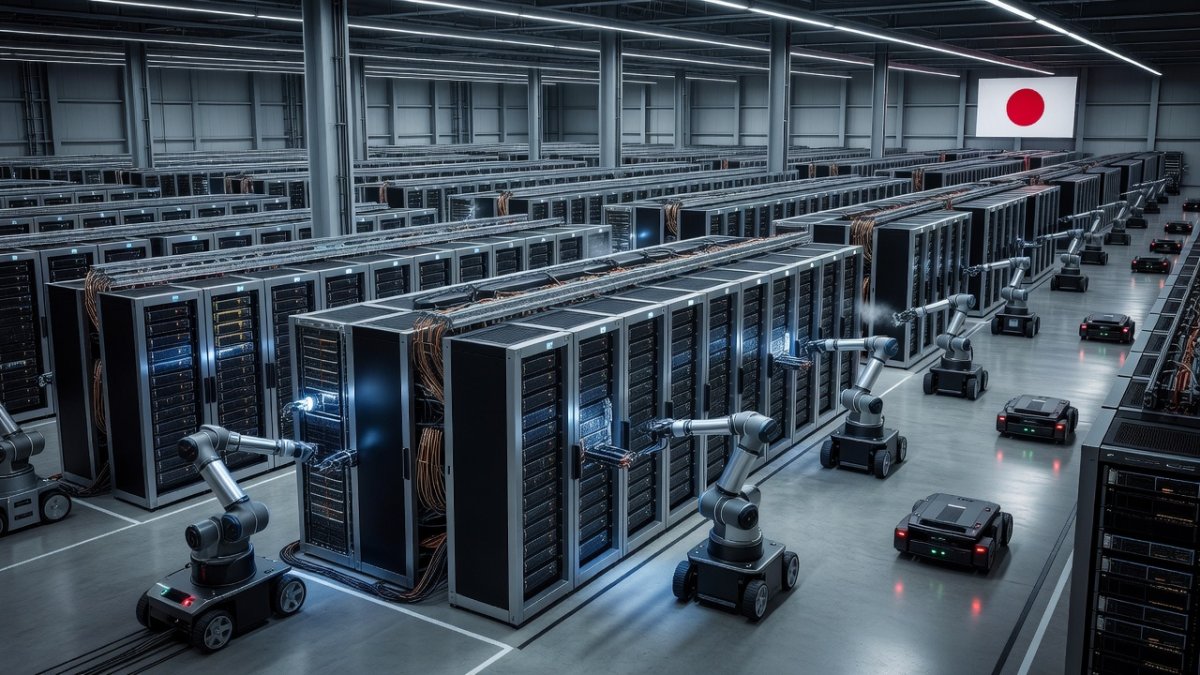
Japan Buys 27,500 Nvidia Rubin GPUs for World's First National AI Robot Factory
Tokyo, Japan — Japan is making an audacious bet on the future of robotics. The nation's newly formed AI consortium, Noetra Corp., has announced plans to acquire 27,500 of Nvidia's next-generation Rubin graphics processing units alongside 13,750 Vera central processing units to build what is being described as the world's first national-scale AI factory dedicated to physical intelligence. The initiative, supported by Japan's Ministry of Economy, Trade and Industry (METI) under the FRONTia Project, represents the centerpiece of a government strategy to deploy 10 million AI-equipped robots across 18 industrial and service sectors by 2040.
Tags: Nvidia, Rubin GPU, Noetra Corp, FRONTia Project, physical AI, Japan robotics, sovereign AI, METI
The Noetra Consortium: Japan's Corporate AI Alliance
Noetra Corp. is not merely another startup. It is a consortium anchored by four of Japan's most powerful technology conglomerates — SoftBank Corp., Sony Group Corp., NEC Corp., and Honda Motor Co. — with participation from approximately 44 companies and organizations across Japan's industrial landscape. The group includes Toyota Motor Corp.-backed Preferred Networks Inc., a leading domestic AI research firm, alongside numerous manufacturing, logistics, and technology partners.
The consortium has been designated by METI as the lead entity for the FRONTia Project, a state-funded program to develop Japan's sovereign physical AI capabilities. In its initial funding tranche for fiscal year 2026, the government has allocated ¥387.3 billion (approximately $2.4 billion) to Noetra, with additional private-sector investment expected to follow as the consortium scales its operations.
NEC confirmed in a press release that Noetra's structure is designed to pool Japan's fragmented AI research efforts — long criticized for being siloed across individual corporate R&D departments — into a single, coordinated national initiative with sufficient computational resources to compete with frontier AI labs in the United States and China.
The Vera Rubin AI Factory: 140 Megawatts of Compute Power
At the heart of the plan is the Nvidia Vera Rubin AI factory, a massive data center facility delivering 140 megawatts of capacity built on Nvidia's Data Center-as-a-Service (DSX) platform. The facility will deploy Vera Rubin NVL72 racks — Nvidia's highest-density compute architecture — interconnected with Spectrum-X Ethernet networking and BlueField data processing units for optimized AI workload performance.
The 27,500 Rubin GPUs and 13,750 Vera CPUs cluster will provide the raw computational power required to train and run large-scale foundation models for physical AI applications. To contextualize the scale: a single Nvidia Rubin GPU is designed to deliver three times the training performance of the previous-generation Blackwell architecture. A 27,500-GPU cluster of this class would rank among the most powerful AI supercomputers in existence, rivaling the largest deployments operated by American hyperscale cloud providers.
Nvidia CEO Jensen Huang framed the announcement in characteristically bold terms. "Japan invented modern manufacturing," Huang said during the launch event. "Now, it is building the AI factories that will power the next industrial revolution."
FRONTia: Japan's Physical AI Roadmap to 2040
The FRONTia Project — an acronym for "Future Robotics and Open Network for Transformative Industrial AI" — is METI's flagship program to accelerate Japan's transition from traditional industrial robotics to AI-native autonomous systems. Japan already leads the world in industrial robot density, with approximately 455 industrial robots per 10,000 manufacturing employees, according to the International Federation of Robotics. The FRONTia initiative aims to build upon this foundation by creating the AI software layer that can make those machines intelligent rather than merely programmable.
The government has set an ambitious target of 10 million AI-equipped robots deployed across 18 sectors by 2040, spanning manufacturing, logistics, healthcare, elder care, construction, agriculture, retail, hospitality, disaster response, and infrastructure maintenance. This target reflects Japan's demographic reality: a rapidly aging population and shrinking workforce that will leave critical labor gaps across the economy. Japan's working-age population peaked in 1995 and has declined every year since. By 2040, government projections estimate labor shortages exceeding 11 million workers.
Robots are not a luxury in this calculus — they are a demographic necessity.
Noetra's Three-Phase AI Model Roadmap
Noetra has laid out a three-phase development roadmap for its multimodal foundation model, designed to progressively increase in capability and sophistication. The first phase, targeted for fiscal year 2026, aims to deliver a reasoning foundation model capable of logical inference and task planning. This initial model would allow robots to interpret high-level instructions and decompose them into actionable sequences.
In the second phase, scheduled for fiscal year 2028, Noetra targets an omni-modal model capable of processing text, images, video, audio, and tactile sensor data simultaneously. This phase would enable robots to operate in complex, unstructured environments — understanding spoken commands, recognizing objects and people visually, and responding to acoustic cues such as alarms or spoken warnings.
The third and final phase, targeted for fiscal year 2030, envisions "real-world native AI" — models with spatial awareness, physical intuition, and the ability to learn new skills through observation and practice. This represents the most technically ambitious goal: an AI that can operate autonomously in unpredictable human environments without requiring explicit programming for every edge case.
"This is not simply about building a faster robot arm," said a Noetra representative in the consortium's announcement. "It is about creating an intelligence layer that any robot — regardless of manufacturer — can use to understand and interact with the physical world."
From Traditional Robotics to AI-Native Systems
The Nvidia Rubin acquisition signals a profound shift in Japan's approach to automation. Traditional Japanese industrial robots — from FANUC's assembly arms to Yaskawa's welding machines — are precision instruments that follow pre-programmed instructions with extraordinary accuracy but virtually zero adaptability. They excel in structured environments like automotive assembly lines but fail in dynamic settings where conditions change unpredictably.
AI-native systems represent a fundamentally different paradigm. These robots do not simply execute stored programs — they perceive their environment, make context-aware decisions, and adapt their behavior in real time. A robot equipped with a physical AI foundation model could, for example, navigate a hospital corridor while avoiding patients and medical equipment, locate a specific room, and adjust its grip on an object based on real-time weight and texture sensing.
Japan's robotics industry, long dominant in industrial automation, has faced increasing competition from Chinese manufacturers in traditional robotics and from American and Chinese AI companies in intelligent systems. The Noetra initiative represents a strategic response: rather than competing solely on hardware cost or manufacturing volume, Japan is staking its future on AI-powered differentiation.
What This Means for Japan's AI Sovereignty
The FRONTia Project and the Noetra consortium are explicitly framed as sovereignty initiatives. Like Europe's investments in Mistral AI and China's state-backed AI development programs, Japan's approach reflects a growing consensus among advanced economies that foundational AI capabilities cannot be outsourced to foreign technology providers — particularly where national security, critical infrastructure, and strategic industries are concerned.
By building its own physical AI foundation model, Japan reduces its dependence on American cloud platforms for AI inference and training. While the Nvidia hardware itself is American, the model architecture, training data, fine-tuning, and deployment will be controlled domestically. The open multimodal foundation model announced by Noetra will be developed in Japan, using Japanese industrial and environmental data, and optimized for Japanese language, regulations, safety standards, and operational contexts.
The implications extend beyond robotics. The same foundation model technology can power AI agents for logistics optimization, digital twins for manufacturing simulation, autonomous vehicles, medical diagnostic systems, and smart infrastructure management. Noetra's approach positions the consortium not merely as a robotics AI developer but as a national AI infrastructure provider whose outputs will ripple across Japan's entire industrial economy.
What to Watch For
Several developments will determine whether this ambitious bet pays off. The first milestone is fiscal year 2026: Noetra must demonstrate that its reasoning foundation model works reliably in real-world robot deployments, not merely in controlled laboratory conditions. The Vera Rubin AI factory is expected to come online in phases through 2027, and GPU delivery timelines from Nvidia will be a critical dependency to watch.
Second, the 44-company consortium structure introduces coordination challenges. Japan's corporate culture is known for consensus-driven decision-making, which can slow execution in fast-moving technology sectors. How effectively Noetra translates broad corporate participation into rapid technical progress will be closely observed.
Third, international competition will intensify. China's robotics AI sector has received massive state investment, and American companies including Tesla, Boston Dynamics, and Figure AI are racing toward general-purpose humanoid robots. Japan's 2040 deployment target of 10 million robots represents a generational commitment — but the technology landscape may look very different long before that deadline arrives.
What is clear is that Japan is no longer content to be a consumer of foreign AI models. With the Noetra consortium, the Vera Rubin AI factory, and the FRONTia Project, the nation is building the foundations for a sovereign AI infrastructure that could reshape both its economy and its demographic future.
By Kenji Tanaka, Staff Writer
This article was produced with AI-assisted research and editorial support. Reporting is based on sources cited in the article.
What's Your Reaction?
 Like
0
Like
0
 Dislike
0
Dislike
0
 Love
0
Love
0
 Funny
0
Funny
0
 Wow
0
Wow
0
 Sad
0
Sad
0
 Angry
0
Angry
0

Japan Correspondent at Global1.News. Tokyo-based voice covering Japanese politics, technology, economy, and culture. Tracks the intersection of tradition and innovation in one of the world's most dynamic societies.














Comments (0)