
Lebanon-Israel-US Framework Agreement Reshapes Middle East Diplomacy
Lebanon-Israel-US Framework Agreement Reshapes Middle East Diplomacy Keywords: Lebanon Israel agreement, Marco Rubio, Hezbollah, Iran proxies, trilateral framework, Middle East peace, Lebanese sovereignty, Washington talks, Arab-Israeli normalization, Eastern Mediterranean Regional Dynamics Frame the Agreement The signing of the trilateral framework agreement between Lebanon, I
Regional Dynamics Frame the Agreement
The signing of the trilateral framework agreement between Lebanon, Israel, and the United States occurs against a backdrop of intense Sunni-Shia competition that has long shaped Middle East alignments. Iran's extensive proxy network, centered on Hezbollah, has repeatedly drawn Lebanon into broader confrontations that extend far beyond its borders. This latest diplomatic step attempts to recalibrate those dynamics by establishing parameters that limit external interference while addressing immediate security concerns along the shared frontier.
Within this competitive landscape, the involvement of the United States as mediator highlights efforts to contain the reach of Iranian influence through structured negotiations rather than continued military escalation. The framework emerges from five rounds of talks in Washington, reflecting sustained diplomatic investment aimed at disentangling local disputes from wider regional rivalries. Such an approach recognizes that Hezbollah's role as a key Iranian proxy has repeatedly complicated Lebanese decision-making and prolonged cycles of violence.
By focusing on a framework for lasting peace and security, the agreement implicitly challenges the sustainability of proxy-based strategies that have destabilized multiple states. The participation of Lebanese and Israeli envoys alongside American officials underscores a shared recognition that unchecked competition between Sunni and Shia actors risks further humanitarian costs and economic disruption across the Levant. This development may encourage other regional players to reassess their reliance on non-state armed groups as instruments of foreign policy.
Ultimately, the trilateral process illustrates how localized conflicts can serve as testing grounds for larger geopolitical realignments. Success here could influence calculations in neighboring arenas where Iranian networks operate, potentially opening space for more conventional state-to-state diplomacy. The emphasis on sovereignty and territorial integrity in official statements signals an attempt to restore balance in a region long skewed by asymmetric proxy engagements.
Historical Context of Prolonged Hostilities
Decades of intermittent conflict between Israel and Hezbollah reached a new intensity with Israel's March invasion and accompanying air strikes. Lebanese authorities have stated that these operations resulted in more than 4,200 deaths, underscoring the devastating human toll of sustained cross-border exchanges. The latest framework agreement seeks to interrupt this pattern by creating mechanisms that could prevent future rounds of fighting from erupting along the southern Lebanese frontier.
Prior attempts at de-escalation, including a truce announced on April 17 following initial direct talks, proved insufficient to halt the violence. That earlier cease-fire collapsed amid continued operations, demonstrating the fragility of arrangements that fail to address underlying political and military realities. The new framework builds on lessons from those failed efforts by embedding commitments within a broader diplomatic structure involving the United States.
The prolonged hostilities have displaced significant populations on both sides of the border and inflicted lasting damage on civilian infrastructure in southern Lebanon. Against this backdrop, the trilateral agreement represents an acknowledgment that purely military approaches have not produced durable security for either Lebanon or Israel. Five rounds of Washington talks provided the venue for translating battlefield realities into negotiated parameters.
Historical patterns suggest that without external facilitation, Lebanese and Israeli officials have struggled to maintain direct channels capable of managing crises. The current framework therefore incorporates American guarantees as a stabilizing element, aiming to convert the most recent cease-fire into a more permanent arrangement. This evolution reflects the exhaustion produced by months of intense combat and the recognition that further escalation carries unacceptable costs for all parties involved.
Core Elements of the Framework
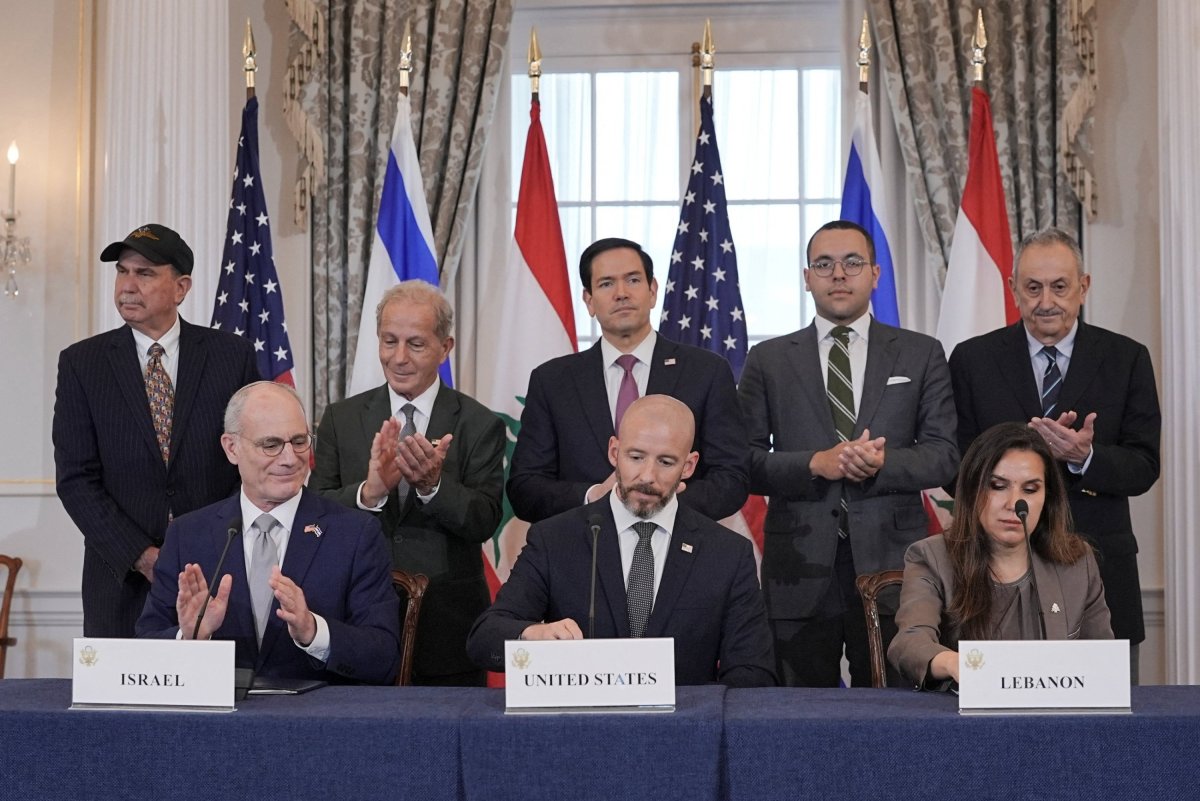
U.S. Secretary of State Marco Rubio described the agreement as one that "begins to put in place a framework for lasting peace and security" during the signing ceremony in Washington. This characterization emphasizes process over immediate deliverables, acknowledging that the document itself does not yet contain publicly detailed provisions. The five rounds of talks that preceded the signing allowed negotiators to identify areas of convergence despite longstanding mistrust between the Lebanese and Israeli sides.
Lebanon's ambassador to Washington, Nada Hamadeh Moawad, framed the accord as "a first step on the road to restoring Lebanese sovereignty and territorial integrity, securing a permanent and final cessation of hostilities and enabling our people to go back to their land." Her remarks highlight the priority placed on reversing the effects of recent displacement and reasserting central authority over all Lebanese territory. Such language aligns with long-standing Lebanese demands for an end to external military presences that undermine state control.
Israel's envoy to the United States, Yechiel Leiter, stated that under the deal "Iran is out, Hezbollah is out, and the road to peace between Israel and Lebanon is in." This formulation signals Israeli expectations that the framework will reduce the operational freedom of Iranian-backed forces near its northern border. The explicit reference to removing both Iranian and Hezbollah influence reflects core security objectives that guided Israel's participation in the Washington negotiations.
Although specific operational details remain undisclosed, the public statements reveal a shared commitment to transitioning from active hostilities to structured peacebuilding. The involvement of senior diplomats from all three capitals indicates that implementation will require continued coordination. By establishing this initial framework, the parties have created a reference point against which future compliance can be measured, even as additional rounds of technical discussions will be needed to translate principles into concrete arrangements.
Lebanon's Strategic Calculus
Lebanese officials approached the Washington talks with the primary objective of restoring full sovereignty over territory currently affected by ongoing conflict. The framework agreement offers a potential pathway for displaced populations to return to their homes in southern Lebanon under conditions that limit the risk of renewed bombardment. This humanitarian dimension carries significant domestic political weight, given the scale of internal displacement caused by the March invasion and subsequent operations.
At the same time, Lebanese negotiators must navigate Hezbollah's entrenched political role within the country's sectarian system. Any arrangement that appears to diminish the group's military capabilities risks triggering internal resistance that could destabilize the fragile governing coalition. The emphasis on territorial integrity in Ambassador Moawad's remarks suggests an attempt to frame the agreement in terms consistent with national rather than factional interests.
Lebanon's strategic position has historically been constrained by its inability to fully control non-state actors operating from its territory. The trilateral framework may provide external support for reasserting state authority, particularly if implementation mechanisms include verification procedures acceptable to Beirut. Success would depend on whether Lebanese institutions can translate diplomatic gains into tangible improvements in security and economic recovery for affected communities.
Balancing these considerations requires careful sequencing so that progress on sovereignty does not precipitate domestic backlash. The agreement's focus on a permanent cessation of hostilities aligns with public demands for an end to cycles of violence that have repeatedly devastated the south. Lebanese policymakers will likely monitor Israeli compliance closely while managing expectations among domestic constituencies regarding the pace of implementation.
Israel's Security Calculus
Israeli officials entered the negotiations seeking reliable guarantees that threats emanating from southern Lebanon would be neutralized over the long term. The framework agreement is presented as advancing that objective by establishing parameters that reduce Hezbollah's freedom of action near the border. Israeli envoy Yechiel Leiter's statement explicitly links the deal to the removal of both Iranian and Hezbollah influence, indicating that security considerations remain paramount.
Establishing an effective northern security zone has been a recurring Israeli priority during previous rounds of fighting. The current framework attempts to achieve this outcome through diplomatic rather than purely military means, potentially lowering the costs associated with indefinite operations in Lebanese territory. Israeli decision-makers appear to view American involvement as essential for enforcing any limitations placed on cross-border threats.
The failure of the April 17 truce demonstrated that temporary halts in fighting do not automatically translate into sustainable security arrangements. Israel's participation in five rounds of Washington talks reflects a determination to embed more durable constraints within a trilateral structure. This approach acknowledges that unilateral measures have proven insufficient to prevent Hezbollah from rebuilding capabilities following earlier conflicts.
Israeli calculations also incorporate the broader regional context in which Iranian proxy networks operate. By securing commitments that explicitly address Hezbollah's role, the framework may contribute to a wider strategy of containment. Implementation will be judged according to whether the agreement produces measurable reductions in the capacity of armed groups to launch attacks across the border, thereby allowing Israeli communities in the north to resume normal life without constant threat of escalation.
The Iranian Dimension and Proxy Calculations
Tehran's insistence that its own negotiations with Washington must encompass Lebanon illustrates the extent to which Iranian strategy treats the Lebanese arena as an extension of its wider regional posture. The trilateral framework directly challenges this linkage by seeking arrangements that sideline Iranian influence through Hezbollah. Israeli statements framing the deal as removing both Iran and Hezbollah from the equation underscore this central contest over Lebanese territory.
Iran has historically leveraged Hezbollah's military infrastructure to project power and deter adversaries without direct confrontation. The framework agreement tests whether diplomatic pressure can disrupt this model by creating incentives for Lebanese state institutions to reassert control. Success would represent a significant constraint on Iran's ability to use Lebanon as a forward operating base.
The timing of the agreement, coming after a new cease-fire declared this month, suggests that external actors including the United States applied coordinated pressure on multiple fronts. Iranian officials have sought to maintain their Lebanese leverage even as broader talks with Washington proceed. The explicit exclusionary language used by Israeli representatives indicates that the framework is designed to limit Tehran's options in this theater.
Proxy calculations in Tehran will likely evolve in response to whether the agreement produces lasting changes on the ground. If Lebanese authorities gain greater capacity to regulate armed activity along the border, Iran's investment in Hezbollah may yield diminishing returns. The framework therefore functions as both a local security instrument and a test case for the viability of Iran's regional strategy of asymmetric deterrence through allied non-state actors.
Arab-Israeli Normalization and Gulf Reactions
The trilateral framework between Lebanon, Israel, and the United States intersects with ongoing efforts to expand Arab-Israeli normalization initiated under the Abraham Accords. While Lebanon has not participated in those earlier agreements, progress toward a stable bilateral arrangement could reduce one source of regional friction that has complicated wider diplomatic initiatives involving Gulf states. Saudi Arabia, the United Arab Emirates, and Bahrain have each pursued varying degrees of engagement with Israel in recent years.
Gulf capitals have watched the Lebanon-Israel track closely because instability along the northern border has periodically threatened to draw in additional actors and disrupt energy markets. A durable framework that limits Hezbollah's operational space may create conditions more conducive to further normalization steps by demonstrating that diplomatic solutions can address security concerns previously managed through military means. The involvement of the United States as guarantor provides reassurance to Gulf partners regarding enforcement.
At the same time, Gulf states remain attentive to Iranian reactions, given Tehran's continued influence through proxy networks across the region. Any perception that the Lebanon agreement significantly weakens Iranian leverage could encourage additional Gulf states to explore economic and diplomatic openings with Israel. Conversely, if implementation stalls, the episode may reinforce skepticism about the durability of agreements that challenge entrenched proxy relationships.
The framework's emphasis on sovereignty and cessation of hostilities aligns with broader Gulf interests in promoting stability that supports investment and trade. By establishing a reference point for managing one of the region's most persistent conflicts, the agreement could indirectly facilitate the next phase of Arab-Israeli normalization, particularly if it demonstrates that American mediation can deliver tangible security improvements without requiring full-scale military campaigns.
Turkey's Regional Positioning
Turkey has maintained an independent foreign policy in the Levant that balances NATO membership with autonomous engagement toward regional actors including Lebanon and Iran. The trilateral framework may affect Ankara's calculations by altering the balance of influence along Lebanon's southern border, potentially creating new opportunities or constraints for Turkish diplomatic and economic initiatives in the Eastern Mediterranean. Turkish officials have historically sought to position their country as an alternative mediator in Lebanese affairs.
Ankara's energy interests in the region intersect with any stabilization of the Lebanon-Israel frontier, as reduced tensions could facilitate exploration and infrastructure projects that require secure maritime boundaries. The framework's focus on permanent cessation of hostilities may therefore indirectly support Turkish efforts to develop energy corridors that avoid conflict zones. Turkish policymakers will assess whether the agreement strengthens or weakens their leverage in Beirut.
NATO considerations also shape Turkey's response, as the United States plays a central role in the trilateral process. Closer coordination between Washington, Beirut, and Jerusalem could either complement or compete with Turkish initiatives aimed at expanding influence among Sunni constituencies in Lebanon. The framework's success in limiting Iranian proxy activity might reduce one source of friction that has complicated Turkish-Iranian relations in recent years.
Overall, Ankara is likely to monitor implementation closely while preserving flexibility to engage all parties. A stable Lebanon-Israel relationship could open space for Turkish economic involvement in reconstruction efforts, whereas renewed escalation would reinforce Turkey's preference for maintaining independent channels that allow it to navigate between competing regional blocs without full alignment with any single side.
Economic and Energy Implications
Stabilization along the Lebanon-Israel border carries significant implications for Eastern Mediterranean energy development, where offshore gas resources have become a focal point of regional competition and cooperation. A framework that reduces the risk of renewed conflict could accelerate licensing rounds and infrastructure investments previously delayed by security concerns. Both Lebanese and Israeli officials have expressed interest in monetizing maritime resources to address domestic economic challenges.
The agreement's emphasis on permanent cessation of hostilities may encourage international energy companies to reassess risk calculations for projects near the shared maritime boundary. OPEC+ dynamics could also be affected if Lebanese production eventually comes online, although current output remains negligible compared with major Gulf producers. Investment flows into Lebanon would likely depend on credible implementation of the framework's security provisions.
Reconstruction needs in southern Lebanon following the March invasion and subsequent fighting create additional economic stakes. Displaced populations returning under improved security conditions would require substantial capital for housing, agriculture, and local infrastructure. The trilateral framework could serve as a foundation for coordinating international assistance packages tied to verified compliance with cease-fire terms.
Broader regional energy connectivity, including potential pipelines and electricity links, would benefit from reduced tensions between Lebanon and Israel. Gulf investors and European partners have previously signaled interest in such projects provided political risks remain manageable. The framework therefore functions not only as a security instrument but also as an enabler for economic recovery that could gradually integrate Lebanon more fully into Eastern Mediterranean energy markets.
Regional Implications and Great Power Dynamics
The trilateral framework introduces a new variable into great power competition involving the United States, China, and Russia across the Middle East. American leadership in brokering the agreement reinforces Washington's role as the primary external security guarantor for arrangements between Lebanon and Israel. This positioning may limit the space available for alternative mediation efforts by Beijing or Moscow, both of which have sought to expand influence in Lebanon through economic and diplomatic channels.
Chinese interests in Lebanese infrastructure and port development could benefit from greater stability, yet Beijing has avoided direct involvement in security negotiations that challenge Iranian positions. Russian calculations similarly balance relations with Tehran against opportunities to engage Israeli and Lebanese actors. The framework's success would demonstrate the continued efficacy of American diplomacy in managing proxy conflicts that other powers have been reluctant to address directly.
Regional stability more broadly hinges on whether the agreement can prevent the Lebanon-Israel front from reigniting wider confrontations that draw in additional state and non-state actors. Sustained implementation would contribute to a more predictable environment that supports trade, investment, and reconstruction across the Levant. Conversely, any breakdown could accelerate fragmentation and invite greater external intervention from multiple directions.
Over time, the framework may influence how other regional disputes are approached, particularly those involving Iranian proxy networks. By establishing a precedent for negotiated limitations on Hezbollah's operational reach, the agreement could encourage similar diplomatic tracks elsewhere. The ultimate measure of success will be whether the trilateral structure produces enduring changes in behavior that outlast immediate political pressures on the signatories.
Source: Daily Sabah By Malik Hassan, Staff WriterThis article was produced with AI-assisted research and editorial support. Reporting is based on sources cited in the article.
What's Your Reaction?
 Like
0
Like
0
 Dislike
0
Dislike
0
 Love
0
Love
0
 Funny
0
Funny
0
 Wow
0
Wow
0
 Sad
0
Sad
0
 Angry
0
Angry
0

Middle East Correspondent at Global1.News. Based in Beirut, covering politics, conflict, energy, and society across the Middle East. Brings context and depth to a region often reduced to headlines.












Comments (0)