
Trump Administration Revives Public Charge Rule for Green Cards
The article details the Trump administration's July 16, 2026, revival of the broad public charge rule, effective September 18, 2026. It expands scrutiny to SNAP, Medicaid, and Section 8 for up to 588,000 annual green card applicants, reversing Biden's 2022 limits. The piece covers the 2019 origins, court blocks, state lawsuits from NYC and California, self-sufficiency arguments from supporters, and the documented chilling effect on immigrant families avoiding benefits.
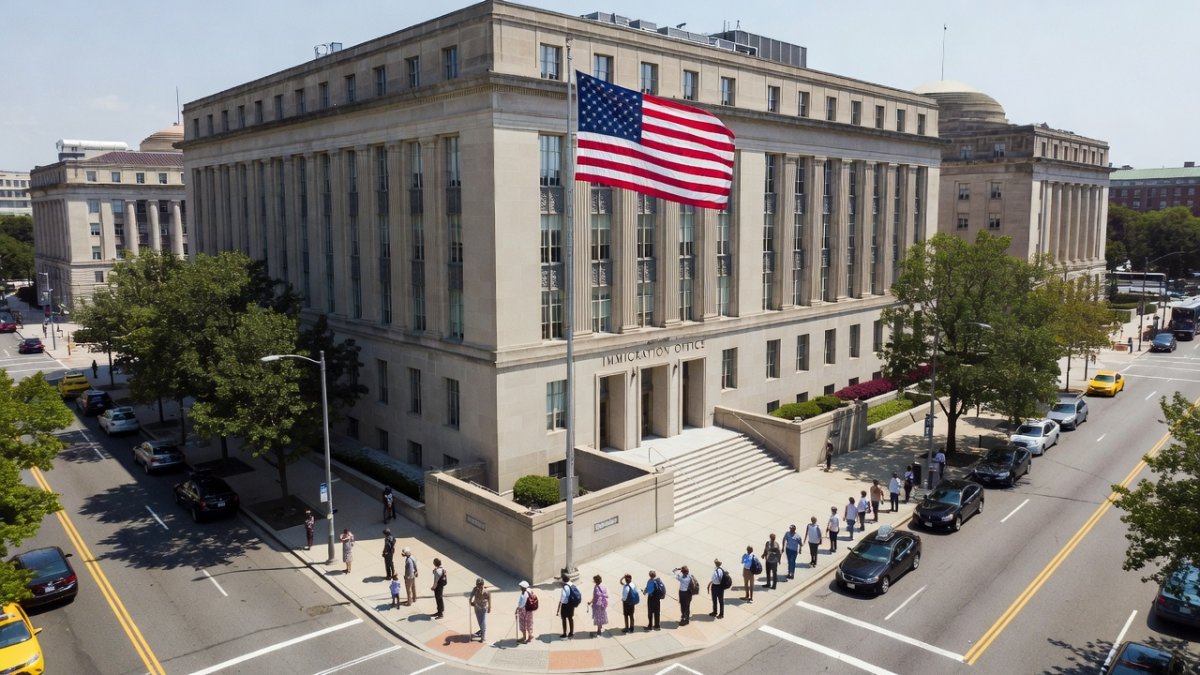
Trump Revives Public Charge Rule for Green Cards
Washington, D.C. — The Department of Homeland Security published a final rule on July 16, 2026, reviving the expansive public charge definition that could deny green cards to noncitizens using food stamps, Medicaid, housing vouchers, and other non-cash benefits. Effective September 18, 2026, the regulation reverses the Biden administration's 2022 rule that confined public charge findings to cash assistance and long-term institutionalization. DHS projects up to 588,000 applicants could face scrutiny or denial each year under the broader criteria, which applies both to those already inside the United States seeking adjustment of status and to individuals abroad applying for admission. This marks the second coming of a Trump-era policy first rolled out in 2019, halted by federal courts, and later rescinded by the prior administration.
What the Public Charge Rule Does
The revived rule instructs immigration officers to treat use of Supplemental Nutrition Assistance Program benefits, Medicaid for non-emergency care, Section 8 housing vouchers, and similar programs as heavily weighted negative factors in green card decisions. Officers must weigh an applicant's age, health, education, income, and family status alongside any documented benefit use. A single instance of benefit receipt can tip the balance toward a public charge finding, even if the applicant later becomes self-sufficient. Unlike the narrower Biden framework, this version captures non-cash supports that millions of working immigrant families access during economic hardship or while awaiting work authorization. The policy explicitly targets both adjustment-of-status cases inside the country and consular processing abroad, creating a unified barrier at every stage of the legal immigration pipeline.
The public charge doctrine dates to the Immigration Act of 1882, when Congress first barred entry to anyone likely to become a “public charge,” a standard rooted in Victorian-era concerns over pauperism and local taxpayer burdens. Over the subsequent century the test remained narrowly focused on cash welfare and institutionalization, reflecting a bipartisan consensus that non-cash supports such as food aid or medical coverage did not signal long-term dependency. The 2026 revival therefore represents the most expansive reinterpretation in 140 years, converting programs designed as temporary bridges for working families into permanent disqualifiers for lawful permanent residency. Immigration scholars note that the new weighting scheme effectively imports a “totality of circumstances” test long criticized for subjectivity. A 2024 Migration Policy Institute analysis of Census data found that 42 percent of noncitizen-headed households with children used at least one of the newly weighted benefits in the prior year, yet median household income in those same families reached 85 percent of the federal poverty line once all earners were counted. Experts such as Princeton sociologist Douglas Massey argue the rule ignores well-documented mobility patterns: most SNAP and Medicaid spells among immigrants last fewer than 18 months and coincide with entry-level employment or childbirth, after which earnings rise and benefit use declines sharply.Who Is Affected
DHS estimates the rule will touch as many as 588,000 green card applicants annually, including spouses of U.S. citizens, parents of citizens, and long-term visa holders adjusting status after years of lawful presence. Low-wage workers in agriculture, hospitality, and healthcare who qualify for SNAP or Medicaid during seasonal layoffs or medical emergencies now risk denial. Mixed-status families face particular exposure: a U.S.-citizen child receiving benefits can indirectly flag a parent's application if officers determine the parent is the household's primary support. The rule also sweeps in refugees and asylees who later pursue permanent residency, despite their initial humanitarian entry. Critics note that the 588,000 figure likely undercounts chilling effects on eligible individuals who forgo benefits entirely to protect future immigration options.
The Road to Revival
The policy traces directly to the Trump administration's 2019 public charge regulation, which expanded the definition beyond cash welfare for the first time in decades. Federal courts blocked that version nationwide, citing procedural flaws and fears of widespread harm. The Biden administration formally reversed it in 2022, restoring the pre-2019 standard limited to cash assistance and institutionalization. The July 16, 2026, Federal Register notice reinstates the broader framework with minor procedural tweaks, citing the same statutory authority under the Immigration and Nationality Act. Supporters within the administration frame the revival as enforcement of long-standing self-sufficiency requirements, while opponents view it as political payback against immigrant communities that helped defeat the first iteration.
Political and Legal Battle Ahead
New York City, California, and multiple other states have already announced plans to sue, arguing the rule exceeds statutory authority and violates equal protection principles. Attorneys general contend the expanded definition will deter eligible families from essential services, producing public health costs that states must absorb. Advocacy groups echo these concerns, citing data from the prior rollout showing sharp drops in Medicaid and SNAP enrollment among immigrant households. Administration officials counter that the rule simply protects American taxpayers from subsidizing future permanent residents. The litigation is expected to reach federal district courts within weeks, potentially triggering emergency injunctions before the September 18, 2026, effective date. Congressional Democrats have signaled oversight hearings, while Republican lawmakers praise the move as fulfillment of campaign promises on immigration enforcement.
Litigation strategy is already drawing on the 2019 playbook that produced nationwide injunctions in New York, California, and Washington. State attorneys general plan to argue that the rule violates the Administrative Procedure Act by failing to quantify costs to public health systems and by redefining statutory language without clear congressional authorization. Legal scholars such as NYU’s Adam Cox predict that district courts will again scrutinize the absence of any grandfathering provision for families already receiving benefits, a factor that tipped the balance in earlier challenges. Beyond the courtroom, the revival collides with demographic realities. Census Bureau projections show that immigrants and their U.S.-born children will account for 78 percent of net labor-force growth through 2035, particularly in agriculture and eldercare sectors already facing chronic shortages. Republican lawmakers defend the measure as restoring “self-sufficiency,” yet a 2025 Congressional Budget Office simulation found that denying green cards to even 15 percent of the projected 588,000 applicants annually would reduce cumulative GDP by $47 billion over a decade through lost wages and payroll taxes. These competing frames—fiscal protection versus economic drag—will shape both the immediate injunction hearings and longer-term legislative attempts to codify or constrain the doctrine.Human Impact: The Chilling Effect
Immigrant advocates warn the rule will recreate the documented chilling effect observed during the 2019 attempt, when thousands of eligible families withdrew from nutrition and health programs out of fear. Hospitals in high-immigrant areas already report rising numbers of uninsured patients avoiding preventive care. Food banks describe parents skipping SNAP recertification to safeguard a spouse's pending green card application. The human cost falls heaviest on U.S.-citizen children in mixed-status households, who lose access to stable nutrition and medical coverage when parents self-exclude. Caseworkers describe families weighing deportation risks against a child's asthma treatment or school lunch, choices no policy should force. Data from prior implementations showed enrollment drops of 20 percent or more in some states, effects that lingered even after court blocks.
Longitudinal studies of the 2019 rule provide the clearest forecast of behavioral responses. A peer-reviewed Urban Institute report documented a 22 percent drop in SNAP participation among eligible immigrant families with U.S.-citizen children between 2018 and 2020, even in states where courts had enjoined the policy. Parallel Medicaid disenrollment reached 18 percent in California and Texas border counties, producing measurable increases in uninsured emergency-room visits and delayed prenatal care. These patterns persisted for months after the rule was blocked, illustrating how fear can outlast legal reversals. Case examples underscore the human stakes. Maria, a Salvadoran lawful permanent resident applicant in Houston, withdrew her two citizen children from Medicaid in March 2019 after a paralegal warned that any benefit record could jeopardize her adjustment interview; both children later required hospitalization for uncontrolled asthma. Similar accounts surfaced in New York food pantries, where parents skipped recertification appointments to protect a spouse’s pending consular interview. Public-health researchers at the University of California, San Francisco, estimate that such self-exclusion added $1.2 billion in uncompensated care costs nationwide during the first iteration, costs ultimately shifted to state and local budgets.What Happens Next
With publication complete, the 60-day clock runs until September 18, 2026. Advocacy organizations are racing to publish guidance in multiple languages explaining which benefits trigger scrutiny and how to document mitigating factors such as steady employment or sponsor income. States preparing lawsuits are coordinating legal strategies to seek nationwide injunctions. DHS has indicated it will issue updated forms and training materials for officers before the effective date. Immigrant communities are organizing know-your-rights workshops emphasizing that benefit use alone does not automatically bar approval, though the expanded weights make success far less certain. The coming months will test whether courts once again halt the policy or allow it to reshape legal immigration pathways for years.
By Jessica Ali, Staff Writer
This article was produced with AI-assisted research and editorial support. Reporting is based on sources cited in the article.
What's Your Reaction?
 Like
0
Like
0
 Dislike
0
Dislike
0
 Love
0
Love
0
 Funny
0
Funny
0
 Wow
0
Wow
0
 Sad
0
Sad
0
 Angry
0
Angry
0

Editor-in-Chief at Global1.News. Atlanta-based journalist who cuts through the BS and tells it like it is. Lead anchor, host, and the voice you hear when the spin stops and the truth starts.















Comments (0)