
China and North Korea Exchange High-Level Visits Amid Treaty Anniversary
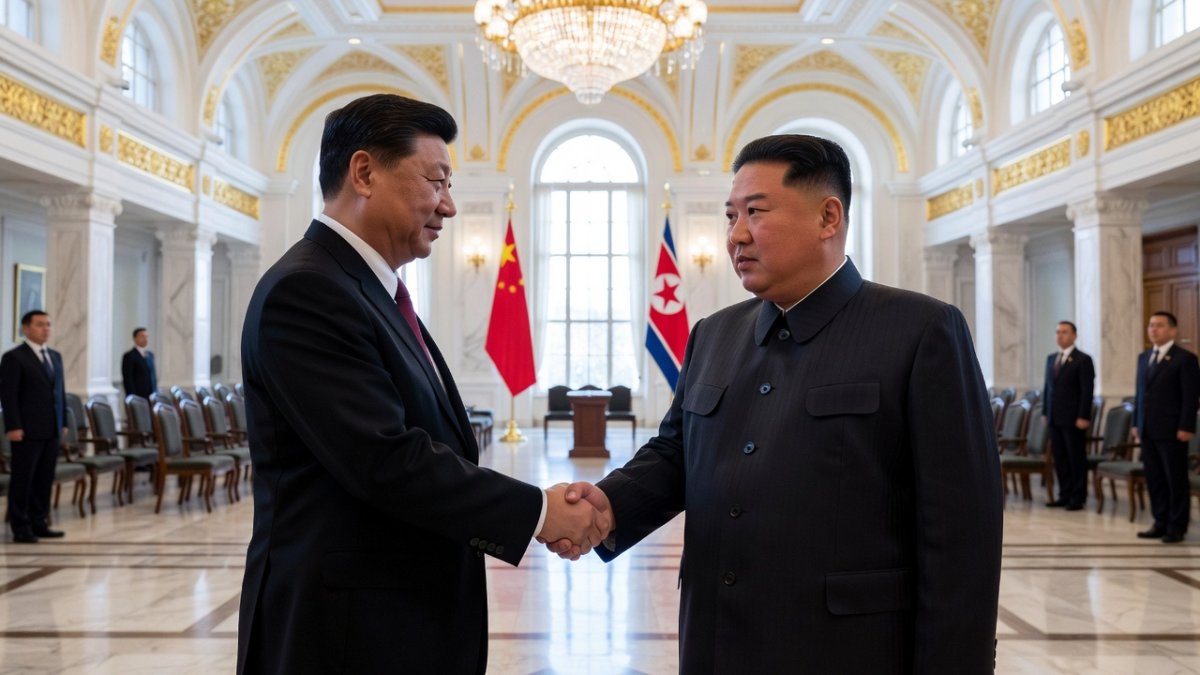
Commemorating the 1961 Treaty Through Reciprocal Diplomacy High-level exchanges between China and North Korea in mid-July have underscored the enduring institutional framework of their bilateral relationship, centered on the 65th anniversary of the 1961 Treaty of Friendship, Cooperation and Mutual Assistance.
Commemorating the 1961 Treaty Through Reciprocal Diplomacy
High-level exchanges between China and North Korea in mid-July have underscored the enduring institutional framework of their bilateral relationship, centered on the 65th anniversary of the 1961 Treaty of Friendship, Cooperation and Mutual Assistance. According to North Korea's state-controlled Korean Central News Agency (KCNA), Jo Yong Won, secretary of the Central Committee of the Workers' Party of Korea and a member of the Presidium of its Political Bureau, held talks with Wang Huning on July 15 at the Pyongyang Assembly Hall. Wang, a member of the Politburo Standing Committee of the Central Committee of the Communist Party of China and chairman of the Chinese People's Political Consultative Conference, arrived in Pyongyang that day at the head of a large Chinese delegation for a three-day visit concluding on July 17.
Jo was quoted by KCNA as stating that "the ever-changing present international political situation has required the two countries to further strengthen the militant unity, support and solidarity and steadily intensify and develop the friendly and cooperation relations for the victorious advance of the common cause of socialism in conformity with the basic spirit of the DPRK-China Treaty of Friendship, Cooperation and Mutual Assistance." This language reflects the formal ideological framing that has long characterized official North Korean discourse on ties with Beijing. The visit's timing, explicitly linked to the treaty anniversary, provides a structured occasion for reaffirming mutual commitments without introducing new formal instruments.
These interactions form part of a broader pattern of reciprocal high-level travel. Prior to Wang's arrival, North Korean Premier Pak Thae-song traveled to China and met with Xi Jinping. During that trip, Pak visited Tianjin and discussed expanding cooperation in economy, trade, education, and culture. Such sequencing—Pyongyang sending a premier-level figure followed by a senior Chinese Politburo Standing Committee member—illustrates the calibrated nature of the exchanges.
Kim Jong-un's Meeting with Wang Huning and Symbolic Gestures
On July 16, North Korean leader Kim Jong-un met with Wang Huning in Pyongyang. Wang conveyed "the best wishes and comradely greetings" from Xi Jinping to Kim. In response, Kim emphasized that the 1961 treaty has played "an important role in defending the basic interests of the two countries and ensuring regional and global peace and security." He added that the Workers' Party of Korea and the North Korean government would continue efforts to develop ties based on the treaty's spirit. These formulations, drawn from official reporting, restate established positions rather than announce discrete new policy initiatives.
Wang also laid a flower basket at the Kumsusan Palace of the Sun during his stay, a standard ceremonial act of respect toward the Kim family mausoleum that carries symbolic weight in North Korean political culture. The three-day duration of the Chinese delegation's visit allowed for both substantive talks and these ritual elements, which reinforce the personal and historical dimensions of the relationship. Wang Huning's profile as China's leading political strategist and fourth-ranking official lends particular analytical interest to the discussions, given his longstanding role in ideological and strategic formulation within the Chinese system.
Available reporting from KCNA, Yonhap, and NK News does not provide detailed operational outcomes or specific agreements beyond the reaffirmation of cooperation. This absence of granular public detail is consistent with the opacity that typically surrounds China-North Korea summitry, leaving external observers to assess significance through context and sequencing rather than disclosed deliverables.
Strategic Context: Balancing Ties with Moscow
The July exchanges extend a string of high-level contacts as Beijing works to keep pace with Pyongyang's deepening ties with Moscow. Xi Jinping visited North Korea in June 2026—his first visit in seven years—signaling an elevation in Chinese engagement after a period of relative restraint. This follows a pattern of increasingly active diplomatic exchanges between Pyongyang and Beijing. From a scholarly perspective, the timing suggests a Chinese interest in maintaining influence and visibility within North Korea's expanding external partnerships, particularly as North Korea has pursued closer military and economic coordination with Russia.
The 1961 treaty itself contains mutual assistance provisions that have historically served as a political and security anchor, even if their practical invocation has been limited. References to the treaty's "basic spirit" in both Jo's and Kim's remarks indicate continuity in how both sides publicly frame the relationship: as a socialist partnership oriented toward mutual defense of core interests amid a fluid international environment. Analysts of alliance politics would note that such commemorative diplomacy often functions to signal resolve to third parties while managing internal expectations within each system.
For China, sustaining this channel supports broader regional objectives, including stability along its northeast border and leverage in conversations about denuclearization and sanctions. For North Korea, the visible Chinese engagement diversifies its external relationships and provides political cover as it navigates sanctions pressure and technological cooperation with other partners. The reciprocal visits of Pak Thae-song to China and Wang Huning to Pyongyang illustrate a deliberate effort to demonstrate balance and momentum.
Implications for Inter-Korean Relations and South Korean Policy
These developments carry direct relevance for inter-Korean dynamics and the foreign policy calculus of the Republic of Korea. Heightened China-North Korea coordination tends to reduce Beijing's willingness to apply unilateral pressure on Pyongyang, a pattern observed across multiple cycles of tension on the peninsula. South Korean policymakers, operating through institutions such as the Ministry of Foreign Affairs and the Ministry of Unification, must weigh how reinforced China-North Korea solidarity affects prospects for dialogue, family reunions, or confidence-building measures.
Historically, periods of close Beijing-Pyongyang alignment have coincided with greater North Korean assertiveness in its dealings with Seoul and Washington. The emphasis on the 1961 treaty's role in "ensuring regional and global peace and security," as articulated by Kim, can be read as an implicit claim that the bilateral relationship itself constitutes a stabilizing factor—an interpretation that diverges from South Korean and U.S. assessments of North Korea's weapons programs. This divergence complicates trilateral coordination among Seoul, Washington, and Tokyo.
South Korea's strategic posture, which combines alliance commitments with efforts to manage relations with China, faces renewed tests when high-level China-North Korea traffic intensifies. Economic interdependence with China remains substantial for Seoul, yet security concerns over North Korean capabilities drive closer integration with U.S. extended deterrence. The July visits do not alter these structural tensions, but they reinforce the environment in which South Korean decision-makers operate. Academic analysis of middle-power diplomacy would highlight the constrained agency Seoul experiences when major-power partners of North Korea actively reaffirm their ties.
Regional Security Architecture and Historical Precedents
The current exchanges invite comparison with earlier phases of China-North Korea diplomacy. The original 1961 treaty emerged during a period of intense Cold War polarization and Sino-Soviet competition for influence in Pyongyang. Its 65th anniversary provides an occasion to reassert relevance in a transformed strategic landscape marked by U.S.-China rivalry, Russian revisionism, and North Korea's advanced nuclear and missile capabilities. Unlike earlier decades, today's interactions occur against the backdrop of North Korea's self-declared irreversible nuclear status and its demonstrated willingness to deepen military-technical cooperation with Russia.
Chinese diplomacy toward North Korea has oscillated between periods of distance—particularly during the peak "maximum pressure" campaign—and renewed engagement when Pyongyang's external options expand. The June 2026 Xi visit and the subsequent July exchanges fit the latter pattern. From the standpoint of regional order, such moves complicate efforts to isolate North Korea diplomatically and raise questions about the cohesion of sanctions enforcement. Korean peninsula specialists have long observed that Beijing prioritizes stability and influence over denuclearization when those goals conflict; the present diplomacy is consistent with that hierarchy of preferences.
For Japan and the United States, the visible solidification of China-North Korea ties underscores the limits of inducement strategies that assume Chinese leverage will be exercised in alignment with nonproliferation goals. Trilateral security cooperation among the United States, South Korea, and Japan has advanced in recent years partly in response to this structural reality. The July visits are unlikely to reverse that trend and may instead accelerate consultations on extended deterrence and information sharing.
Policy Implications and Analytical Caveats
Several policy implications follow from the available evidence. First, the commemorative framing around the 1961 treaty allows both sides to deepen practical cooperation—potentially in economic, educational, and cultural domains as referenced during Pak Thae-song's Tianjin visit—under an established legal-political umbrella. Second, the involvement of Wang Huning, whose portfolio emphasizes ideology and united front work, suggests that Beijing attaches importance to the normative and party-to-party dimensions of the relationship, not solely transactional state interests. Third, the absence of publicly detailed deliverables means that assessments of concrete outcomes must remain provisional pending further reporting or observable behavioral changes.
Limitations in open-source information should be acknowledged clearly. Official KCNA accounts and secondary reporting from Yonhap, NK News, Chosun Ilbo, and Kyodo provide the core factual base, yet they do not disclose the full content of discussions or any unpublished understandings. Claims about specific trade volumes, military assistance, or future summit schedules would exceed the evidence and are therefore avoided here. Scholarly caution requires distinguishing between demonstrated diplomatic activity and inferred strategic intent.
In sum, the July 2026 high-level visits represent a deliberate reaffirmation of China-North Korea ties at a moment when Pyongyang's relationship with Moscow has gained prominence. For Korean peninsula dynamics, the exchanges reinforce existing constraints on inter-Korean progress and complicate the external environment facing South Korean foreign policy. They also illustrate the continuing utility of historical treaty frameworks as vehicles for contemporary signaling. As regional competition intensifies, such calibrated diplomacy between Beijing and Pyongyang will remain a central variable in assessments of stability and order in Northeast Asia.
By Prof. David Park, Staff WriterThis article was produced with AI-assisted research and editorial support. Reporting is based on sources cited in the article.
What's Your Reaction?
 Like
0
Like
0
 Dislike
0
Dislike
0
 Love
0
Love
0
 Funny
0
Funny
0
 Wow
0
Wow
0
 Sad
0
Sad
0
 Angry
0
Angry
0

East Asia/Technology Correspondent at Global1.News. Seoul-based voice covering Korean politics, technology, business, and culture. Analyzes how technology and geopolitics intersect across East Asia.














Comments (0)