
Xi Jinping and Guterres Meet at WAIC 2026: Reaffirming UN Ties While Building New AI Frameworks
Xi Jinping and Guterres Meet at WAIC 2026: Reaffirming UN Ties While Building New AI Frameworks In a recent CGTN report on the video titled "Xi Jinping: China has always been a staunch supporter of the UN," President Xi Jinping met UN Secretary-General Antonio Guterres in Shanghai on July 17, 2026, during the World Artificial Intelligence Conference.
The Shanghai Meeting and Its Immediate Context
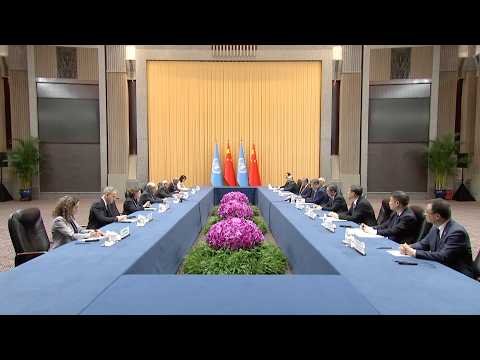
During the bilateral exchange at the Shanghai World Artificial Intelligence Conference, Xi Jinping underscored the importance of multilateral cooperation in emerging technologies while commending António Guterres for his decade of service at the United Nations. Xinhua reporting framed the remarks as an affirmation of the UN's central role in coordinating global responses to artificial intelligence challenges, noting that both leaders discussed mechanisms for inclusive standard-setting. The encounter occurred on the margins of what Chinese state media described as Xi's first keynote address at WAIC, elevating the conference's profile beyond its prior ministerial-level participation.
Observers noted that the timing allowed Xi to link China's domestic AI priorities with broader UN frameworks on sustainable development. Guterres reportedly highlighted the need for equitable access to computational resources, a point that aligned with ongoing discussions within the UN's Office for Digital and Emerging Technologies. This exchange set a cooperative tone ahead of the formal launch of the World Artificial Intelligence Cooperation Organization later in the program.
President Xi Jinping hosted Antonio Guterres on the sidelines of the 2026 World Artificial Intelligence Conference and the High-Level Meeting on Global AI Governance. Xi praised Guterres' leadership over the past decade and reiterated China's firm support for the United Nations. The meeting occurred as WAIC opened with Xi delivering his first keynote address at the event, which runs from July 17 to 20.
China's Consistent Stance on the United Nations System
Beijing has long positioned itself as a defender of the post-1945 international order centered on the UN Charter. Xi's remarks in Shanghai echoed this line, emphasizing that China remains a staunch supporter of the organization. This stance aligns with China's participation in UN peacekeeping operations and its financial contributions to the regular budget and peacekeeping assessments. The message serves to distinguish China's approach from unilateral actions by other powers in technology and trade domains.
Launch of WAICO as a Complementary Multilateral Body
The World Artificial Intelligence Cooperation Organization was established with 29 founding member states, including several from the Global South as well as select European and Asian partners. Its mandate centers on capacity-building, ethical guideline development, and technical assistance programs hosted primarily in Shanghai's Pudong district. Unlike the OECD AI Principles, which emphasize voluntary policy recommendations among high-income economies, or the EU AI Act's risk-based regulatory architecture, WAICO positions itself as a platform open to countries still developing foundational AI infrastructure.
By hosting the secretariat in Shanghai, Chinese authorities gain procedural influence over agenda-setting and the sequencing of working groups. This location advantage complements existing efforts such as the Belt and Road Initiative's digital corridors, allowing WAICO to integrate training modules with physical infrastructure projects already underway in participating states. Early documents indicate that the organization will avoid binding enforcement mechanisms, distinguishing it further from the EU's compliance regime.
During the conference, 29 countries signed the agreement establishing the World AI Cooperation Organization, headquartered in Shanghai. WAICO represents a China-led effort to shape rules for artificial intelligence governance. Guterres addressed the opening session, calling for AI to be shaped by all of humanity rather than dominated by a few powerful nations or corporations. The new body operates alongside existing UN processes rather than replacing them.
The Dual-Track Strategy in Global Governance
The UN80 Initiative has advanced proposals for streamlining Secretariat functions, expanding development financing windows, and updating technology governance structures to reflect multipolar realities. China's stated positions within these debates include support for measured Security Council enlargement that preserves veto prerogatives while increasing representation from Africa and Asia. Parallel emphasis on reforming international financial institutions aligns with calls for greater voice for emerging economies in technology standard bodies.
China's Global Governance Initiative complements these UN80 elements by advocating principles of sovereign equality and non-interference in domestic technology policy. When linked to WAICO activities, the GGI provides an overarching narrative that positions the new organization as an extension of existing UN reform efforts rather than a rival structure. This framing has been used in diplomatic outreach to secure additional founding members ahead of the 2026 conference cycle.
China's approach combines continued engagement with the UN and the creation of new specialized institutions such as WAICO. This dual-track method allows Beijing to address gaps in existing frameworks while preserving the UN's central role in peace and security matters. The strategy reflects the Global Governance Initiative, which has secured endorsements from nearly 160 countries. It also responds to the UN80 Initiative marking the organization's 80th anniversary, which focuses on institutional reform and modernization.
Implications for the Global South and Multipolar Order
Survey data from Pew and NPR have consistently shown higher favorability ratings toward China in parts of Southeast Asia, sub-Saharan Africa, and Latin America compared with Western Europe and North America. These patterns correlate with sustained engagement through Belt and Road infrastructure financing, vaccine distribution during the COVID-19 period, and more recent offers of AI training centers. Countries such as Indonesia and Kenya have cited tangible benefits from Chinese-built data centers and scholarship programs when explaining their diplomatic positioning.
Alternative governance frameworks like WAICO offer Global South governments additional channels for negotiating technology transfer terms without immediate alignment to export-control regimes led by the United States. This diversification reduces the risk of being locked into single-supplier ecosystems and supports national strategies that prioritize development outcomes over security-focused restrictions. Chinese officials have framed these arrangements as complementary to existing UN development financing discussions.
A July 15, 2026 NPR/Pew survey indicated that China and Xi receive more favorable views than the United States and its leadership in many Global South nations. WAICO's establishment offers developing countries a platform to participate in AI standard-setting without relying solely on forums dominated by advanced economies. This development strengthens China's regional influence and supports its broader objective of expanding multilateral options beyond traditional Western-led structures.
US-China Technology Competition and Export Controls
United States Bureau of Industry and Security export controls, expanded in October 2022 and subsequent updates, have restricted advanced semiconductor shipments to Chinese entities, prompting accelerated domestic programs at SMIC and Huawei's Ascend line. These measures have produced measurable delays in certain high-end training clusters while spurring parallel investment in legacy-node optimization. European and ASEAN semiconductor supply chains have experienced secondary effects, including re-routing of assembly operations and new licensing requirements for dual-use equipment.
WAICO functions as an institutional counterweight by convening states outside the CHIPS Alliance framework and emphasizing open participation rather than alliance-based coordination. Its Shanghai base allows Chinese ministries to shape technical working groups that prioritize interoperability standards compatible with domestic chip ecosystems. Over time, this may influence procurement decisions in member states seeking to maintain access to both Western and Chinese AI hardware stacks.
The United States continues to maintain export controls on advanced AI chips to China. These measures form part of ongoing strategic competition in technology, trade, and influence within multilateral institutions. China's promotion of WAICO and its reaffirmation of UN principles occur against this backdrop. The dual engagement allows Beijing to pursue technological self-sufficiency while signaling commitment to cooperative governance norms.
Strategic Calculus and Second-Order Effects
Each side pursues distinct objectives. China seeks to shape AI rules in ways that support its domestic innovation goals and extend influence among developing states. The UN gains visibility through high-level Chinese endorsement at a moment of internal reform discussions. For ASEAN and the EU, the emergence of WAICO introduces new channels for engagement but also raises questions about overlapping mandates. Global South countries may gain additional leverage in negotiations over technology access and standards.
Looking Ahead: Balancing Institutional Innovation and Continuity
The Shanghai meeting illustrates how Beijing integrates new mechanisms like WAICO into its foreign policy without discarding established UN-centered diplomacy. This pattern is likely to continue as AI governance evolves. Observers will watch whether WAICO coordinates with UN agencies or develops independent procedures. The outcome will influence the distribution of authority in global technology regulation and the relative weight of different multilateral forums. By Prof. Marcus Chen, Staff Writer
This article was produced with AI-assisted research and editorial support. Reporting is based on sources cited in the article.
What's Your Reaction?
 Like
0
Like
0
 Dislike
0
Dislike
0
 Love
0
Love
0
 Funny
0
Funny
0
 Wow
0
Wow
0
 Sad
0
Sad
0
 Angry
0
Angry
0
World Politics Analyst at Global1.News. Based in Beijing, covering US-China relations, global trade, and geopolitical strategy. Brings deep analytical perspective to the power dynamics shaping international affairs.














Comments (0)