
4-Way Race for Democratic Party Leadership Tests Lee Jae-myung's Influence
4-Way Race for Democratic Party Leadership Tests Lee Jae-myung's Influence The Four Candidates and Emerging Alliances The Democratic Party leadership contest that opened in early July features four declared or expected candidates whose backgrounds reflect distinct currents within the party. Former Prime Minister Kim Min-seok entered the race on July 7, criticizing former party
The Four Candidates and Emerging Alliances
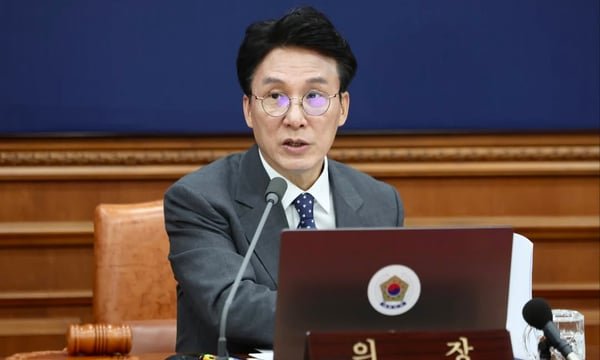
The Democratic Party leadership contest that opened in early July features four declared or expected candidates whose backgrounds reflect distinct currents within the party. Former Prime Minister Kim Min-seok entered the race on July 7, criticizing former party leader Jung Chung-rae for prioritizing personal positioning over legislative delivery. Jung, who resigned his post last month to run, is expected to formalize his candidacy shortly. Six-term lawmaker Son Yong-gil, who regained his National Assembly seat in the June 3 by-election, and National Assembly member Ko Min-jung, a former broadcaster and spokesperson for President Moon Jae-in, completed the field on July 8.
Kim currently leads Jung by twenty-one points among Democratic Party supporters according to one local pollster, yet the outcome remains uncertain because the party has altered its internal voting formula for the first time. Ordinary dues-paying members will now cast ballots of equal weight to those of convention delegates, reversing a system in which a delegate’s vote carried roughly seventeen times the influence of a rank-and-file member. This structural change, advanced by Jung earlier this year, was presented as a measure to enhance party sovereignty, but it also redistributes power among factions that have long relied on delegate networks.
Transforming Party Democracy: The New Electoral System
The shift toward equal weighting of member and delegate votes marks a significant departure from the delegate-heavy model that shaped previous leadership contests. Under the old rules, organized factions could concentrate influence through convention delegates drawn from regional and institutional bases. By equalizing the franchise, the Democratic Party has introduced an element of direct accountability that echoes earlier experiments in party democratization during the Roh Moo-hyun and Moon Jae-in eras, when reformers sought to curb the dominance of metropolitan elites and regional machines.
Whether the reform will produce more responsive leadership or simply intensify factional mobilization among dues-paying members remains an open question. Historical precedent suggests that changes in internal rules often favor candidates who can activate broader networks rather than those who rely solely on established delegate brokers. In this sense, the July contest tests not only individual ambitions but also the durability of the institutional legacy Jung sought to establish during his tenure.
Legislative Gridlock and Presidential Frustration
President Lee Jae-myung, himself a Democratic Party member, presides over a legislature in which his party holds 161 of 300 seats along with the speakership and the chairmanship of the Legislation and Judiciary Committee. Despite this institutional advantage, complaints have persisted inside the Blue House that the party has been slow to convert its majority into enacted legislation. Lee has expressed this frustration directly at Cabinet meetings, highlighting the gap between electoral success and policy output.
The mismatch between formal control and legislative pace carries particular weight in the Korean context, where the president’s agenda on economic regulation, education reform, and inter-Korean engagement depends on swift parliamentary action. When a ruling party fails to advance its program despite commanding the speakership and key committees, the resulting perception of paralysis can erode public confidence and invite opposition narratives about governmental ineffectiveness.
Factionalism and the Shadow of 2028
Jung’s candidacy occurs against the backdrop of criticism that his year as party leader coincided with the very legislative sluggishness now cited by pro-Lee members. His campaign therefore functions less as an endorsement of the presidential agenda than as an effort to preserve his faction’s influence over candidate nominations for the 2028 general elections. Relinquishing the chair would likely diminish that bloc’s leverage in the next round of candidate selection, a high-stakes consideration given Korea’s tradition of factional continuity across electoral cycles.
Kim and Son appear to be coordinating their efforts, with Son indicating he would withdraw if his candidacy threatened to split the anti-Jung vote. Ko Min-jung’s entry adds further complexity. Drawing support from the pro-Moon constituency that overlaps with Jung’s base, she campaigns on generational renewal and the retirement of senior figures. Her presence may either fragment Jung’s support or provide an alternative outlet for younger members seeking distance from established leadership circles.
Opposition Intransigence: A Comparative Perspective
The internal contest within the Democratic Party stands in sharp relief to developments inside the opposition People Power Party. Following the PPP’s decisive losses in the June 3 local elections, party leader Jang Dong-hyuk has declined to step down and has instead threatened disciplinary measures against critics within his own ranks. This contrast underscores differing institutional cultures: while the Democratic Party is conducting an open, multi-candidate contest that redistributes voting power, the PPP has opted for centralized control even after electoral setbacks.
Such divergence matters for the broader health of Korean party politics. A ruling party willing to subject its leadership to competitive internal elections may strengthen democratic norms inside its organization, yet it also risks prolonged uncertainty at a moment when legislative momentum is required. The opposition’s refusal to renew its leadership, meanwhile, may preserve short-term cohesion at the cost of longer-term adaptability.
Strategic Implications for South Korean Governance
The outcome of the Democratic Party contest will shape the institutional environment in which President Lee pursues his remaining term. A leadership aligned with the presidential agenda could accelerate the translation of electoral majorities into statutory achievements, particularly in areas such as chaebol oversight and educational equity that have historically required sustained legislative majorities. Conversely, a leadership more protective of existing factional arrangements might perpetuate the very delays that have already drawn presidential criticism.
Over the longer horizon, the contest foreshadows the factional alignments that will determine candidate selection for the 2028 presidential and legislative races. Korean political history demonstrates that control over party nomination processes often determines which generational and regional cohorts ascend to national office. The July leadership election therefore functions as an early indicator of how power will be distributed within the Democratic Party as it prepares for the post-Lee era, with consequences that extend well beyond the immediate legislative calendar.
By Prof. David Park, Staff WriterThis article was produced with AI-assisted research and editorial support. Reporting is based on sources cited in the article.
What's Your Reaction?
 Like
0
Like
0
 Dislike
0
Dislike
0
 Love
0
Love
0
 Funny
0
Funny
0
 Wow
0
Wow
0
 Sad
0
Sad
0
 Angry
0
Angry
0
East Asia/Technology Correspondent at Global1.News. Seoul-based voice covering Korean politics, technology, business, and culture. Analyzes how technology and geopolitics intersect across East Asia.















Comments (0)