
China Targets US Destroyer Replica in Xinjiang Missile Tests
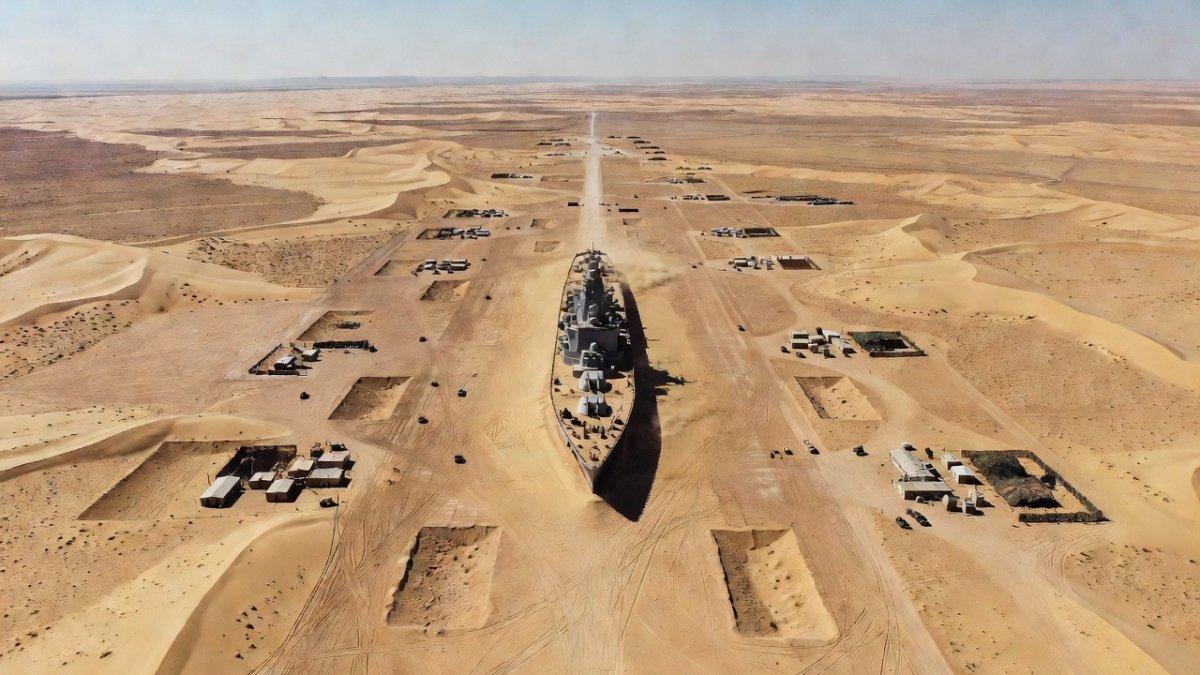
On July 27 2026, commercial satellite imagery captured a full-scale replica of a U.S. Navy Arleigh Burke-class guided-missile destroyer at the Ruoqiang Test Range deep inside China’s Taklamakan Desert in Xinjiang. The discovery underscores Beijing’s continued investment in realistic naval targets to refine anti-ship strike capabilities. This development immediately raises questions about how such testing could affect regional maritime security and alliance planning.

On July 27 2026, commercial satellite imagery captured a full-scale replica of a U.S. Navy Arleigh Burke-class guided-missile destroyer at the Ruoqiang Test Range deep inside China’s Taklamakan Desert in Xinjiang. The discovery underscores Beijing’s continued investment in realistic naval targets to refine anti-ship strike capabilities. This development immediately raises questions about how such testing could affect regional maritime security and alliance planning.
China Targets US Destroyer Replica in Xinjiang Missile Tests
Tokyo — Article continues with analysis from satellite imagery provided by Vantor, revealing the latest in a series of full-scale naval mock-ups constructed for PLA missile evaluation.
Intro — the discovery of the desert replica
Satellite imagery has identified a full-scale mock-up resembling a U.S. Navy Arleigh Burke-class guided-missile destroyer at the Ruoqiang Test Range in the Taklamakan Desert, Xinjiang.
The structure, supplied through commercial geospatial data from Vantor, sits in a remote area long used for military evaluation. This find adds to a pattern of replica targets constructed over several years at the same site.
Analysts note the replica matches the Flight IIA variant of the Arleigh Burke class. Its presence points to ongoing Chinese efforts to refine systems aimed at naval assets.
What the satellite images reveal
The images show a detailed outline matching the dimensions and features of an Arleigh Burke-class destroyer. Key elements such as the hull shape, superstructure, and sensor placements appear replicated at full scale.
Vantor provided the high-resolution data that allowed identification of the mock-up. The site lies within the established Ruoqiang Test Range boundaries in far-western Xinjiang.
Previous constructions at the same location have included an aircraft carrier mock-up. This latest addition follows the established practice of building naval targets for evaluation purposes.
Kill chain testing — the military purpose
The replica supports testing of China’s anti-ship missile kill chain. This process integrates surveillance, tracking, targeting, and strike phases into a coordinated sequence.
By placing a realistic target in a desert environment, evaluators can assess how well these phases function together under controlled conditions. The approach allows repeated trials without requiring live naval assets.
Multiple analysts have confirmed this represents the most recent in a series of such replicas developed over several years at the Ruoqiang range.
In military doctrine a kill chain encompasses the sequence of target detection, tracking, engagement decision, and effect assessment required to neutralize a threat. China's Ruoqiang facility in the Taklamakan Desert supplies a controlled environment for exercising this sequence against large naval silhouettes, allowing repeated sensor-to-weapon loops under arid conditions that approximate certain electromagnetic and thermal profiles. The site's isolation reduces variables that would arise in coastal ranges, enabling systematic refinement of command links between reconnaissance assets and strike platforms.
Systems such as the DF-21D and DF-26 ballistic missiles, together with the YJ-18 and YJ-12 cruise missiles, have been associated with anti-ship missions and can be evaluated against the replica's radar cross-section and infrared signature. Desert testing permits static positioning and instrumentation that live naval exercises cannot easily replicate, yet it cannot fully reproduce ship motion, sea clutter, or evasive maneuvering. These constraints limit the fidelity of terminal guidance data and require supplementary validation at sea to confirm performance against moving targets.
Technical analysis of PLA anti-ship capabilities
The replica enables evaluation of missile systems designed to engage surface vessels. Focus areas include sensor accuracy, guidance performance, and overall system integration against destroyer-sized targets.
China has expanded its inventory of anti-ship missiles in recent years. The Ruoqiang site provides a land-based venue to measure these weapons against representative hull forms and electronic signatures.
Japan’s Ministry of Defense has monitored these developments through open-source imagery and official channels. Japanese Aegis-equipped destroyers share similar design principles with the Arleigh Burke class, making the test data relevant to regional naval assessments.
The People's Liberation Army Rocket Force and Navy integrate ballistic and cruise missiles into layered strike packages that would employ the Ruoqiang target data for trajectory and seeker optimization. These weapons are designed to challenge Aegis-equipped surface combatants through saturation attacks and maneuvering reentry vehicles. U.S. Navy countermeasures, including SM-3 and SM-6 interceptors as well as close-in systems, continue incremental upgrades to address hypersonic and sea-skimming threats, creating an ongoing competition between penetration aids and defensive architectures.
Japan's Aegis-equipped destroyers form part of the same defensive network in the western Pacific, requiring interoperability standards with U.S. forces for coordinated tracking and engagement. The technological race therefore extends beyond bilateral U.S.-China dynamics to encompass allied sensor fusion and rules of engagement that affect response times across the first island chain.
Taiwan implications and regional tension
Experts connect the replica testing to China’s broader military preparations concerning Taiwan. Anti-ship capabilities form one component of potential operations across the Taiwan Strait.
The ability to simulate strikes on U.S. Navy destroyers demonstrates an emphasis on disrupting naval support during contingencies. The Taklamakan location offers isolation suitable for large-scale exercises.
Regional observers note that such testing occurs alongside other capability developments, though specific timelines for operational deployment remain subject to further verification.
Anti-ship capabilities tested at Ruoqiang directly support efforts to deter or delay intervention by carrier strike groups during a Taiwan contingency. In such scenarios, U.S. Navy surface combatants would operate within range of Chinese coastal and airborne sensors, relying on destroyer screens for area air defense while conducting strikes or evacuation operations. The replica program aligns with China's broader anti-access/area denial posture, which seeks to raise operational costs for forces approaching the Taiwan Strait.
Japanese defense analysts have noted that any acceleration in Chinese readiness timelines would compress warning periods for regional capitals and necessitate earlier alliance consultations. The testing therefore contributes to a deterrence calculus in which both sides adjust deployment patterns and logistics routes to account for contested sea lanes around Taiwan.
Japan and Asia-Pacific security implications
China’s expanding anti-ship systems pose direct considerations for Japan’s sea lanes of communication. These routes carry critical energy imports and trade volumes essential to the Japanese economy.
The U.S.-Japan alliance relies on the operational survivability of Arleigh Burke-class destroyers in the Indo-Pacific. Any demonstrated improvement in targeting these vessels affects alliance planning and deterrence calculations.
Japanese defense officials continue to track PLA missile advancements through established monitoring programs. The presence of similar Aegis technology on Japan Maritime Self-Defense Force vessels underscores the shared technical baseline under evaluation.
Japan's energy imports transit routes that pass near the Taiwan Strait and South China Sea, exposing supply lines to potential disruption if anti-ship systems mature further. This geographic exposure has informed revisions to Japan's 2022 National Security Strategy and accelerated acquisition of standoff munitions and enhanced maritime surveillance. Countermeasures under development include extended-range cruise missiles, improved Aegis integration, and expanded joint training with U.S. and Australian forces to strengthen collective deterrence.
U.S.-Japan alliance commitments require rapid consultation mechanisms when threats to sea lines of communication emerge. The Ruoqiang testing therefore reinforces Tokyo's emphasis on distributed maritime operations and resilient logistics planning across the southwest island chain.
What to watch for
Future satellite passes over the Ruoqiang range may reveal additional modifications or new replica configurations. Analysts will examine whether testing expands to include electronic warfare or decoy elements.
Japanese policy responses could involve adjustments to maritime patrol priorities or alliance coordination mechanisms. METI and MOFA will assess impacts on energy security and diplomatic engagement in the region.
Continued commercial imagery releases from providers such as Vantor will supply ongoing visibility into site activity. Observers should compare new data against the established pattern of replica construction at the site.
Tags: China missile tests, Arleigh Burke replica, Taklamakan Desert, Ruoqiang Test Range, anti-ship capabilities, Taiwan tensions, Japan sea lanes, US-Japan alliance, Vantor satellite imagery, PLA kill chain, Aegis destroyers, regional security
By Kenji Tanaka, Staff Writer
This article was produced with AI-assisted research and editorial support. Reporting is based on sources cited in the article.
What's Your Reaction?
 Like
0
Like
0
 Dislike
0
Dislike
0
 Love
0
Love
0
 Funny
0
Funny
0
 Wow
0
Wow
0
 Sad
0
Sad
0
 Angry
0
Angry
0

Japan Correspondent at Global1.News. Tokyo-based voice covering Japanese politics, technology, economy, and culture. Tracks the intersection of tradition and innovation in one of the world's most dynamic societies.















Comments (0)