
The Quad and ASEAN's First Step Off The Fence
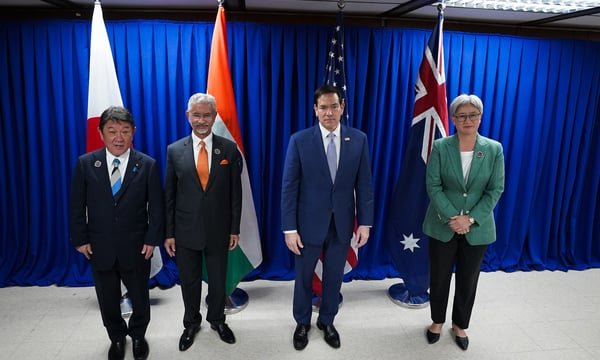
The Manila Meeting and Its Immediate Context The Quad foreign ministers convened on July 22, 2026, in Manila during the 59th ASEAN Foreign Ministers Meeting. United States Secretary of State Marco Rubio, Japanese Foreign Minister Toshimitsu Motegi, Australian Foreign Minister Penny Wong, and Indian External Affairs Minister S. Jaishankar issued a dedicated joint statement on cooperation with ASEAN.
The Manila Meeting and Its Immediate Context
The Quad foreign ministers convened on July 22, 2026, in Manila during the 59th ASEAN Foreign Ministers Meeting. United States Secretary of State Marco Rubio, Japanese Foreign Minister Toshimitsu Motegi, Australian Foreign Minister Penny Wong, and Indian External Affairs Minister S. Jaishankar issued a dedicated joint statement on cooperation with ASEAN. This marked the first occasion on which the Quad produced a standalone document focused exclusively on its engagement with the ten-member grouping.
The Philippines, holding the 2026 ASEAN chairmanship, hosted the gathering on the sidelines of the regular ASEAN ministerial schedule. The statement outlined areas of practical collaboration, including maritime domain awareness, supply-chain resilience, and health security, while reiterating support for ASEAN centrality in regional architecture.
The July 22 statement specifically referenced the Quad’s Indo-Pacific Maritime Domain Awareness initiative, which seeks to integrate satellite data-sharing platforms among the four partners to assist ASEAN coast guards in monitoring illegal fishing and trafficking routes across the South China Sea and Andaman Sea. On supply chains, the document highlighted ongoing work through the Quad’s Critical and Emerging Technology Working Group to map semiconductor and rare-earth dependencies, offering ASEAN states technical assistance for diversification away from single-source suppliers. Health security provisions built on the earlier Quad Vaccine Partnership by proposing joint stockpiling mechanisms for antivirals and medical countermeasures, with explicit reference to ASEAN’s existing public-health networks. These concrete deliverables were framed around the July 22 date to underscore the Quad’s intent to move from declaratory policy to operational programs timed with the ASEAN calendar.
ASEAN's Historical Posture and Incremental Shifts
ASEAN has long pursued a policy of formal neutrality, balancing relations with major powers through mechanisms such as the ASEAN Regional Forum and the East Asia Summit. This approach, often described as fence-sitting, allowed member states to avoid explicit alignment amid United States-China strategic competition. The July 2026 statement does not overturn that posture but signals a willingness to institutionalize dialogue with the Quad on functional issues.
Analysts note that the document avoids language framing the Quad as a security alliance. Instead, it emphasizes shared interests in a free and open Indo-Pacific, a formulation that aligns with ASEAN's own Outlook on the Indo-Pacific adopted in 2019. The cautious phrasing suggests ASEAN members are testing deeper engagement without abandoning their traditional equidistance.
Vietnam has quietly welcomed the Quad’s maritime domain awareness proposals, viewing them as complementary to its own efforts to strengthen coastal surveillance against Chinese maritime militia activity. In contrast, Cambodia and Laos have expressed reservations, preferring to channel any new cooperation through the ASEAN+3 process where China retains a seat at the table. The 2019 AOIP’s emphasis on ASEAN-led, inclusive regionalism is invoked in the July 2026 statement to reassure these members that Quad engagement will remain project-based rather than alliance-oriented. This differentiation among ASEAN states illustrates how the July 2026 document functions as a lowest-common-denominator text that accommodates both enthusiastic and cautious capitals without requiring formal consensus on strategic alignment.
The Quad's Deliberate Rebranding Efforts
Revived in 2017, the Quad has consistently sought to present itself as a cooperative platform rather than an anti-China coalition. The 2026 joint statement continues this trajectory by focusing on non-traditional security and economic coordination. References to ASEAN centrality and the need for inclusive regionalism appear throughout the text, reflecting the Quad's awareness of Southeast Asian sensitivities.
Concrete proposals in the statement include expanded cooperation on disaster response and digital infrastructure standards. These areas allow the Quad to demonstrate tangible value while sidestepping contentious military exercises that might alarm ASEAN capitals. The approach mirrors earlier Quad initiatives such as vaccine distribution and critical minerals partnerships, which similarly avoided explicit geopolitical confrontation.
The Quad’s Indo-Pacific Maritime Domain Awareness program, referenced on July 22, extends the 2022 pilot that shared commercial satellite imagery with several ASEAN navies; the new statement commits additional funding for training workshops in Singapore and Jakarta. Vaccine and critical minerals initiatives are cited as precedents for the health-security and supply-chain pillars now offered to ASEAN, demonstrating the Quad’s preference for functional, deliverable-focused diplomacy. Infrastructure standards cooperation draws on the Quad’s earlier work with the Blue Dot Network to certify quality projects, providing ASEAN governments with an alternative benchmark to China’s Belt and Road Initiative without requiring political endorsement of the Quad itself.
South Korea's Comparative ASEAN Strategy
Seoul maintains its own structured engagement with ASEAN through the ASEAN+3 framework and the Korea-ASEAN Solidarity Initiative launched in 2022. These mechanisms encompass economic, cultural, and security dialogues that parallel several Quad priorities without requiring formal membership in the grouping. South Korea's network of bilateral free trade agreements with ASEAN members further deepens economic interdependence.
Korean middle-power diplomacy offers a useful reference point for assessing the Quad-ASEAN statement. Seoul has emphasized practical cooperation on supply-chain diversification and maritime safety while preserving space for engagement with China. This calibrated posture may inform how individual ASEAN states evaluate the risks and benefits of Quad-linked initiatives.
Korea’s bilateral FTAs with Vietnam, Singapore, and Indonesia already cover 80 percent of ASEAN’s combined GDP, giving Seoul leverage in ongoing upgrade negotiations for the Korea-ASEAN FTA that began in 2023. The Korea-ASEAN Solidarity Initiative’s maritime security pillar includes joint coast-guard exercises and port-security capacity building that overlap thematically with the Quad’s July 22 maritime domain awareness commitments. By maintaining these parallel tracks, Seoul demonstrates that middle powers can pursue functional cooperation with ASEAN on supply-chain resilience and maritime safety without forcing member states to choose between Quad initiatives and established ASEAN+3 mechanisms.
Implications for Regional Architecture and Inter-Korean Dynamics
The July 2026 statement arrives at a moment when regional institutions face pressure to adapt to intensifying great-power competition. By establishing a dedicated channel, the Quad and ASEAN have created a new procedural precedent that could evolve into regular ministerial or working-level meetings. Such institutionalization would mark a departure from ad hoc consultations.
For South Korea, developments in Southeast Asia carry indirect relevance to inter-Korean relations. ASEAN states have historically played hosting and mediating roles in Korean Peninsula diplomacy, including the 2018 inter-Korean summits and ASEAN-led forums on non-proliferation. Closer Quad-ASEAN coordination could influence the diplomatic space available for future Peninsula initiatives, particularly if ASEAN members become more receptive to Quad perspectives on regional order.
The new Quad-ASEAN track may gradually alter the balance within the East Asia Summit, where ASEAN+3 members have traditionally set the agenda. If working-level meetings on maritime domain awareness and supply chains become regularized, they could feed into the November 2026 East Asia Summit hosted in Manila, potentially elevating Quad priorities on the formal summit agenda. For inter-Korean diplomacy, this shift matters because ASEAN chairs have historically provided neutral venues for Peninsula-related side meetings; greater ASEAN receptivity to Quad framing of regional order could narrow the diplomatic maneuvering room available to Pyongyang and its traditional interlocutors.
Strategic Significance and Remaining Uncertainties
The joint statement represents an incremental rather than transformative development. ASEAN continues to prioritize consensus-based decision-making, meaning any deeper institutional ties with the Quad will require sustained consensus among all ten members. The Philippines' chairmanship provided a favorable environment for the initial statement, yet subsequent chairs may apply different emphases.
Over the longer term, the document's significance lies in its procedural innovation. A standing Quad-ASEAN dialogue track could gradually reshape expectations about acceptable forms of minilateral engagement within Southeast Asia. South Korea's experience navigating similar partnerships suggests that functional cooperation can advance without forcing binary alignment, provided all parties maintain flexibility on sensitive political questions.
Looking ahead, ASEAN’s potential evolution toward selective minilateral engagement will be tested during the Philippines’ 2026 chairmanship and the subsequent rotation of chairs. If the July 22 precedent leads to annual Quad-ASEAN ministerial side meetings, it could normalize the presence of minilateral groupings within ASEAN’s institutional ecosystem. For middle powers such as South Korea, this trajectory offers both opportunity and caution: deeper functional cooperation on maritime awareness and supply chains becomes feasible, yet any perception that ASEAN is tilting toward Quad strategic preferences risks provoking pushback from China and from more cautious ASEAN members, requiring careful calibration of Seoul’s own ASEAN engagement strategy.
By Prof. David Park, Staff WriterThis article was produced with AI-assisted research and editorial support. Reporting is based on sources cited in the article.
What's Your Reaction?
 Like
0
Like
0
 Dislike
0
Dislike
0
 Love
0
Love
0
 Funny
0
Funny
0
 Wow
0
Wow
0
 Sad
0
Sad
0
 Angry
0
Angry
0

East Asia/Technology Correspondent at Global1.News. Seoul-based voice covering Korean politics, technology, business, and culture. Analyzes how technology and geopolitics intersect across East Asia.















Comments (0)