
The $724 Billion AI Spending Pact Just Broke — and Wall Street Is Finally Asking the Right Questions
Let me tell you something I've been watching all week. For the last three years, Big Tech and Wall Street had a quiet understanding: spend whatever you want on AI infrastructure, and we'll keep pushing your stock prices higher as long as revenue keeps growing.
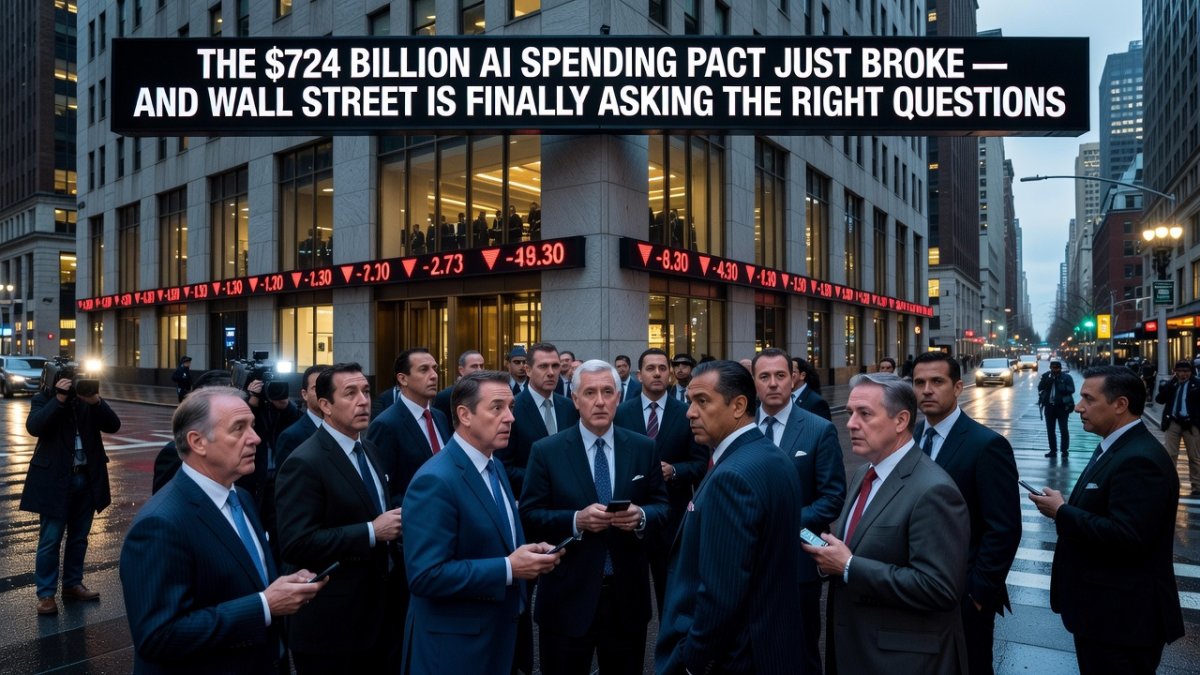
The $724 Billion AI Spending Pact Just Broke — and Wall Street Is Finally Asking the Right Questions
Let me tell you something I've been watching all week. For the last three years, Big Tech and Wall Street had a quiet understanding: spend whatever you want on AI infrastructure, and we'll keep pushing your stock prices higher as long as revenue keeps growing. That deal just collapsed. And I mean spectacularly.
Thursday July 23 was the day the music stopped. The Magnificent Seven tech stocks lost nearly $800 billion in a single session — $797 billion according to Bloomberg, the worst single-day wipeout since the tariff tantrum in April 2025. Tesla cratered 19% in five days. Alphabet dropped 8.5%. Amazon, Meta, Microsoft, all red. The index fell 4.8% and erased about $2 trillion from their late-May peak. And the trigger wasn't bad earnings. It was the opposite. Both Alphabet and Tesla beat revenue estimates. The market punished them for how much they're spending to get there.
That's the story I want to walk through today, because it matters for every independent hosting provider and infrastructure operator who's been watching the hyperscalers gobble up power, hardware, and colo space like there's no tomorrow. There might not be.
Wall Street Just Changed the Rules on AI Spending
New York — July 27, 2026 — Bloomberg ran a piece on Saturday titled "Big Tech Earnings Slam Into a Market in Revolt Over AI Spending," and that headline says everything you need to know. The quote that stopped me cold came from Jason Lemire, chief investment officer at Bold Wealth Partners. He said: "It used to be the more the better, but now it is the less the better. We're seeing capital raises, negative cash flows, rising debt."
Let that sink in. For three years, the single biggest driver of tech stock valuations was how aggressively companies were building AI infrastructure. The more data centers, the more GPUs, the more capex — the higher the multiple. Wall Street treated AI spending as a proxy for future dominance. If you weren't spending enough, you were falling behind. Now? The market is penalizing the exact same behavior it was rewarding six months ago.
The Alphabet Tipping Point — When Record Revenue Isn't Enough
Alphabet's Q2 2026 earnings, reported July 22, should have been a home run. Revenue hit $119.8 billion — a record. Google Cloud grew 82% year over year to $24.77 billion. Operating margin held at 34%. By every income statement measure, this was one of the strongest quarters in the company's 22-year public history.
Then you look at the cash flow statement. Alphabet spent $44.9 billion on capital expenditures in Q2 alone — almost exactly double the $22.4 billion it spent in Q2 2025. For the first six months of 2026, capex hit $80.6 billion versus $39.6 billion in the first half of 2025. Operating cash flow was $39.1 billion. That means Alphabet burned $5.9 billion more on infrastructure than it generated from operations. Negative free cash flow for the first time since its 2004 IPO.
And here's the part that should terrify anyone who believes this spending cycle has a soft landing: Alphabet raised full-year 2026 capex guidance to $195-205 billion, up from the $180-190 billion range it set just three months ago. That's $17 billion above market expectations, and it came in the same quarter where the company bought back zero shares for the second straight period. When a company that printed $70 billion in free cash flow in 2023 stops buying back stock because all its cash is going to data centers, the market takes notice.
The Magnificent Seven Bloodbath — $2 Trillion Gone in a Month
The Alphabet selloff was the trigger, but the reaction spread across the entire sector. The Bloomberg Magnificent Seven Index fell 4.8% on July 23 alone, wiping out $797 billion in a single session. Over the following days, the damage deepened: Tesla down 19% in five days. Alphabet down 8.5%. Amazon down 6.3%. Meta down 6%. Even Microsoft, the AI darling with its OpenAI stake, shed 1.3%.
As of Friday, the Mag Seven are down roughly 11% from their late-May peak, erasing about $2 trillion in combined market value. The Philadelphia Semiconductor Index (SOX), which was up 101% through the first half of the year, has lost 17% in July alone and is on pace for its worst month since the 2022 rate-hiking cycle.
This is not a small rotation. This is a structural repricing of how Wall Street values AI infrastructure spending, and it's happening in real time.
Michael Burry Is Watching — and He's Seen This Movie Before
Michael Burry, the "Big Short" investor who called the 2008 housing collapse, has been vocal about this exact dynamic. In a recent interview, he said AI bulls are hoping for a "third door" — a scenario where infinite AI demand justifies unlimited infrastructure spending and both hardware makers and hyperscalers win simultaneously. His response: "There is no third door."
Burry has placed a targeted short against Applied Materials, one of the semiconductor equipment suppliers that has ridden the AI capex wave to a 313% stock gain in 2026. He's also warned that current market conditions mirror the final months of the 1999-2000 dot-com bubble — where everyone knew the spending was excessive but no one wanted to be the first to call it.
"The Big Short investor said Wall Street delivered its verdict on Big Tech's artificial intelligence spending, with investors increasingly favoring companies showing stronger returns over larger capital commitments," according to a StockTwits report on his commentary. Translation: show me revenue, not roadmaps.
The Numbers Don't Lie — 4% Revenue on 100% of the Spend
Here's the math that's finally bothering Wall Street. Bank of America calculates that hyperscaler capex now consumes 94% of operating cash flows after dividends and buybacks. Combined AI infrastructure spending across Alphabet, Microsoft, Amazon, and Meta is projected at $724 billion for 2026, climbing to $950 billion in 2027 according to Bloomberg-compiled analyst estimates. Some analysts already see it topping $1 trillion by 2027.
And what's the direct AI services revenue generated by all that spending? Roughly $25 billion. That's about 4% of what's being spent on infrastructure. Even if you count indirect revenue — cloud migrations, AI-enhanced ad targeting, enterprise Copilot subscriptions — the gap between capex and returns is historically unprecedented. At no point in the history of corporate technology investment has such a small fraction of output been traced back to such a massive capital commitment.
This is the core tension that the market revolt is about. Not whether AI will eventually generate returns — it almost certainly will — but whether the current pace of spending can be sustained until those returns materialize. Bold Wealth's Lemire put it bluntly: "There is going to be an AI winter at some point."
What This Means for Independent Hosting Providers
So what does a Wall Street revolt over AI capex mean for someone running a hosting operation in Atlanta or Dallas or Phoenix? Let me give you three things to watch.
First — the secondary GPU market is about to get interesting. When hyperscalers feel pressure to show better free cash flow, the first thing they cut is excess capacity. That means GPUs originally ordered for expansion projects that got cancelled will hit the secondary market. We already saw this with Meta's $10 billion compute lease to Anthropic — a sign that Meta had more hardware than it needed and needed to monetize it. Expect more of that. If you've been waiting for GPU prices to come down, watch the secondary market through Q3 and Q4.
Second — colo pricing could actually soften in secondary markets. The hyperscalers have been the primary demand driver pushing colo prices up 15-25% in every available market. If Alphabet, Meta, and Microsoft slow their leasing pace to protect cash flow, that demand pressure eases. The 75 blocked data center projects from Q1 2026 are already a leading indicator. The question is whether this earnings-driven pullback accelerates the cooling cycle we started seeing two weeks ago.
Third — don't assume the $725 billion is all happening. A lot of that projected capex number assumes continued investor tolerance for negative free cash flow. That tolerance just evaporated. When Alphabet can't buy back stock because its data center budget consumes all free cash, and the market drops 8% for the trouble, the CFOs at Meta and Amazon are taking notes. I'm not saying the buildout stops. I'm saying the rate of acceleration slows. And in an industry where every forecast assumes exponential growth, a slowdown in the rate of acceleration feels like a contraction even when it's not.
The Structural Reality — This Isn't the End of AI Infrastructure, It's the End of the Blank Check
Let me be clear about what I'm NOT saying. I'm not saying AI demand is fake. I'm not saying data centers stop getting built. I'm not saying hyperscalers are going bankrupt. Alphabet still has $242 billion in cash and marketable securities. Microsoft has even more. These companies aren't going anywhere.
What I am saying is that the blank-check era for AI infrastructure spending just ended. For the last two years, hyperscalers could announce any capex number and the stock went up. That dynamic is gone. From now on, every billion dollars of data center spending will be justified against measurable revenue growth. CFOs will start asking the questions that should have been asked two years ago: When does this investment break even? What's the ROIC? How much of this capacity is actually utilized?
And for the independent hosting providers who've been getting squeezed out of every market by hyperscaler demand — this is your window. Not because the hyperscalers disappear, but because they slow down. Because they start negotiating harder on colo leases. Because they offload excess GPU capacity. Because for the first time in three years, the pricing power equation tilts slightly in your direction.
The Bottom Line
The deal is broken. For three years, Wall Street rewarded Big Tech for spending more on AI infrastructure. On July 23, 2026, it started rewarding them for spending less. That's not a market blip. That's a structural shift in how the most valuable companies on earth will be evaluated for the next phase of this cycle.
Lemire put it best: "It used to be the more the better, but now it is the less the better."
If you're running a hosting business, you need to understand that this changes the demand curve for hardware, colo space, and power for at least the next 12 to 18 months. Plan accordingly. Watch the secondary market. Lock in your current customers. And for the love of everything, don't bet your business on the assumption that $950 billion in 2027 capex is a foregone conclusion. Because the market just told you it's not.
— Allan Ali, Founder
This article was produced with AI-assisted research and editorial support. Reporting is based on sources cited in the article.
What's Your Reaction?
 Like
0
Like
0
 Dislike
0
Dislike
0
 Love
0
Love
0
 Funny
0
Funny
0
 Wow
0
Wow
0
 Sad
0
Sad
0
 Angry
0
Angry
0

Publisher of Global1.News. Automation architect, systems builder, and the guy making sure the truth gets published.












Comments (0)