
China's AI Push Faces New Test as Disasters Fuel Misinformation Surge
Typhoon Noul's landfall has exposed a critical vulnerability in China's digital landscape, where state-driven AI advancements are now fueling a surge of fabricated disaster content that undermines rescue efforts and public trust. As AI tools become more accessible, fake videos of nonexistent threats and misleading emergency scenes spread rapidly on social media, turning natural calamities into vectors for panic and confusion.
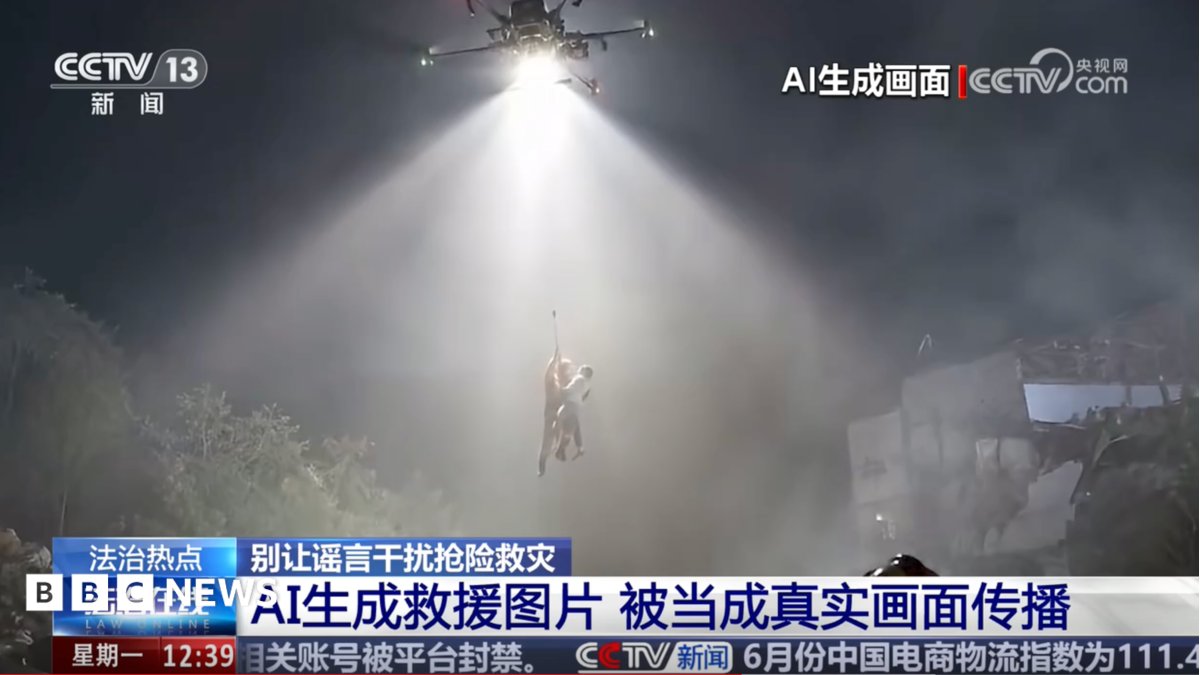
Typhoon Noul's landfall has exposed a critical vulnerability in China's digital landscape, where state-driven AI advancements are now fueling a surge of fabricated disaster content that undermines rescue efforts and public trust. As AI tools become more accessible, fake videos of nonexistent threats and misleading emergency scenes spread rapidly on social media, turning natural calamities into vectors for panic and confusion. This collision between technological ambition and governance challenges raises urgent questions about how Beijing can maintain control amid escalating crises.
China's AI Ambition Collides With Misinformation Crisis as Disasters Strike
Beijing, China —
The AI Misinformation Crisis During Natural Disasters
Typhoon Noul's landfall has highlighted an emerging threat for Chinese authorities: the rapid spread of AI-generated fake videos that distort rescue operations and trigger public panic. Content showing fabricated scenes of dead bodies in floodwaters, nonexistent crocodiles released into rivers after the Hengzhou snake farm flooding, and emergency responses that never occurred has flooded social media platforms. In some cases, false claims of power outages led residents to rush for emergency supplies, complicating already strained evacuation efforts.
The Technology Paradox in China's AI Strategy
China's 2017 declaration that artificial intelligence would serve as the main driving force of national progress has accelerated domestic investment on an unprecedented scale, positioning the sector as central to long-term technological supremacy. State-controlled reports indicate more than 6,000 AI companies now operate within the country, sustained by vast capital inflows that intensify competition among firms seeking state backing. This concentration of resources has lowered technical barriers for content creation, allowing individuals to deploy the same tools developed under national priorities for generating realistic but fabricated disaster imagery and video. The resulting accessibility creates direct tension between state ambitions for AI leadership and the immediate governance challenges posed by misuse during crises such as Typhoon Noul.
Professor Xu Xiaoke of Beijing Normal University has proposed building trusted information infrastructure, including official government early-warning systems and dedicated disaster interfaces accessible to approved news organizations. Such mechanisms could provide verified channels that bypass unmoderated platforms, yet their effectiveness hinges on overcoming the very public skepticism that past information controls have deepened. The Liulan Dam incident near Naning illustrates this paradox: authorities instructed journalists to describe a major structural failure merely as an opening or gap, even as downstream flooding proved deadly. This pattern of softening language, occurring alongside heavy AI investment, inadvertently widens the space in which fabricated content gains credibility.
The Trust Vacuum Created by Past Disaster Cover-Ups
The Liulan Dam breach near Naning in July exposed how official instructions to journalists to characterize a major wall failure as an opening or gap directly undermined public confidence. Downstream flooding caused at least 26 deaths, yet the deliberate softening of terminology left residents reliant on unofficial sources once the scale became evident. This episode forms part of a recurring pattern in which local authorities prioritize narrative control over transparent reporting, creating conditions where fabricated material encounters less resistance. When combined with the rapid dissemination of AI-generated visuals, such gaps in credible information allow misleading content to fill the void before verified updates can circulate.
In 2021, Henan province officials faced arrests after underreporting 139 fatalities during severe flooding, an event that further illustrated how concealment erodes institutional authority. These documented cases have produced a persistent trust vacuum that amplifies the impact of false narratives during subsequent emergencies. The Hengzhou snake farm flooding, which released hundreds of snakes, was followed by fabricated images purporting to show crocodiles released into rivers, an example of how real incidents become vectors for distortion when official channels lack credibility. Authorities must therefore contend not only with the technical ease of AI fabrication but also with the structural mistrust that grants such fabrications greater resonance among populations already conditioned to doubt state messaging.
The Legal and Enforcement Response Underway
Chinese authorities have introduced penalties that range from fines to detention and, in cases where misinformation produces serious consequences, up to seven years in prison. On 23 July the Cyberspace Administration directed local branches to target fabricated data, malicious editing, staged scenes, misattributed historical footage, and impersonation of officials, while requiring platforms to intensify content review. Zhejiang Police Department officials have noted that many creators fabricate material specifically to increase followers and views through sensational disaster coverage, distinguishing these actors from those who deliberately aim to provoke unrest. Ningbo Public Security Bureau representative Gao Kai has stated that the internet is not a lawless zone, announcing the formation of specialized task forces to monitor short video platforms and investigate cases swiftly.
Enforcement actions have already resulted in arrests and public punishments, yet the spectrum of motivations complicates uniform application. Some individuals publish false content for amusement without foreseeing harm, while others seek personal gain or intend to generate panic. Gao Kai has urged the public to approach unknown sources with skepticism and rely on official announcements during emergencies. The combination of publicized case outcomes, platform obligations, and graduated penalties reflects an attempt to deter misuse through both deterrence and education, though the speed at which new AI tools emerge continues to test the adaptability of these measures.
Expert Perspectives on the Detection Challenge
Scholars underscore the difficulties of keeping pace with technological change. Professor Chen Bin of the Communist Party Central Party School noted that AI lowers barriers so that individuals can generate realistic yet fabricated text, images, audio, and video at scale through simple prompts. Professor Gao Fuping from East China University of Political Science and Law identified motivations ranging from amusement to deliberate efforts at social unrest. Professor Xu Xiaoke of Beijing Normal University stressed that detection methods lag behind generation capabilities, describing an ongoing cat-and-mouse dynamic where geographic verification and source checks remain essential but insufficient alone. This lag underscores the need for proactive infrastructure like verified early-warning channels to counter the trust vacuum left by past cover-ups.
Global Implications for AI Governance Models
Shanghai and Washington-based lawyer Peter Pang has argued that platforms enabling distribution bear primary responsibility as enablers, alongside creators who must account for foreseeable harms. He illustrated this with a hypothetical scenario in which a person runs over a pedestrian after panic induced by a fake post: the creator cannot disclaim responsibility by claiming they did not directly cause the accident, because they established the foundation from which the reaction occurred. Pang has observed rising caseloads worldwide involving AI misuse, suggesting that legal systems everywhere must confront questions of intermediary liability and downstream consequences rather than focusing solely on individual posters.
Professor Xu Xiaoke has warned that detection technology continues to lag behind generation capabilities, describing an ongoing cat-and-mouse dynamic in which geographic verification and source checks remain necessary yet insufficient. He identified political elections, public health emergencies, armed conflicts, natural disasters, and livelihood issues as high-risk areas likely to see increased volume and speed of AI-generated misinformation. Rather than reacting after false content spreads, governments and platforms should prepare verification protocols in advance. While China’s approach emphasizes centralized enforcement, the underlying challenge of aligning rapid technological change with slower legal adaptation mirrors difficulties reported in the United States and European Union, where similar debates over platform accountability and preemptive safeguards are underway.
The Strategic Outlook for China's Information Control Model
Beijing's digital authoritarianism framework now confronts a structural test as it balances AI leadership ambitions against domestic stability requirements. Professor Gao Fuping advocated combining public education with enforcement and publicizing punishment cases, noting that existing laws suffice if applied consistently. Professor Chen Bin cautioned that legal frameworks evolve more slowly than the technology itself. Success will depend on building trusted information infrastructure, such as official early-warning interfaces accessible to approved media, while addressing the root mistrust that amplifies AI fabrications during crises. As detection tools struggle to keep pace, these measures will prove essential to closing the gap between innovation and control.
By Prof. Marcus Chen, Staff Writer
This article was produced with AI-assisted research and editorial support. Reporting is based on sources cited in the article.
What's Your Reaction?
 Like
0
Like
0
 Dislike
0
Dislike
0
 Love
0
Love
0
 Funny
0
Funny
0
 Wow
0
Wow
0
 Sad
0
Sad
0
 Angry
0
Angry
0

World Politics Analyst at Global1.News. Based in Beijing, covering US-China relations, global trade, and geopolitical strategy. Brings deep analytical perspective to the power dynamics shaping international affairs.













Comments (0)