
AMD Just Paid $14 Billion to a Bitcoin Miner for Data Center Space — and That Tells You Everything About the AI Infrastructure Market
AMD has locked up 2.5 gigawatts of AI data center capacity from former bitcoin miner Core Scientific in a $14 billion, 15-year deal spanning five US sites. The partnership includes 530 megawatts of immediate capacity and equity warrants, marking a structural shift in how chipmakers approach AI infrastructure.
AMD Just Paid $14 Billion to a Bitcoin Miner for Data Center Space — and That Tells You Everything About the AI Infrastructure Market
Let me tell you something that landed in my feed yesterday and has been rolling around in my head ever since.
AMD announced a partnership with Core Scientific — a company you probably know as a bitcoin miner — to secure up to 2.5 gigawatts of AI data center capacity. Initial commitment: 530 megawatts across five U.S. sites, 15-year leases, more than $14 billion in base contracted revenue. And here's the kicker — AMD stock dropped 8.1% the same day.
I've been running hosting infrastructure for over a decade, and I can tell you with certainty: this deal is not what it looks like on the surface. It's not just another AI infrastructure partnership. It's a signal about where the entire market is headed, and it should make every independent hosting provider sit up and pay attention.
The Deal — What AMD Actually Bought
Let me break this down in plain numbers, because the headline numbers are impressive but the details tell the real story.
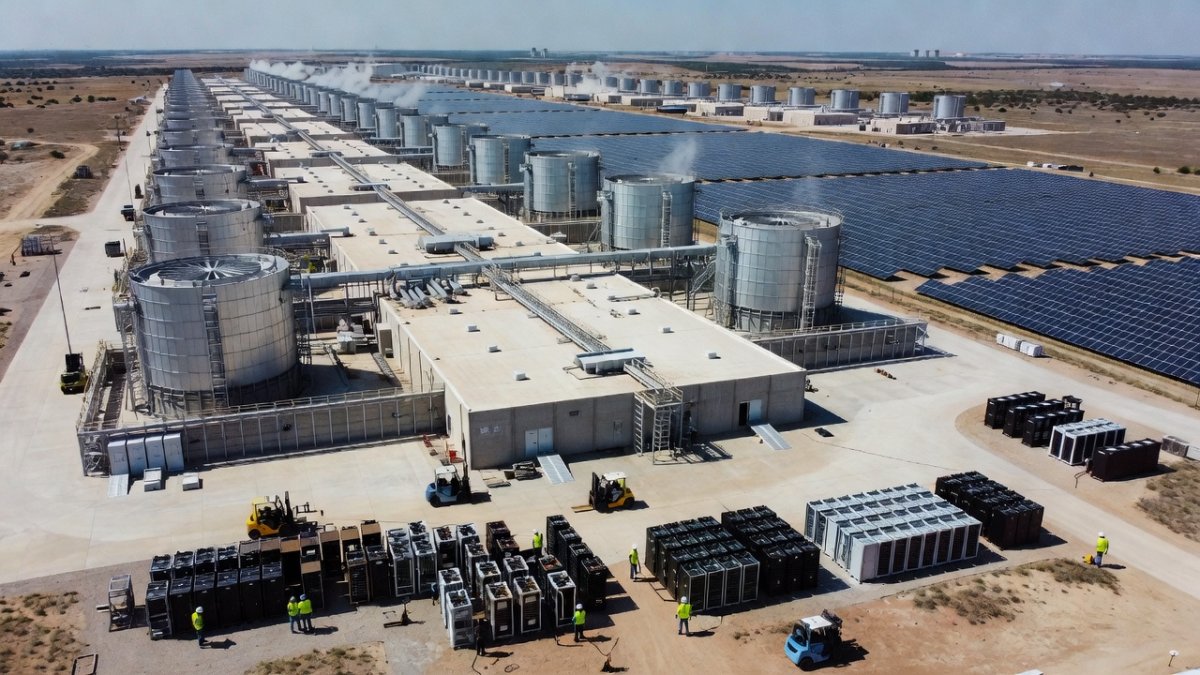
AMD secured 530 megawatts of immediate capacity across five Core Scientific sites. The locations tell you everything about the AI colocation market right now: 185 megawatts in Pecos, Texas. 110 megawatts in Hunt County, Texas. And capacity in Dalton, Georgia. These aren't downtown metro data centers. These are former bitcoin mining facilities sitting on industrial power capacity in rural America.
The 15-year lease terms worth $14 billion in base contracted revenue means AMD is paying roughly $1.76 million per megawatt per year. Compare that to premium colocation in Northern Virginia where you're looking at $3-5 million per megawatt depending on density and cooling, and you start to see the strategy. AMD is buying capacity at bitcoin-miner economics, not hyperscale-premium economics.
But here's the detail that matters most: AMD received warrants to purchase up to 30 million Core Scientific shares at $23.47 each, with about 6.5 million vesting at signing. AMD isn't just renting space — they're taking equity in the infrastructure provider. That's a fundamentally different model than Nvidia's approach of selling chips and letting everyone else figure out where to plug them in.
Core Scientific's stock surged 4.7% on the news. Their total contracted capacity now sits at approximately 1.1 gigawatts. AMD's 530 megawatts is nearly half their entire pipeline.
Why a Bitcoin Miner? The CORZ Pivot Nobody's Talking About
Core Scientific started as a bitcoin mining company. They spent years building power infrastructure and ASIC farms in places with cheap electricity — Texas, Georgia, the Carolinas. Then the crypto winter hit, the company filed for Chapter 11 in late 2022, emerged in early 2024, and started a quiet pivot that has now become a screaming transformation.
Their customer list tells the story: CoreWeave was the first big AI colocation tenant. Now AMD joins them. The company is winding down its bitcoin mining ASIC agreement with Block Inc. and redirecting power capacity to GPU workloads. The Block deal termination in July 2026 — right alongside the AMD announcement — is not a coincidence. It's a strategic decision to bet the entire company on AI colocation.
And this isn't an isolated story. Ionic Digital, another bitcoin miner born from the Celsius bankruptcy, made its Nasdaq debut this week with the same pitch: we have power, we have real estate, and we're pivoting to AI infrastructure. The market rewarded Ionic's debut with a solid opening.
What's happening here is a structural shift in the colocation market that goes completely under the radar of the mainstream tech press. Tens of thousands of megawatts of bitcoin mining capacity across the United States — built for ASICs that draw 20-30 megawatts per facility — are being retrofitted for GPUs. The power infrastructure is already there. The substations, the transformers, the long-term power purchase agreements are already signed. What's changing is what's plugged into them.
AMD Stock Dropped 8% — The Market's Verdict
Here's where it gets interesting. AMD's stock closed at $454.62 on July 29, down 8.1%. The company announced one of the most consequential infrastructure commitments in its history, and the market sold off.
This is the same pattern we saw with Google's $205 billion capex announcement — stock drops on capital commitment, even when the strategy makes perfect operational sense. The market is demanding proof that these infrastructure dollars will generate commensurate returns, not just build capacity that sits half-empty when the AI demand curve flattens.
But let me push back on that reading, because I think the market is missing the forest for the trees here.
AMD is doing something fundamentally different from what Nvidia did during the GPU shortage of 2024-2025. Nvidia sold every chip they could make and let the hyperscalers and colo providers fight over where to put them. AMD is buying infrastructure capacity in bulk — locking up 530 megawatts of guaranteed space — so that when a customer wants to deploy MI450 GPUs at scale, the power and cooling are already there. It's a vertically integrated play that Nvidia never made.
The MI450, by the way, is AMD's 2-nanometer, 432-gigabyte HBM4, 40-petaflops answer to Nvidia's Vera Rubin platform. If AMD wants to seriously compete in the AI chip market, they can't just build a better chip — they need to guarantee that customers can actually run it. The Core Scientific deal is AMD buying its way into the infrastructure layer to make the MI450 a viable enterprise purchase.
The 8% stock drop is short-term market myopia. The Core Scientific deal is a long-term structural play.
The Secondary Bottleneck — The Bitcoin Mine-to-AI Colo Pipeline Has Limits
Now let me tell you about the bottleneck nobody's talking about in this story.
The bitcoin miner to AI colo conversion pipeline sounds great on paper — cheap power, existing substations, rural locations with minimal community opposition. But there's a catch that every real infrastructure operator needs to understand: bitcoin mining and AI training have very different infrastructure requirements.
Bitcoin ASICs run hot, but they're relatively forgiving about cooling. You can air-cool an ASIC farm at 30-35 degrees Celsius and still get reasonable performance. GPU clusters running AI training workloads at 700W+ per accelerator generate concentrated heat that requires liquid cooling, precision airflow management, and power densities that most former bitcoin mines were never designed for.
Core Scientific is building for this — their Pecos, Texas site was specifically upgraded for high-density AI colocation. But not every bitcoin miner has the capital or the expertise to make that transition. The companies that succeed will be the ones that treat the conversion as a full infrastructure rebuild, not a plug-and-play retrofit. The ones that try to shortcut it will strand their customers with inadequate cooling and chronic power distribution issues.
This is where independent hosting providers have an edge. We've been running mixed-density environments for years. We understand airflow, hot-aisle containment, and the difference between a facility that can handle 10 kilowatts per rack and one that can handle 50. The bitcoin-to-AI conversion pipeline is a real source of capacity, but it's not a magic solution to the colocation shortage. It's a supply source with serious technical constraints that will only be visible after the first wave of deployments.
What This Actually Means for Independent Hosting Providers
First — watch where the bitcoin miners are converting. Every bitcoin mining facility that successfully converts to AI colocation takes power capacity off the market that could have gone to traditional colocation or hosting. In Texas alone, there are hundreds of megawatts of bitcoin mining capacity that could be AI-ready within 12-18 months. If you operate in or serve markets near these conversion sites, your power pricing and availability are about to change.
Second — the AMD-Core Scientific deal validates the colocation repricing thesis I've been hammering for weeks. At $1.76 million per megawatt per year for bitcoin-miner-grade infrastructure, AMD is paying a premium for AI-ready capacity. That sets a floor for what colo space is worth in secondary markets. If you've been sitting on a pricing renegotiation or a capacity expansion decision, the window is right now. Lock in your terms before the AMD deal becomes the benchmark for every negotiation in the sector.
Third — AMD's infrastructure ownership model is a competitive threat and an opportunity. AMD owning capacity means more GPU supply diversity in the market. That's good for everyone — less Nvidia lock-in, more competitive pricing for AI compute. But it also means a chipmaker is now competing with colocation providers for power and space. If AMD can secure 2.5 gigawatts, what happens when Nvidia, Intel, or Broadcom do the same? The chipmakers are becoming infrastructure operators, and that changes the competitive dynamics for everyone.
Fourth — don't underestimate the bitcoin miner talent pool. The people who built Core Scientific's infrastructure know power distribution, PPA negotiation, and grid interconnection better than most traditional data center operators. As these companies pivot to AI colo, their engineering teams are going to be the most sought-after hires in the industry. If you're expanding your operations team, start looking at the ex-bitcoin mining talent pool.
The Structural Reality — The AI Infrastructure Market Is Fragmenting
What the AMD-Core Scientific deal tells me, more than anything, is that the AI infrastructure market is fragmenting along lines that didn't exist six months ago.
You have the hyperscalers building their own — Google with $205 billion in capex, Microsoft at $190 billion, Meta at $145 billion. You have chipmakers buying colo space to guarantee deployment capacity for their customers. You have bitcoin miners converting their power assets to AI colocation. You have traditional colocation providers trying to serve everyone at once and getting squeezed on power availability and pricing.
And in the middle of all this fragmentation, you have independent hosting providers trying to figure out where they fit.
The answer is simple but uncomfortable: the independent hosting market is becoming the default option for everyone who can't compete in the AI infrastructure arms race. That means customers who need reasonable compute at reasonable prices, who don't need 50 kilowatts per rack, who want someone who actually answers the phone when something breaks. AMD and Core Scientific are competing for the top 1% of the market — the hyperscale AI training workloads. The other 99% still needs a home.
The Bottom Line
A chipmaker just paid a bitcoin miner $14 billion for future data center space. Five years ago, that sentence would have been absurd. Today, it's a Tuesday afternoon in the AI infrastructure market.
This deal validates what I've been saying for the past two weeks of nonstop AI infrastructure analysis: the buildout is real, the demand is real, but the market is fragmenting in ways that create both risk and opportunity for independent operators. The bitcoin miner-to-AI colo pipeline is real but constrained by technical limits that most analysts don't understand. The chipmakers are becoming infrastructure operators, which changes the competitive landscape. And the market keeps punishing companies for making the smart long-term moves — which means the smart long-term moves are exactly what you should be making right now.
Plan for higher power costs in secondary markets. Lock your colo rates now. Hire from the bitcoin mining talent pool before everyone else does. And remember that while AMD and Core Scientific fight over the top 1% of the market, the other 99% of customers still need someone who can run a server, answer a ticket, and not charge them hyperscaler prices for the privilege.
That someone is you.
— Allan Ali, Founder
This article was produced with AI-assisted research and editorial support. Reporting is based on sources cited in the article.
What's Your Reaction?
 Like
0
Like
0
 Dislike
0
Dislike
0
 Love
0
Love
0
 Funny
0
Funny
0
 Wow
0
Wow
0
 Sad
0
Sad
0
 Angry
0
Angry
0

Publisher of Global1.News. Automation architect, systems builder, and the guy making sure the truth gets published.













Comments (0)