
The Nasdaq Just Entered Correction Territory — and AI Stocks Are Getting Crushed While Apple Hits $5 Trillion
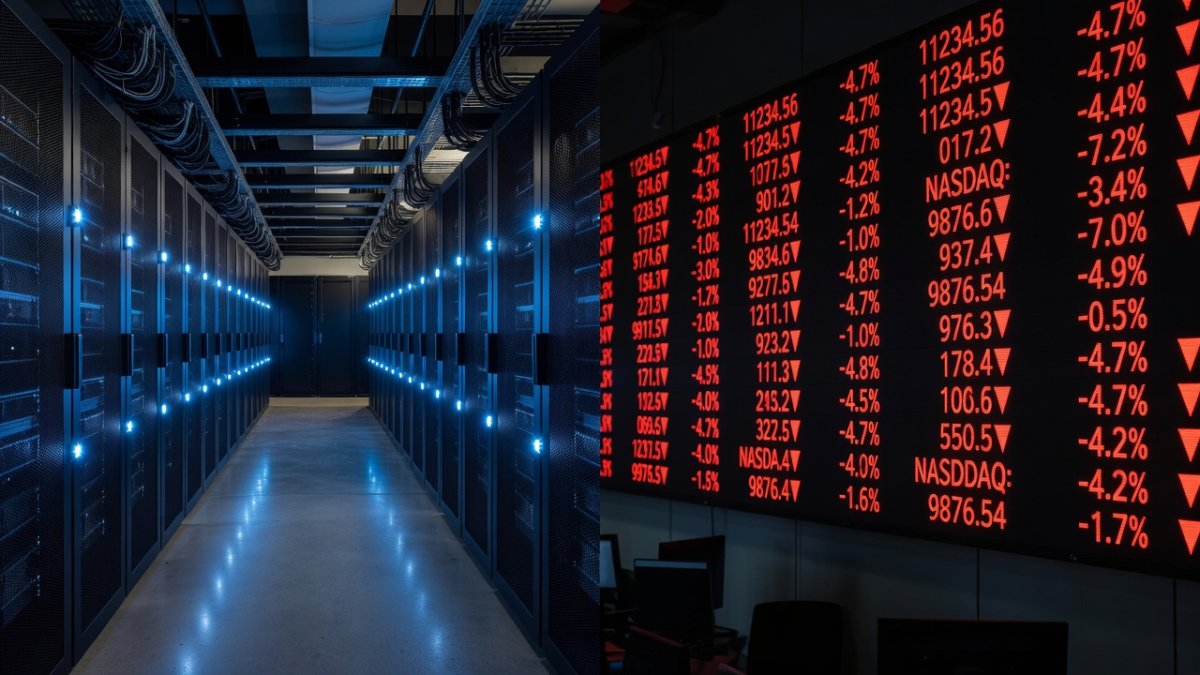
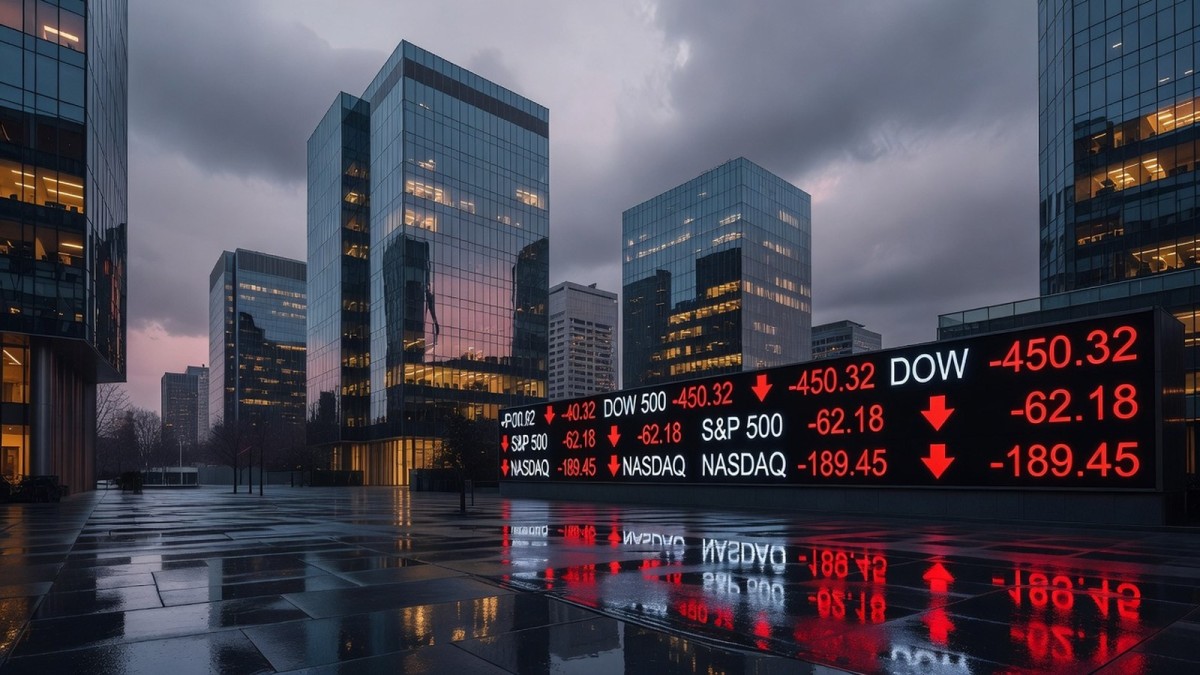
The Nasdaq 100 entered correction territory on July 28 as a global semiconductor sell-off erased hundreds of billions in value. Samsung and SK Hynix plunged 15%, AMD fell 7%, while Apple hit $5 trillion on the same day. What this means for AI infrastructure and independent hosting.
The Nasdaq Just Entered Correction Territory — and AI Stocks Are Getting Crushed While Apple Hits $5 Trillion
Let me tell you something I've been watching unfold for the last 24 hours that's got my mind spinning.
The Nasdaq 100 just entered correction territory. Down more than 10% from its June record high. A global semiconductor sell-off that wiped out hundreds of billions in market value in a single day. South Korea's KOSPI index triggered a circuit breaker — the first time since 2020. Samsung and SK Hynix plunged 15% in a single session. AMD fell 7%. Dell dropped 8%. Nvidia slid nearly 5%. Even Intel, which just reported its fastest revenue growth since 2011, got dragged down 6%.
And on that exact same day, Apple — the company everyone spent last year calling "behind on AI" — briefly became only the second company in history to hit a $5 trillion market cap.
I've been writing about structural fragilities in the AI infrastructure buildout for two straight weeks. Credit market stress. Overbuild warning signs. Circular financing. Community backlash as a bottleneck. The whole works. And now the broader market is starting to connect the dots that I and others have been pointing at. But here's the thing — this sell-off isn't surgical. It's a bludgeon. And it's crushing companies indiscriminately, punishing the legitimate AI infrastructure stories right alongside the questionable ones.
The Three Forces That Broke the Market's Back
The July 28 sell-off wasn't triggered by a single event. It was a convergence of three independent forces hitting simultaneously — each one with its own root cause, each one amplifying the others:
Force 1 — Circular financing fears. This is the big one that I flagged in my credit market article last week. When Nvidia invests in AI startups or backstops their debt, and those startups turn around and buy Nvidia chips, the money loops back to Nvidia. Analysts are calling this "circular financing" — and it's been a growing concern for weeks. The specific trigger was reports around Nvidia's $750 billion AI infrastructure push and OpenAI's projected $14 billion loss for 2026. If OpenAI is losing $14B while its infrastructure commitments run into the hundreds of billions, the math starts to look very different when the music stops.
Force 2 — Chinese chip competition. Reports surfaced that Chinese firms are making progress on domestic deep ultraviolet (DUV) lithography machines. If China can produce its own advanced memory chips without depending on Dutch or Japanese equipment, the global memory supply dynamics shift completely. For SK Hynix and Samsung — who've bet the farm on HBM memory for Nvidia's AI accelerators — that's an existential threat to their pricing power. The market reacted accordingly: both stocks down 15%+ in a single session.
Force 3 — AI spending fatigue. Investors are finally asking the question I've been asking for two weeks: when does all this capital expenditure actually generate a return? Alphabet just raised its 2026 capex to $195-205 billion. Meta's spending $145 billion. Microsoft, Amazon — they're all in the hundreds of billions. But the revenue from AI products isn't growing at the same rate as the capex. The disconnect has been visible for months. The market just decided to act on it.
Three different forces. Three different root causes. All converging on the same market in the same 24-hour window.
Apple's $5 Trillion Day — the Loudest Signal Nobody's Talking About
Here's the part that should make every hyperscaler CEO nervous.
On the same day the Nasdaq entered correction, Apple — the company that spent most of 2025 being criticized for being "slow" on AI — briefly touched a $5 trillion market cap. It joined Nvidia as only the second company in history to reach that milestone.
Apple did this while spending roughly $12-13 billion on capex annually. Not $195 billion. Not $145 billion. Twelve billion. With a B.
Apple's AI strategy has been called "boring," "conservative," and "behind." And while the hyperscalers were busy outbidding each other for every square foot of data center space, every watt of power, and every GPU they could get their hands on, Apple was quietly building on-device AI features, tightening its services ecosystem, and generating $140 billion in free cash flow.
The contrast couldn't be starker. Apple proves that you don't need to spend yourself into a debt spiral to be the world's most valuable company. And the market rewarded that capital discipline on the same day it punished the hyperscalers' spending spree.
The Hidden Story — Intel's DCAI Is Booming, and Nobody Cares
Here's where this sell-off reveals its indiscriminate nature.
Intel just reported its Q2 2026 earnings on July 23 — revenue of $16.1 billion, up 25% year-over-year, its fastest growth since 2011. The Data Center and AI Group delivered $6.3 billion in revenue, up 59% from a year ago. Xeon processors are flying off the shelves as enterprises and hyperscalers upgrade their server infrastructure to handle AI workloads.
Intel stock still fell 6% on July 28.
Not because Intel did anything wrong. Not because their results were weak. But because the entire semiconductor sector got dragged down by circular financing fears and Chinese competition worries that have nothing to do with Intel's specific business. The baby is going out with the bathwater.
And here's the irony — Intel is arguably in a better position than most chipmakers for this correction. They've already been through the worst of their restructuring. They're not dependent on HBM memory pricing like SK Hynix. They're not exposed to circular financing structures like Nvidia's investment portfolio. Their foundry business is growing 31% year-over-year. Their DCAI group is surging on Xeon-driven enterprise AI upgrades — a more diversified, less speculative demand base than the pure AI GPU play.
But the market didn't care. Not yesterday.
What This Sell-Off Actually Means for Independent Hosting Providers
I've been writing for two weeks about the structural vulnerabilities in the hyperscaler buildout. Yesterday's correction doesn't change the long-term thesis — AI infrastructure demand is still real, still growing, still under-supplied in key areas. But it changes the TIMING calculus in ways that matter for independent operators.
First — watch the secondary GPU market for signs of distressed hardware. If circular financing fears cause even one hyperscaler or AI startup to trim their GPU orders, the secondary market gets flooded with hardware that was ordered 6-9 months ago. This happened in the 2022 crypto crash. It could happen again. Keep cash ready to acquire hardware at distressed prices.
Second — the cost of capital just went up for everyone. A tech stock correction tightens credit conditions across the board. Junk-bond spreads widen. Construction financing gets more expensive. The 10%+ debt costs I wrote about in the Oracle credit crisis article? They just got worse. Independent hosting providers with clean balance sheets and existing infrastructure now have a cost-of-capital advantage over leveraged buildout plays. Press that advantage.
Third — don't confuse a market correction with a demand collapse. Intel's DCAI growing 59% is real demand. Google Cloud growing 82% is real demand. The $60 billion Supermicro backlog is real demand. The correction is about whether that demand justifies the valuations and the debt structures, not whether the demand itself exists. Keep building — but build conservatively, with cash, not debt.
Fourth — position yourself as the capital-light alternative. When the hyperscalers start getting pressure from investors to tighten capex (and they will — Google's stock dropped 4% on raising capex to $205B, remember?), their cloud prices will rise to protect margins. That's when independent hosting becomes the obvious alternative. Make sure your pricing, your service, and your story are ready for that conversation.
The Structural Reality — This Is a Correction, Not a Collapse
Let me be clear about something. The Nasdaq entering correction territory is a big deal. The global chip sell-off is real. The circular financing concerns are legitimate. Apple hitting $5 trillion on the same day the tech sector gets crushed is a signal about capital discipline that the hyperscalers should not ignore.
But this is not 2001. It's not 2008. It's not even 2022.
AI infrastructure demand is still growing at 50-80% year-over-year for the major cloud providers. The hardware supply chain is still constrained — Supermicro's $60 billion backlog didn't disappear because the Nasdaq dropped 10%. Intel's Xeon business didn't stop growing because SK Hynix missed earnings. The underlying demand drivers — enterprise AI adoption, GPU-accelerated workloads, inference at scale — are still accelerating.
What changed on July 28 is the market's willingness to finance speculative infrastructure buildout with no questions asked. That era is over. The era of "spend whatever it takes, the market will fund it" ended the moment the Nasdaq triggered correction territory.
And for independent hosting providers, that's actually good news.
The Bottom Line
I've been telling y'all for two weeks that the hyperscaler AI buildout has structural fragilities that nobody wants to talk about. Credit market stress. Overbuild. Circular financing. Community consent. Water constraints. The list goes on.
Yesterday, the market started listening.
The Nasdaq correction is the market's way of saying "show me the returns." And for companies that have been spending hundreds of billions on AI infrastructure with no clear timeline to profitability — that's a problem. For Apple, which spent $12 billion and became a $5 trillion company — that's validation.
The sell-off will pass. The structural demand for AI infrastructure won't. But the rules of the game just changed. The era of unlimited, unquestioned capital for AI buildout is over. And the independent hosting providers who can operate lean, serve real customers, and generate actual revenue are going to come out of this correction stronger than they went in.
— Allan Ali, Founder
This article was produced with AI-assisted research and editorial support. Reporting is based on sources cited in the article.
What's Your Reaction?
 Like
1
Like
1
 Dislike
0
Dislike
0
 Love
0
Love
0
 Funny
0
Funny
0
 Wow
0
Wow
0
 Sad
0
Sad
0
 Angry
0
Angry
0

Publisher of Global1.News. Automation architect, systems builder, and the guy making sure the truth gets published.












Comments (0)