
Japan and Australia Sign Quantum Technology Cooperation Pact
Japan and Australia signed a quantum technology memorandum in Sydney covering supply chains, R&D, commercialization, startups, and workforce development. The agreement completes a Quad-wide quantum framework. Japan has committed over 150 billion yen to quantum through 2030.
Japan and Australia Sign Quantum Technology Cooperation Pact
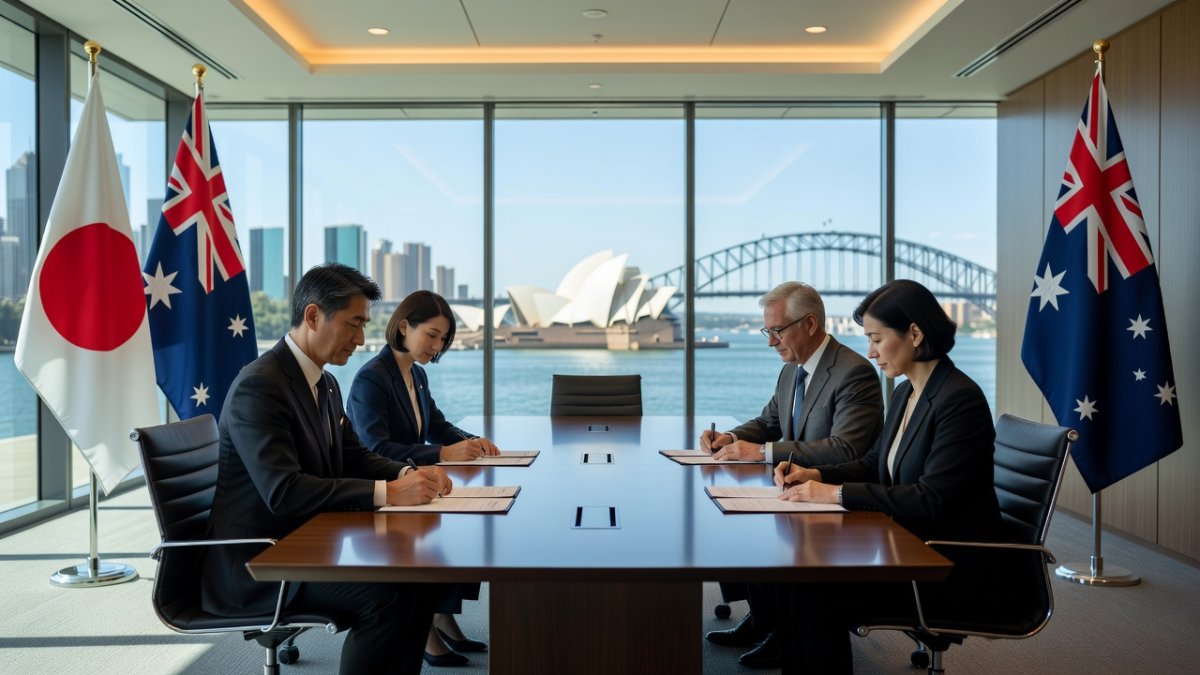
Tokyo — Japan and Australia have agreed to deepen cooperation on quantum science and technology, signing a memorandum of cooperation that spans supply chain resilience, research and development, commercialization, startup support, and human resource development. The agreement, signed in Sydney on Monday by Japanese Minister for Science and Technology Policy Kimi Onoda and Australian Minister for Industry and Innovation Tim Ayers, marks the latest step in Tokyo's strategy to build an international quantum network.
What the Memorandum Covers
The memorandum of cooperation on quantum science, technology, and innovation establishes a formal framework for bilateral collaboration across multiple dimensions of the emerging quantum sector. Both governments agreed to work together on supply chain resilience for quantum components, joint research and development initiatives, pathways to commercialize quantum discoveries, support for quantum-focused startups, and programs to develop a skilled quantum workforce.
Ayers emphasized the agreement's significance for the region. "This agreement will accelerate the spread of quantum technology in Japan and Australia and in the broader Indo-Pacific region," he said following the signing ceremony.
The MoC builds on the existing Special Strategic Partnership between the two countries, extending cooperation into an area that both governments view as critical to future economic competitiveness and national security.
The Quad Quantum Dimension
Japan has now signed similar quantum technology memorandums with the United States, India, and Australia — completing a Quad-wide framework for quantum cooperation. The development positions quantum technology as the latest domain of strategic coordination among the four Indo-Pacific democracies, following established cooperation on maritime security, infrastructure, and semiconductor supply chains.
Japan's Ministry of Foreign Affairs has identified quantum technology as a priority area for international science diplomacy, and the Quad quantum architecture gives Tokyo access to complementary research strengths across three partner nations. Australia brings deep expertise in quantum computing hardware through institutions such as the University of New South Wales and the Australian National University, while the United States leads in quantum algorithm development and India contributes growing capacity in quantum software and theory.
Japan's Domestic Quantum Investment
The international agreements reflect a broader strategic push at home. Japan's government has committed over 150 billion yen (approximately $1 billion USD) to quantum research and development through 2030, with some estimates placing the broader national quantum strategy at 1.05 trillion yen when private-sector contributions are included.
Japan's corporate quantum ecosystem is among the most developed in Asia. Fujitsu and the RIKEN research institute have already built a 256-qubit superconducting quantum computer, which became available to research institutions and companies this year. The National Institute of Advanced Industrial Science and Technology has ordered a gate-based superconducting quantum computer from Fujitsu designed to scale to hundreds of qubits. NTT is pursuing photonic quantum computing, while Toshiba maintains a leading position in quantum key distribution for secure communications.
The government-backed Quantum Innovation Initiative coordinates public-private research across these players, and the recently announced FugakuNEXT supercomputer project — a collaboration among RIKEN, Fujitsu, and Nvidia with a $740 million budget — will integrate quantum-classical hybrid computing capabilities when it targets operations by 2030.
Australia's Quantum Strengths
For Japan, the partnership with Australia offers access to research infrastructure and commercial pipelines that complement domestic capabilities. Australia's quantum ecosystem includes the Pawsey Supercomputing Research Centre, which has already launched a dedicated Japan-Australia quantum computing partnership, and the CSIRO, whose work spans quantum sensing, energy systems, and robotics.
The cooperation also opens channels for Japanese companies to participate in Australia's growing quantum commercialization landscape. Fujitsu has already established a partnership with the Australian National University to bring quantum computing capabilities to Australian researchers and enterprises, and the new government-level agreement is expected to accelerate further corporate tie-ups.
Ayers noted that the partnership would strengthen links between the two countries' quantum ecosystems by increasing opportunities for collaboration, investment, and commercialization — areas where Australia has identified Japan as a particularly valuable partner given Tokyo's aggressive public funding and its established corporate research infrastructure.
Supply Chain Resilience and Strategic Autonomy
The inclusion of supply chain resilience in the memorandum reflects a growing recognition among Quad nations that quantum components — including cryogenic cooling systems, specialized semiconductors, and photonic detectors — are subject to the same concentration risks that have disrupted semiconductor supply chains in recent years. Japan, which leads globally in certain precision manufacturing and materials science domains relevant to quantum hardware, is positioned as a critical node in any future quantum supply network.
The agreement calls for joint assessments of quantum supply chain vulnerabilities and coordinated approaches to building resilient sourcing channels. This aligns with Japan's economic security strategy, which has prioritized reducing dependence on single-source suppliers for strategic technologies since the passage of the Economic Security Promotion Act in 2022.
Implications for Japan's Technology Sector
For Japanese technology companies, the Australia agreement opens new commercialization pathways. Japan's quantum sector has historically been strong in research but slower to translate laboratory advances into market-ready products. The partnership with Australia — whose innovation ecosystem includes active venture capital and technology transfer mechanisms — could accelerate the commercialization of Japanese quantum discoveries.
Japanese startups in the quantum space, including QunaSys and other emerging firms, stand to benefit from expanded access to Australian research infrastructure and potential co-investment opportunities. The human resource development component of the MoC also addresses a pressing need: Japan faces a shortage of quantum-skilled engineers and scientists, and joint training programs with Australian universities could help close the gap.
What to Watch For
The memorandum is a framework agreement, and its impact will depend on the pace of implementation. The first joint projects under the MoC are expected to focus on quantum computing access — allowing Japanese researchers to use Australian quantum hardware and vice versa — and on supply chain mapping for quantum components.
With all four Quad members now linked by bilateral quantum agreements, the next logical step would be a multilateral quantum cooperation framework, potentially structured along the lines of the Quad Critical and Emerging Technology Working Group. Whether such a framework emerges may depend on the outcomes of pilot projects between Japan and Australia in the coming months.
For Japan, the agreement represents both a strategic hedge — diversifying its quantum partnerships beyond the United States — and an acknowledgment that the scale of the quantum challenge requires international collaboration. No single nation, including Japan, can build a complete quantum ecosystem alone.
By Kenji Tanaka, Staff Writer
This article was produced with AI-assisted research and editorial support. Reporting is based on sources cited in the article.
What's Your Reaction?
 Like
0
Like
0
 Dislike
0
Dislike
0
 Love
0
Love
0
 Funny
0
Funny
0
 Wow
0
Wow
0
 Sad
0
Sad
0
 Angry
0
Angry
0

Japan Correspondent at Global1.News. Tokyo-based voice covering Japanese politics, technology, economy, and culture. Tracks the intersection of tradition and innovation in one of the world's most dynamic societies.













Comments (0)