
Wang Yi's Mongolia Visit: Northeast Asian Geopolitics
Wang Yi's Mongolia Visit and the Geopolitics of Northeast Asian Balancing The Institutional Rhythm of China-Mongolia Relations Chinese Foreign Minister Wang Yi arrived in Ulaanbaatar on June 13, 2026, for a three-day visit that aligned with the established pattern of bilateral exchanges between Beijing and Ulaanbaatar. This timing reflected the predictable cadence of high-level
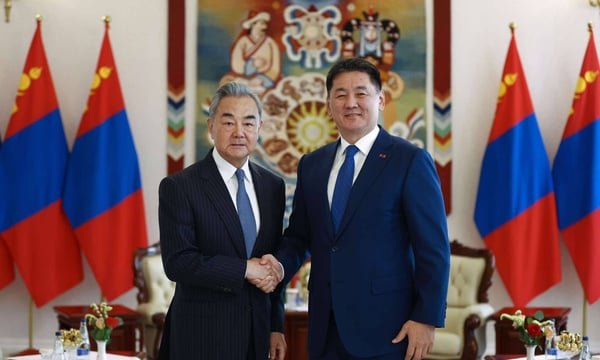
The Institutional Rhythm of China-Mongolia Relations
Chinese Foreign Minister Wang Yi arrived in Ulaanbaatar on June 13, 2026, for a three-day visit that aligned with the established pattern of bilateral exchanges between Beijing and Ulaanbaatar. This timing reflected the predictable cadence of high-level diplomacy that has characterized relations since the normalization of ties in the post-Cold War era. The visit occurred against the backdrop of Mongolia's recent political transition, which has introduced new leadership dynamics into the country's foreign policy apparatus.
Meetings with President Khurelsukh Ukhnaa, Prime Minister Uchral Nyam-Osoryn, and Foreign Minister Battsetseg Batmunkh produced a joint communiqué that reaffirmed commitments to regional development and postwar international order principles. Wang Yi also delivered a personal letter from President Xi Jinping to Khurelsukh, underscoring the personal dimension of the engagement. These elements illustrate how China approaches Mongolia as a strategic neighbor whose stability and orientation matter for Beijing's northern flank.
Concrete Outcomes in Infrastructure and Public Health
Discussions centered on the Gashuun Sukhait-Ganqimaodu railway project, which aims to improve mineral export routes from Mongolia's southern deposits into China. Border port upgrades were also addressed, alongside Chinese assistance for livestock disease control and the commissioning of the China-aided Ulaanbaatar wastewater treatment plant. These projects represent tangible deliverables rather than aspirational statements, focusing on connectivity and environmental infrastructure that directly affect Mongolia's economy and urban livability.
The June 15 meeting with Prime Minister Uchral coincided with Xi Jinping's birthday, an occurrence that carried symbolic resonance in Ulaanbaatar even if it was not formally highlighted in official statements. Uchral's subsequent participation in the World Economic Forum's Annual Meeting of the New Champions in Dalian further embedded the visit within Mongolia's broader calendar of international economic outreach. Preparation for hosting UNCCD COP17 in August 2026 added another layer of multilateral visibility to Mongolia's diplomatic schedule.
Mongolia's Third Neighbor Policy and Its Limits
Mongolia continues to pursue its Third Neighbor policy, which seeks to offset geographic dependence on China and Russia through diversified partnerships with Japan, South Korea, India, the United States, Turkiye, and Kazakhstan. This approach has historical roots in Mongolia's post-1990 effort to avoid becoming a buffer state once again. Japan's Emperor Naruhito conducted a historic state visit in July 2025, signaling Tokyo's willingness to engage at the highest level.
Foreign Minister Battsetseg's trip to Tokyo in June 2026 produced confirmation of a "Special Strategic Partnership for Peace and Prosperity." Japan indicated readiness to support expansion of Chinggis Khaan International Airport and to deepen cooperation on rare earths and critical minerals. These steps demonstrate how Mongolia leverages its resource base and geographic position to attract investment from democratic partners without directly challenging its two immediate neighbors.
South Korea's Parallel Balancing Experience
South Korea's own position as a middle power navigating relations between the United States and China offers instructive parallels. Since taking office in June 2025, President Lee Jae-myung has sustained diplomatic engagement with Mongolia, recognizing the country as a potential partner in resource security and regional connectivity initiatives. Korea's alliance with the United States provides a structural anchor that Mongolia lacks, yet both nations must manage economic interdependence with China while preserving strategic autonomy.
Where Mongolia relies on the Third Neighbor concept to create diplomatic space, Korea operates within a formal alliance framework supplemented by minilateral arrangements such as trilateral cooperation with the United States and Japan. This difference in institutional anchoring shapes how each country responds to Chinese diplomatic overtures. Korea's experience with major-power diplomacy, including its historical management of relations during periods of Sino-American tension, supplies analytical context for interpreting Mongolia's current maneuvers.
Regional Dynamics in Northeast Asia
Wang Yi's visit occurs within a Northeast Asian environment marked by overlapping security dilemmas and economic interdependencies. Mongolia's hosting of UNCCD COP17 in August 2026 positions it as a convening actor on environmental governance, an area where China has sought greater influence. The railway and port projects discussed during the visit could accelerate mineral flows that feed Chinese industrial supply chains, thereby tightening economic linkages even as Mongolia courts additional partners.
For South Korea, these developments carry implications for its own critical minerals strategy and its efforts to diversify supply sources away from concentrated dependence. The Gashuun Sukhait-Ganqimaodu railway, once operational, may alter logistics patterns that currently route through Russian territory, introducing new variables into regional transport economics. Such shifts affect not only bilateral ties but also the broader configuration of influence among Northeast Asian states.
Strategic Significance and Policy Implications
The visit underscores China's preference for steady, institutionalized engagement with Mongolia rather than dramatic gestures. By focusing on specific infrastructure and health projects, Beijing reinforces its role as the dominant economic partner while allowing Ulaanbaatar to maintain the appearance of balanced diplomacy. This calibrated approach mirrors patterns observed in China's relations with other smaller neighbors that possess strategic location or resources.
South Korea's policymakers will likely monitor how effectively Mongolia's Third Neighbor policy delivers concrete diversification, particularly in critical minerals and infrastructure financing. Historical precedents from Korea's own post-Cold War diplomacy suggest that sustained, multi-vector engagement can yield incremental gains in autonomy, though geographic realities impose enduring constraints. The interplay between Mongolia's outreach to Japan and Korea and China's project-specific diplomacy will continue to shape the contours of Northeast Asian geopolitics in the coming years.
By Prof. David Park, Staff WriterThis article was produced with AI-assisted research and editorial support. Reporting is based on sources cited in the article.
What's Your Reaction?
 Like
0
Like
0
 Dislike
0
Dislike
0
 Love
0
Love
0
 Funny
0
Funny
0
 Wow
0
Wow
0
 Sad
0
Sad
0
 Angry
0
Angry
0
East Asia/Technology Correspondent at Global1.News. Seoul-based voice covering Korean politics, technology, business, and culture. Analyzes how technology and geopolitics intersect across East Asia.











Comments (0)