
Israeli Settler Violence Intensifies in the Occupied West Bank: A Village Under Weekly Siege
In a recent BBC News report, Lucy Williamson documented the systematic weekly attacks on the Palestinian village of al-Mughayyir in the occupied West Bank — where teenage Israeli settlers, backed by soldiers, lay siege to homes with impunity.
In a recent BBC News report, Lucy Williamson documented the systematic weekly attacks on the Palestinian village of al-Mughayyir in the occupied West Bank — where teenage Israeli settlers, backed by soldiers, lay siege to homes with impunity.
Israeli Settler Violence Intensifies in the Occupied West Bank: A Village Under Weekly Siege
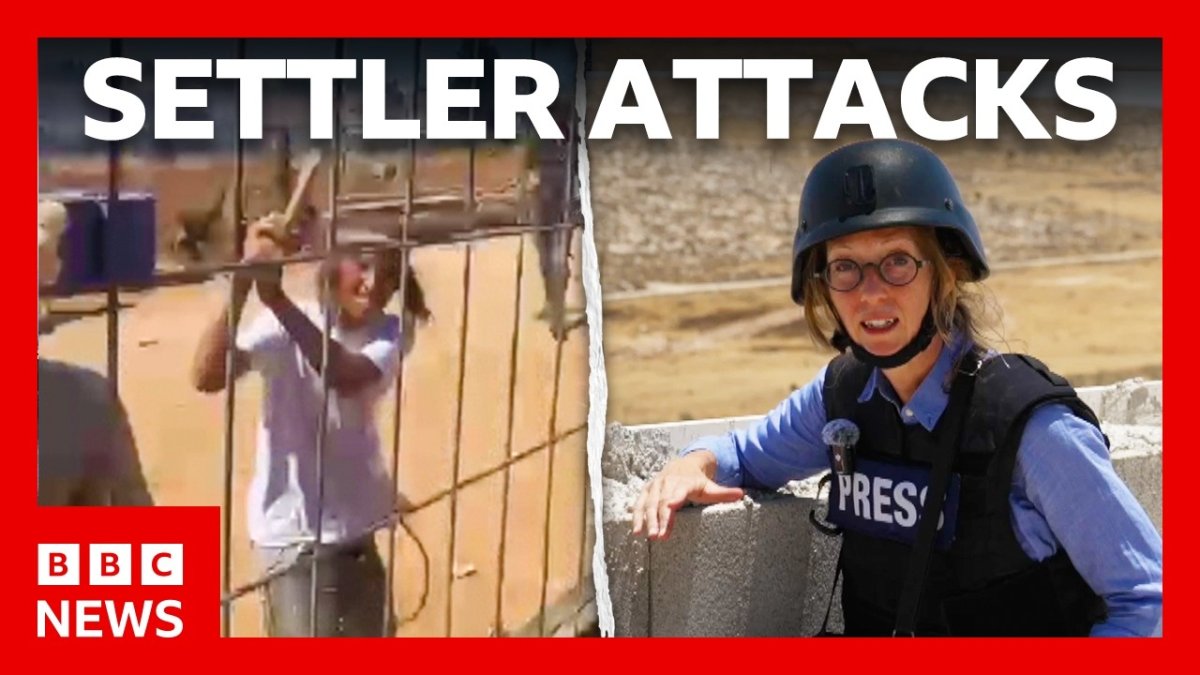
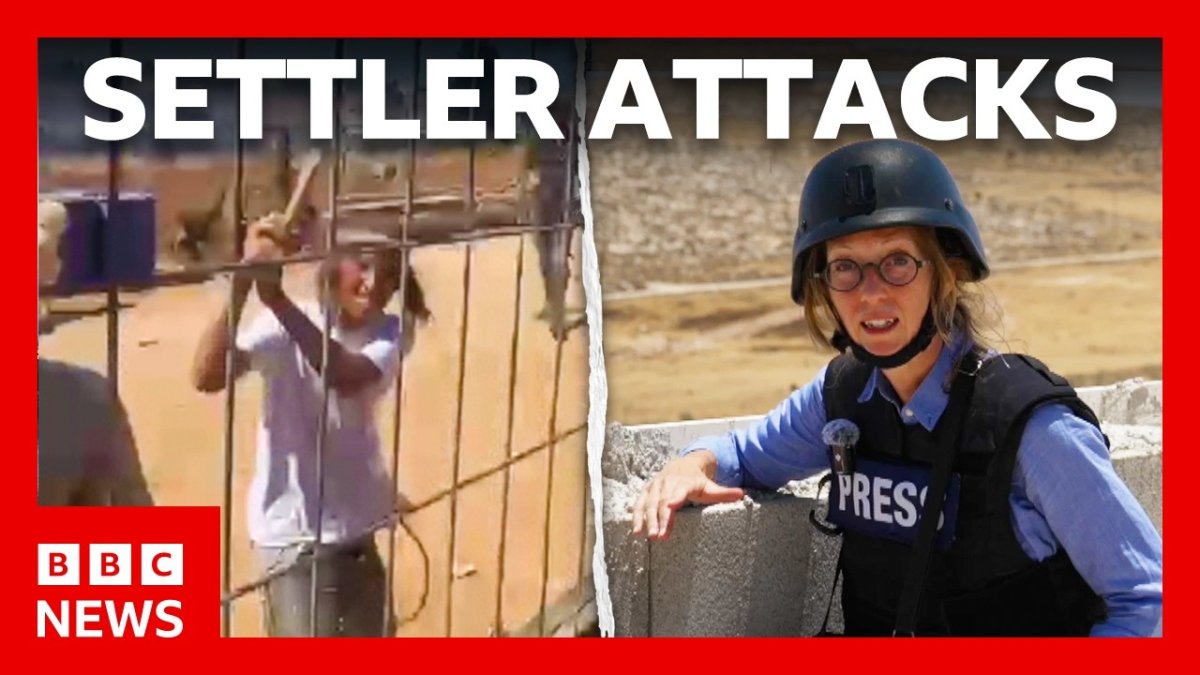
Al-Mughayyir, Occupied West Bank – 29 July 2026 — In the Palestinian village of al-Mughayyir, near Ramallah, the Abu Alia family has become the weekly target of armed Israeli settlers who arrive with clubs, backed by Israeli soldiers who watch and do nothing. The BBC's Lucy Williamson spent a week documenting a pattern of systematic violence that has become routine across the occupied West Bank — where settler attacks have surged to more than three per day, and where the line between the army and the settlers has all but disappeared. The embedded BBC News YouTube video captures the sequence of events in real time.
The Siege of al-Mughayyir: A Pattern of Impunity
The large, bolted gate of the Abu Alia family compound in al-Mughayyir village held firm against the teenage settlers; its thin metal bars ringing with each blow as they smashed it again and again with clubs. But this gate, on the edge of the village near Ramallah, has become far more than a single family's battleground. It is the weekly frontline in a systematic campaign of intimidation that has become routine across the occupied West Bank. Israeli soldiers stood by as the teenagers attacked — making no effort to detain them or confiscate their clubs. Footage obtained by the BBC shows soldiers strolling up to the attackers and making gentle moves to guide them away, an effort that proved wholly ineffective as the teenagers returned again and again to bash the gate.
An angle-grinder power tool visible in the footage passed between hands during the attack — photographed first with soldiers, then settlers, then soldiers again at the Abu Alias' fence. The IDF gave no explanation, saying only that it was investigating allegations of damage to property.
Rafeeq Abu Alia told the BBC: "First thing this morning, they came... There were four settlers and they were armed. Then more settlers came and laid siege to the house, insulting and provoking us. They came with the army. The soldiers entered, followed by the settlers. The army beat people inside the house."
Interpretations of the soldiers' restrained response suggest a deliberate policy of non-interference that effectively grants settlers operational freedom during these raids. This approach aligns with broader patterns where military presence serves more as a protective buffer than an enforcement mechanism, allowing attacks to escalate without immediate accountability. Such dynamics reinforce perceptions among Palestinian residents that state institutions prioritize settler security over maintaining order in mixed areas.
The circulation of the angle-grinder between military and civilian hands during the incident points to a logistical integration that blurs operational boundaries. Analysts view this as evidence of coordinated resource sharing rather than isolated misconduct, fitting into Netanyahu's characterization of the attackers as roughly 150 juvenile delinquents or 70 teenagers from broken homes. This framing downplays the organized nature of the sieges while shifting focus away from institutional support structures that enable repeated incursions.
Over time, these weekly confrontations erode the distinction between spontaneous youth violence and sustained territorial pressure. The pattern observed in al-Mughayyir illustrates how impunity operates through graduated tolerance, where initial non-intervention evolves into de facto endorsement of settler initiatives. This contributes to a cycle in which Palestinian communities experience escalating restrictions on movement and daily life without corresponding legal recourse.
The Deadly Toll
Medics from the Palestinian Red Crescent treated multiple residents for tear gas inhalation and beating injuries during the al-Mughayyir raid. One person was hospitalized with a gunshot wound. Seventeen-year-old Fadi Hamdallah al-Nassan, a player on the Palestinian national youth football team, later died from complications of that leg wound one week after the attack. Two additional Palestinians were killed in a separate settler assault the following day in a nearby location. The UN recorded 45 Palestinians injured by settlers in a single week, including 12 children. Injuries from such incidents have exceeded three per day since the start of this year.
The IDF stated that forces responded to reports of a confrontation, entered the house to search for stone-throwers, detained one person for participation in a violent riot, and fired to remove a threat, noting that a hit was identified. Rules of engagement were loosened after the 7 October 2023 Hamas attacks, permitting live fire against stone-throwers. Palestinian Red Crescent workers reported that soldiers took their ambulance keys, blocking medical access. One ambulance worker stated that when ordered to remain in place, personnel must comply and wait, describing this obstruction as routine.
Fadi al-Nassan's background as a national youth football team member underscores the generational reach of these casualties, transforming individual tragedies into symbols of disrupted futures for Palestinian communities. His death from a leg wound one week after the raid highlights how delayed medical complications compound the immediate violence, extending the human cost beyond the initial confrontation. This case fits into a wider statistical trend where injuries among minors have become normalized in weekly tallies.
The reported seizure of ambulance keys by soldiers during the raid represents a tactical barrier that systematically delays emergency response. Palestinian Red Crescent accounts describe this as a recurring practice rather than an exception, suggesting it functions as an informal control measure during operations. Such obstructions amplify mortality risks in areas already facing elevated violence levels, particularly when combined with loosened rules of engagement that permit live fire against stone-throwers.
Beyond al-Mughayyir, the daily average exceeding three injuries since the start of the year signals a structural shift in casualty patterns across the West Bank. The UN's single-week count of 45 injured, including 12 children, provides a snapshot of intensity that outpaces prior periods. Interpretations link this escalation to the post-October 2023 policy adjustments, which have lowered thresholds for the use of force and reduced external oversight on settler-military interactions.
The Settlement Machine
Two hundred thirty-one new settler outposts have been established since the current Israeli government took office in December 2022. Peace Now reports that these outposts now control 18 percent of the West Bank and have displaced more than 100 Palestinian communities. Israel has allocated 19 billion shekels, equivalent to 6.2 billion dollars, for settlement expansion and is seeking an additional 600 million shekels, or 196 million dollars. A 20-year ban on settlement activity in the Jenin area was lifted. Prime Minister Benjamin Netanyahu has described the attackers as 150 juvenile delinquents or 70 teenagers from broken homes, a characterization that contrasts with evidence of organized violence on the ground.
Hagit Ofran of Peace Now described the current phase as a race to expand settlements before October elections. Major General Avi Bluth, IDF West Bank commander, stated that farm outposts align well with the security concept when conducted ethically and legally. Construction has begun on new military sites in areas that fell under Palestinian control following the Oslo Accords. These developments occur against a backdrop of sustained financial and administrative support from the Israeli state.
Under the Fourth Geneva Convention, settlement activity in occupied territories is classified as illegal, a position reaffirmed in multiple international legal assessments. The establishment of 231 new outposts since December 2022, controlling 18 percent of the West Bank, represents a quantitative acceleration that challenges prior diplomatic frameworks. This expansion has displaced over 100 Palestinian communities, creating contiguous zones that limit future territorial contiguity for any potential Palestinian entity.
Russia and China have voiced explicit condemnations of these developments at the UN Security Council, framing them as obstacles to negotiated outcomes. In contrast, the United States position under the current administration has shown greater accommodation toward Israeli policy priorities, resulting in muted responses to outpost growth. This divergence at the international level reduces coordinated pressure on settlement financing, which includes the 19 billion shekels already allocated and additional requests for 600 million shekels.
The lifting of the 20-year ban on settlement activity in the Jenin area, alongside new military construction in former Oslo Accords-designated Palestinian zones, signals a strategic reorientation of control. Hagit Ofran's characterization of the current phase as a pre-election expansion race suggests that domestic political timelines are driving the pace. These moves collectively undermine the viability of the two-state framework by altering facts on the ground faster than diplomatic processes can respond.
Soldiers as Settlers, Settlers as Soldiers
Village council member Abu Waheed stated that the army is the settlers, but their clothes are green. Thousands of settlers were recruited into security squads after 7 October 2023 with minimal vetting; most were later disbanded following reports of abuse. An anonymous Israeli soldier described extremist settlers as teenagers who look at you with hate, adding that one told soldiers he would put a bullet in their head. The same soldier recalled seeing only fear in Palestinian faces and never fear among Jewish residents. Settlers operate with the perception that there is no law and can attack in broad daylight.
Settler Adar Lafair said they are the residents and are carrying out a conquest here. His wife Rivka expressed a dream that squads would be allowed to conquer a nearby Palestinian village. These statements reflect a broader shift in which civilian and military roles have become increasingly blurred in the occupied West Bank.
The post-October 2023 recruitment of thousands of settlers into security squads with minimal vetting illustrates an expedited integration strategy that prioritized rapid deployment over screening. Subsequent disbandment of most squads following abuse reports reveals the operational risks of this approach, yet the initial influx has already altered local power balances. This sequence demonstrates how temporary measures can produce lasting shifts in the composition of forces operating in Palestinian areas.
Abu Waheed's observation that the army and settlers differ only in uniform color captures a perceptual reality on the ground, where distinctions in authority appear nominal during confrontations. The anonymous soldier's accounts of extremist teenagers expressing direct hostility toward military personnel further complicate the chain of command, indicating that ideological motivations sometimes override formal hierarchies. Such testimonies suggest that state-settler integration extends beyond logistics into shared operational mindsets.
Statements from settlers like Adar Lafair and Rivka, framing their presence as an ongoing conquest and expressing ambitions to seize additional villages, reflect ideological commitments that align with expanded security roles. The disbandment process, while corrective, has not reversed the underlying fusion of civilian settlement activity with military functions. This integration reduces external accountability mechanisms and sustains the perception among settlers that legal constraints are minimal during daylight operations.
Geopolitical Implications
Settlements are illegal under the Fourth Geneva Convention. The UN count of 45 injured in one week, including 12 children, and the rise to more than three injuries per day this year mark a sharp escalation. Russia and China have condemned settlement expansion at the UN Security Council. The United States position under the current administration has been more accommodating to Israeli policy. West Bank violence is destabilizing the broader region as the Iran conflict and Gaza aftermath intersect. The two-state solution has become an increasingly remote possibility. October Israeli elections could reshape the trajectory of these developments.
The sustained rate of more than three injuries per day, documented by the UN across multiple weeks, contributes to regional instability by fueling cycles of retaliation that extend beyond the West Bank. Intersections with the ongoing Iran conflict and Gaza aftermath create overlapping flashpoints where localized settler violence can trigger wider escalations. This pattern reduces the margin for de-escalation efforts by external actors seeking to contain spillover effects.
The two-state solution faces structural erosion as settlement outposts consolidate control over 18 percent of the West Bank, fragmenting potential Palestinian territory. International divisions, with Russia and China issuing condemnations while the United States maintains a more accommodating stance, limit unified diplomatic leverage. These dynamics accelerate the shift toward unilateral facts on the ground that preempt negotiated borders.
October Israeli elections introduce a variable that could either intensify or moderate the current trajectory, depending on coalition outcomes. Pre-election expansion efforts, as noted by observers, indicate that domestic political incentives are currently aligned with continued outpost growth. This timing compresses the window for external interventions aimed at preserving conditions for a viable two-state framework amid rising casualties and institutional integration between settlers and security forces.
By Irina Volkov, Staff Writer
This article was produced with AI-assisted research and editorial support. Reporting is based on sources cited in the article.
What's Your Reaction?
 Like
0
Like
0
 Dislike
0
Dislike
0
 Love
0
Love
0
 Funny
0
Funny
0
 Wow
0
Wow
0
 Sad
0
Sad
0
 Angry
0
Angry
0
Russia/Eastern Europe Correspondent at Global1.News. Covering Russian politics, energy, security, and the shifting dynamics of the post-Soviet space. Provides clear-eyed analysis on one of the world's most opaque regions.












Comments (0)