
Japan's Incremental Rebalancing: Beyond the US-China Dual Hedge
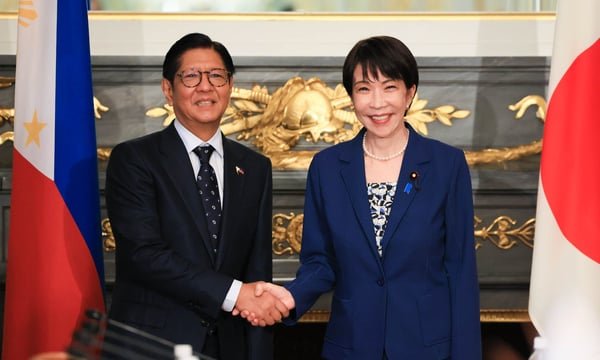
Japan's Shifting Diplomatic Posture Japanese Prime Minister Takaichi Sanae has pursued incremental adjustments to Tokyo's longstanding dual hedge approach, which has long combined security reliance on the United States with economic engagement with China. Recent meetings, including one with Philippine President Ferdinand Marcos, Jr. in Tokyo on May 28, 2026, reflect efforts to
Japan's Shifting Diplomatic Posture
Japanese Prime Minister Takaichi Sanae has pursued incremental adjustments to Tokyo's longstanding dual hedge approach, which has long combined security reliance on the United States with economic engagement with China. Recent meetings, including one with Philippine President Ferdinand Marcos, Jr. in Tokyo on May 28, 2026, reflect efforts to broaden partnerships beyond this framework. These steps occur against the backdrop of a Trump-Xi summit in mid-May that highlighted uncertainties in great-power relations.
Pressures on the Japan-U.S. Security Alliance
The source text notes persistent Japanese concerns over both abandonment and entanglement within the alliance. In March, U.S. President Donald Trump suggested Japan dispatch naval assets to the Strait of Hormuz, a proposal Prime Minister Takaichi Sanae rejected by citing the pacifist constitution. During the subsequent Trump-Xi summit, comments on Taiwan raised fresh doubts about Washington's commitment to the status quo in the Taiwan Strait, even as Trump reportedly defended Takaichi in talks with Xi.
Strains in Sino-Japanese Economic and Political Ties
Relations with China have featured sharp exchanges, particularly after Takaichi's November 2025 remarks describing a potential naval blockade of Taiwan as a survival-threatening situation that could require Japan Self Defense Forces mobilization. Beijing responded with strong rhetoric, including a social media post by the Chinese consul general of Osaka advocating violence against the prime minister. Economic measures followed, such as a call limiting trips to Japan that produced a 56.8 percent year-on-year drop in Chinese tourism in April, alongside a renewed import ban on Japanese seafood and restrictions on rare earth exports.
Expansion of Multilateral Security Frameworks
Tokyo has participated in initiatives that move away from the older hub-and-spokes model of U.S. alliances. Under the former Biden administration, the Quadrilateral Security Dialogue gained prominence, and two new trilateral frameworks were established that include Japan: one with the Philippines and another with South Korea. These arrangements indicate a gradual diversification of security ties even as the core U.S. alliance remains central.
Implications for South Korea's Diplomatic Positioning
South Korea faces parallel choices in managing relations among the United States, China, and Japan. The source text records Japan's trilateral security framework with South Korea, which could influence Seoul's own hedging calculations amid shared regional pressures. Economic interdependence with China remains vital for Korean industries, while security commitments to the United States continue to shape defense planning. Domestic political debates in South Korea over historical issues with Japan and supply-chain vulnerabilities tied to rare earth materials may intensify as Tokyo signals greater willingness to accept friction with Beijing.
Outlook for Regional Stability
Neither the Japan-U.S. alliance nor Sino-Japanese economic links appear poised for sudden collapse, yet the described trendlines have prompted Tokyo to pursue additional diplomatic options. South Korean policymakers will likely monitor these developments closely, weighing opportunities for coordinated multilateral engagement against the risks of heightened tensions affecting trade, tourism, and security cooperation in Northeast Asia.
By Prof. David Park, Staff WriterThis article was produced with AI-assisted research and editorial support. Reporting is based on sources cited in the article.
What's Your Reaction?
 Like
0
Like
0
 Dislike
0
Dislike
0
 Love
0
Love
0
 Funny
0
Funny
0
 Wow
0
Wow
0
 Sad
0
Sad
0
 Angry
0
Angry
0
East Asia/Technology Correspondent at Global1.News. Seoul-based voice covering Korean politics, technology, business, and culture. Analyzes how technology and geopolitics intersect across East Asia.














Comments (0)