
China's White Paper Charts Path for Equitable Global Governance Reform
China's White Paper Charts Path for Equitable Global Governance Reform The CGTN video explores the pressing need for updates to international institutions in light of shifting power dynamics and emerging challenges, setting the stage for China's recent contributions to this debate. On June 17, 2026, China's State Council Information Office released a 36-page white paper titled
The Urgency of Global Governance Reform
Global governance structures established after World War II face mounting pressure to adapt to contemporary realities, as highlighted in discussions around the CGTN video. The existing framework struggles to address interconnected crises ranging from economic inequality to technological disruption, prompting calls for systemic adjustments that reflect the distribution of economic power today. China's approach emphasizes gradual, consensus-based changes rather than abrupt overhauls, aligning with its broader foreign policy focus on stability and multilateral engagement.
Foreign Minister Wang Yi has consistently advocated for timely reforms through nine specific directions presented at the United Nations, underscoring the risks of inaction. These include updating decision-making bodies to prevent marginalization of key stakeholders. The white paper positions reform as essential for maintaining international order, particularly as developing nations increase their contributions to global growth without corresponding influence in rule-making processes.
Vice President Han Zheng reinforced this sense of urgency during his June 5, 2026, address at the St. Petersburg International Economic Forum, where he outlined implementation priorities that prioritize practical steps over rhetorical commitments. This framing connects reform efforts to China's domestic priorities of sustainable development and international cooperation, avoiding overstatements about immediate enforcement timelines.
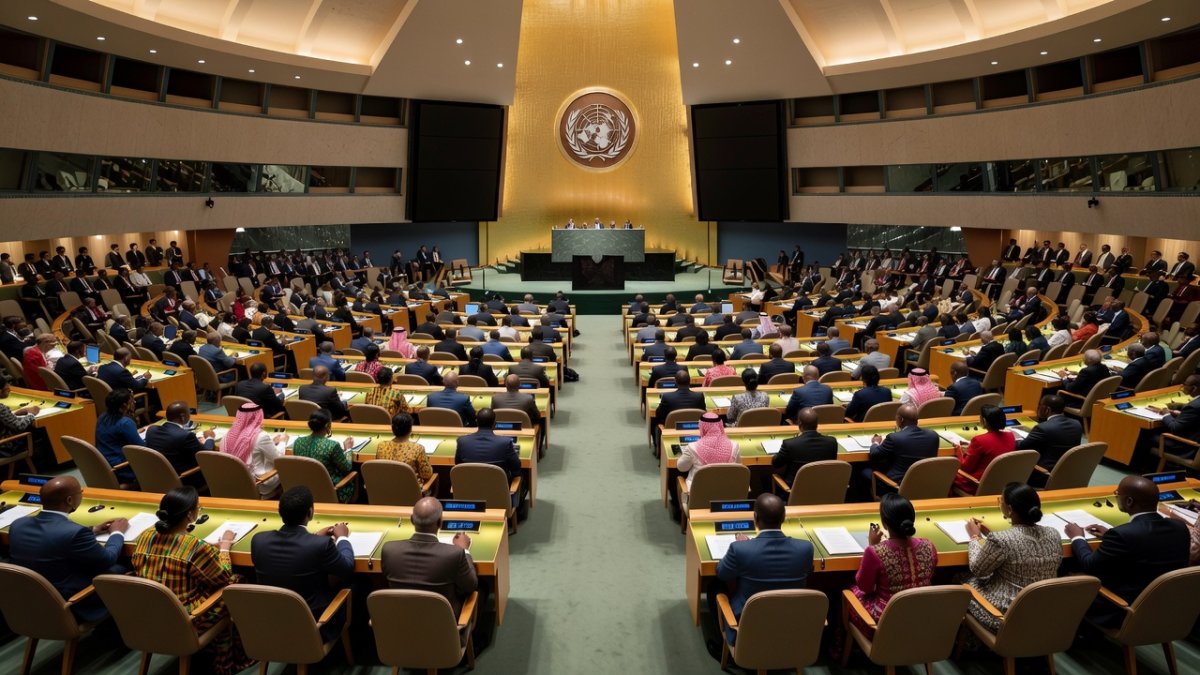
The United Nations General Assembly in New York. (Global 1 News)
The White Paper's Key Proposals
The white paper released by the State Council Information Office details China's principles for a more balanced international system, expanding on the Global Governance Initiative with concrete areas for action. It covers institutional adjustments at the United Nations and financial bodies while addressing gaps in technology regulation. The document avoids prescriptive mandates, instead presenting proposals that invite dialogue among member states.
Central to the white paper is the elaboration of four implementation priorities articulated by Vice President Han Zheng: equal cooperation, inclusive development, rule of law, and innovation-driven growth. These priorities guide China's engagement with partners, including deepened coordination with Brazil on multilateral issues. The proposals acknowledge limitations in current data on enforcement mechanisms, focusing instead on historical patterns of incremental reform.
By linking these ideas to China's strategic interests, the white paper illustrates how governance updates support broader objectives such as the Dual Circulation strategy, though specific operational details remain subject to ongoing diplomatic processes. This measured presentation reflects the Ministry of Foreign Affairs' emphasis on principled consistency in international forums.
UN Security Council Reform Dynamics
Reform of the UN Security Council remains a focal point in global governance discussions, with the white paper advocating expanded representation to better reflect geopolitical realities. Foreign Minister Wang Yi has included this among his nine reform directions, stressing the need for mechanisms that accommodate rising powers without destabilizing existing consensus procedures. The G4 group comprising Brazil, Germany, India, and Japan continues its campaign for permanent seat expansion, while the African Union pursues two permanent seats.
China's position supports measured enlargement that enhances legitimacy for the Global South, consistent with its advocacy at the Boao Forum for Asia 2026. This approach recognizes competing claims among aspirants and seeks to balance them through inclusive negotiations rather than unilateral pushes. Second-order effects could influence regional dynamics in Asia and Africa, where greater African representation might strengthen South-South coordination.
Strategic calculations here involve leverage through diplomatic networks, as China coordinates with Brazil to advance shared interests in multilateral forums. The white paper notes that such reforms must proceed via established UN channels to preserve institutional integrity, avoiding timelines that overstate near-term outcomes.
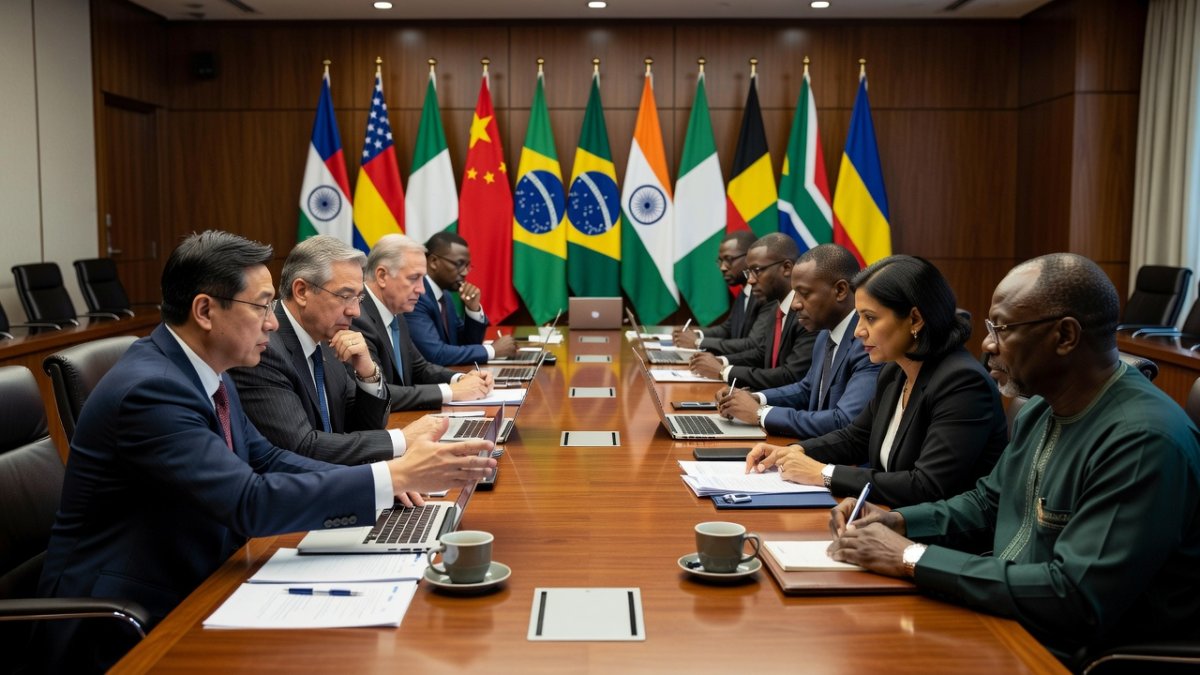
Diplomatic engagement on global governance reform. (Global 1 News)
Economic Governance and IMF/World Bank Reform
Adjustments to international financial institutions form another pillar of the white paper, with emphasis on quota reforms at the IMF to align voting power with current economic contributions. Foreign Minister Wang Yi has highlighted this direction as critical for fairness, noting that developing economies now account for a larger share of global output yet hold disproportionate influence in decision-making. The proposals connect to China's interests in stable financial systems that facilitate trade and investment flows.
Vice President Han Zheng's priority of inclusive development directly informs these economic governance suggestions, aiming to reduce asymmetries that disadvantage emerging markets. Coordination with Brazil exemplifies practical steps toward this goal, focusing on joint advocacy rather than isolated initiatives. Geopolitical analysis reveals that such reforms could generate second-order effects for the EU and ASEAN, potentially encouraging parallel adjustments in regional development banks.
The white paper acknowledges that implementation depends on multilateral agreement, with no assumption of rapid enforcement. This cautious stance aligns with the Ministry of Foreign Affairs' diplomatic record of promoting dialogue at forums like the Boao Forum for Asia, where Global South perspectives on economic representation have gained prominence.
Emerging Technology Governance
China has proposed establishing a dedicated global AI governance body as part of broader efforts to regulate emerging technologies, a theme addressed in the white paper alongside frameworks for cyberspace and outer space. Foreign Minister Wang Yi included AI governance, space governance, and related areas among his nine reform directions, recognizing the rapid evolution of these domains beyond existing treaty structures. The white paper stresses the importance of inclusive rule-making to prevent technological divides.
Vice President Han Zheng's innovation-driven growth priority supports these proposals by linking technology governance to equitable access and development benefits. China advocates strengthened mechanisms that incorporate input from developing nations, consistent with its engagement at the Boao Forum for Asia 2026. Strategic implications extend to the Global South, where enhanced participation could mitigate risks of exclusion from standards-setting processes dominated by advanced economies.
Analysis of leverage shows China drawing on its technological investments to promote cooperative norms, while second-order effects for the EU and ASEAN involve potential alignment or divergence in regulatory approaches. The white paper presents these ideas without claiming immediate operational details, reflecting ongoing diplomatic efforts through the Ministry of Foreign Affairs.
The Global South's Rising Role and Strategic Implications
The Global South's growing demand for systemic change, evident at the Boao Forum for Asia 2026, underscores the white paper's emphasis on greater representation in international institutions. China's Global Governance Initiative has resonated in these circles by prioritizing equal footing and inclusive development, fostering partnerships that amplify collective influence. Coordination with Brazil illustrates how bilateral ties can advance multilateral objectives.
Strategic calculus for major powers involves weighing the benefits of expanded participation against concerns over diluted authority, with China positioning itself as a bridge between established and emerging actors. Second-order effects could reshape dynamics within ASEAN and the EU, encouraging more responsive engagement with Global South priorities. The white paper connects these shifts to China's foreign policy doctrine of peaceful development and mutual benefit.
Overall, the proposals outlined in the document and advanced by Foreign Minister Wang Yi and Vice President Han Zheng point toward an international order that accommodates contemporary economic and technological realities through sustained dialogue. This approach prioritizes long-term stability over short-term gains, acknowledging the complexities of achieving consensus across diverse stakeholders.
By Prof. Marcus Chen, Staff WriterThis article was produced with AI-assisted research and editorial support. Reporting is based on sources cited in the article.
What's Your Reaction?
 Like
0
Like
0
 Dislike
0
Dislike
0
 Love
0
Love
0
 Funny
0
Funny
0
 Wow
0
Wow
0
 Sad
0
Sad
0
 Angry
0
Angry
0
World Politics Analyst at Global1.News. Based in Beijing, covering US-China relations, global trade, and geopolitical strategy. Brings deep analytical perspective to the power dynamics shaping international affairs.












Comments (0)