
China Grapples with AI-Generated Misinformation During Natural Disasters
China now confronts a dual crisis in which intensifying natural disasters coincide with the rapid proliferation of AI-generated falsehoods that erode public trust and complicate emergency response. Typhoon Noul and earlier flood events have exposed how synthetic media spreads faster than official corrections, turning routine crises into information battlegrounds.
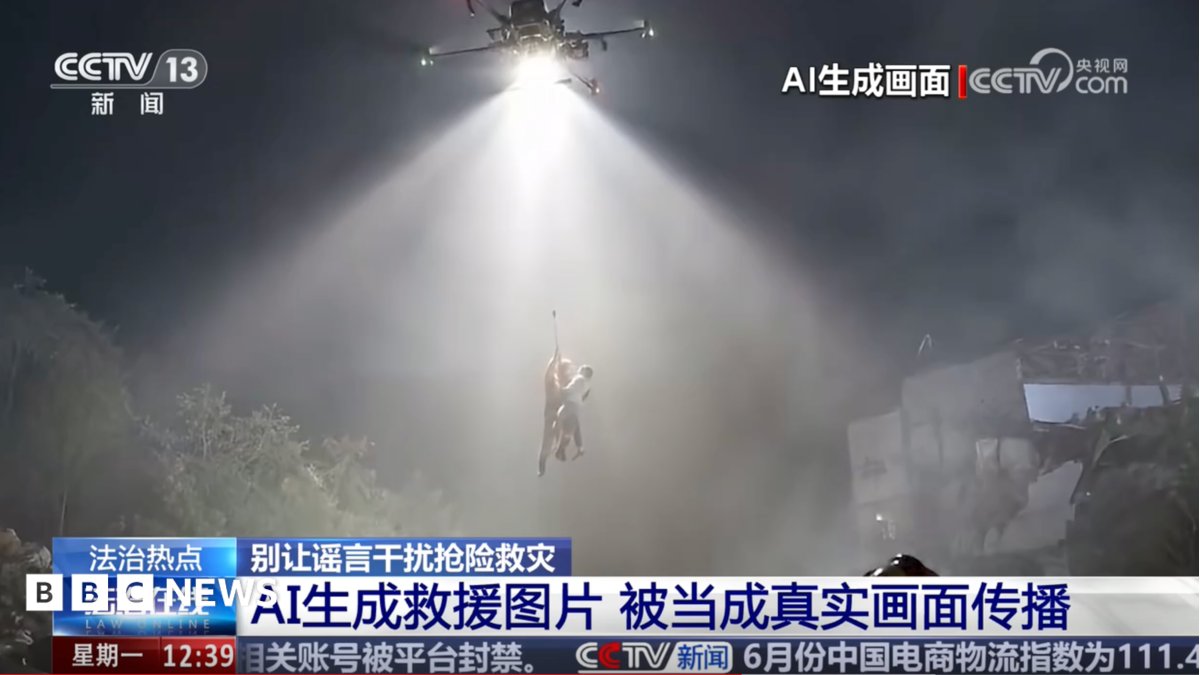
China now confronts a dual crisis in which intensifying natural disasters coincide with the rapid proliferation of AI-generated falsehoods that erode public trust and complicate emergency response. Typhoon Noul and earlier flood events have exposed how synthetic media spreads faster than official corrections, turning routine crises into information battlegrounds. This convergence tests the limits of the country’s long-standing strategy to harness artificial intelligence for national advancement while containing its disruptive side effects.
The Rise of Fabricated Content in Recent Flood Events
China faces mounting difficulties managing the spread of AI-generated misinformation as natural disasters occur with increasing frequency. Typhoon Noul's landfall over the weekend has drawn attention to this issue, where officials must address not only physical damage but also misleading videos circulating on social media. Past storms and flooding incidents have produced similar waves of false content, including depictions of dead bodies in floodwaters and claims of severe flooding in unaffected regions.
Concrete Examples of Misleading Videos and Their Effects
Recent cases demonstrate the tangible consequences of such fabrications. Videos falsely reporting power outages have triggered panic buying of emergency supplies among residents. In Hengzhou city, Guangxi, flooding in early July led to the escape of hundreds of snakes from a breeding farm, after which fake images appeared showing crocodiles being released into a river. These incidents illustrate how AI tools amplify sensational claims during crises, turning isolated rumors into coordinated waves of public alarm that strain local resources.
Official Views on Motivations Behind Content Creation
Huang Zhihua, Deputy Chief in charge of online public security for Zhejiang Police Department, explained to Chinese state media that many creators exploit disaster news to gain followers. Sensational or exaggerated material attracts more likes and views, prompting deliberate fabrication for attention. This pattern reflects broader challenges in maintaining accurate information flows during emergencies, where individual incentives align against collective stability.
AI Technology's Impact on Information Production
Prof. Chen Bin, writing in the newspaper of the Communist Party's Central Party School, observed that AI dramatically lowers technical barriers to producing false information. Individuals no longer need sophisticated skills, as simple prompts to AI tools can generate convincing text, images, audio, and video that appear realistic yet remain entirely fabricated. Such capabilities enable large-scale manufacturing of misleading material that outpaces traditional verification methods.
Range of Motivations Identified by Experts
Prof. Gao Fuping from East China University of Political Science and Law noted that motivations vary from creating something amusing to generating traffic for personal gain or deliberately causing panic and social unrest. These drivers complicate efforts to distinguish benign experiments from harmful interventions in public discourse, requiring authorities to calibrate responses according to intent and potential harm.
China's Strategic Embrace of AI Since 2017
The Chinese government has positioned AI as a central element of national progress since 2017, describing it as the main driving force behind the country's development. Xinhua reports indicate more than 6,000 AI companies operating within China. This strategic focus supports domestic innovation and broader foreign policy objectives tied to technological leadership, yet it simultaneously creates vulnerabilities when the same tools facilitate misinformation during disasters. China’s 2017 New Generation Artificial Intelligence Development Plan established a deliberate national architecture that democratized access to advanced generative tools through subsidies for chips, cloud infrastructure, and open-source repositories. The resulting ecosystem lowered barriers for both state and private actors, embedding AI within information operations in ways that now enable rapid fabrication of disaster imagery. This dual-use outcome stems directly from a sovereignty-driven model that prioritizes comprehensive technological independence over segmented controls.
China's AI Paradox: Innovation versus Misinformation
China’s pursuit of AI leadership since 2017 has generated a structural paradox in which the same policies that accelerate innovation also facilitate its misuse. State-backed funding and relaxed data rules have diffused powerful generative capabilities across society, allowing malicious actors to produce convincing deepfakes during floods or dam incidents. While official rhetoric emphasizes “AI for good,” the absence of narrow regulatory segmentation means that tools developed for disaster-response simulations readily serve fabricated content, creating a predictable tension between technological sovereignty and information security.
Trust Dynamics and Historical Information Handling
Official tendencies to downplay disasters have contributed to a trust vacuum that allows false content to flourish. In July, journalists received instructions to soften language around a dam breach near Nanning, where the Liulan Dam breach resulted in at least 26 deaths downstream. Earlier, in 2021, local officials in Henan province faced arrest for concealing or underreporting 139 deaths. The 2026 Liulan Dam episode repeated patterns from the Henan floods, as real-time videos on WeChat and Douyin contradicted state narratives and intensified skepticism when suppressed. The Great Firewall’s concentration of information control leaves any perceived gap between lived experience and official messaging immediately vulnerable to synthetic alternatives that appear locally sourced. This environment raises the political and technical costs of verification, allowing AI-generated material to gain credibility where official channels have already lost it.
Regulatory Measures Announced in July 2026
On 23 July 2026, China's Cyberspace Administration launched a nationwide crackdown on fake internet content related to floods and other disasters. Punishments include fines and prison terms reaching up to seven years. Police have established specialized task forces to monitor social media platforms, reflecting efforts to safeguard social stability amid technological disruptions. These measures extend the Cybersecurity Law, Data Security Law, and Personal Information Protection Law by treating generative AI output under existing prohibitions on fabricating false information, with seven-year sentences calibrated as signals rather than isolated punishments. Unlike Western approaches that rely on platform self-regulation or risk classification, Beijing’s framework holds platforms and users jointly responsible under centralized sovereignty, updating enforcement tools to match the sophistication of synthetic media.
Platform Accountability and Forward-Looking Strategies
Shanghai and Washington-based lawyer Peter Pang emphasized that platforms must face legal accountability as the primary enablers of such content. Prof. Xu Xiaoke from Beijing Normal University warned that AI-generated misinformation will likely increase in both volume and speed of spread. Rather than reacting after false information goes viral, governments and platforms should prepare preventive measures in advance to address these evolving threats. Under the 2017 Cybersecurity Law, platforms must maintain monitoring teams and report synthetic content within strict timeframes, contrasting with Section 230 immunity in the United States and the EU’s graduated risk assessments. Yet heavy pre-publication scrutiny has not eliminated generation on encrypted channels, revealing inherent limits: rapid removal succeeds for visible falsehoods but leaves upstream production untouched. Future governance will therefore need to reconcile China’s platform-responsibility model with lighter Western regimes to manage the global spread of synthetic disaster content.
By Prof. Marcus Chen, Staff Writer
This article was produced with AI-assisted research and editorial support. Reporting is based on sources cited in the article.
What's Your Reaction?
 Like
0
Like
0
 Dislike
0
Dislike
0
 Love
0
Love
0
 Funny
0
Funny
0
 Wow
0
Wow
0
 Sad
0
Sad
0
 Angry
0
Angry
0

World Politics Analyst at Global1.News. Based in Beijing, covering US-China relations, global trade, and geopolitical strategy. Brings deep analytical perspective to the power dynamics shaping international affairs.














Comments (0)