
China's Carrier Ambitions and the Shifting Security Landscape of Northeast Asia
China's Carrier Ambitions and the Shifting Security Landscape of Northeast Asia The Fujian Transit and Its Immediate Context The June 23 transit of China's third aircraft carrier, the Fujian, through the Taiwan Strait represents a notable demonstration of Beijing's expanding naval reach. Taiwan's Ministry of National Defense confirmed the passage and activated joint intelligenc
The Fujian Transit and Its Immediate Context
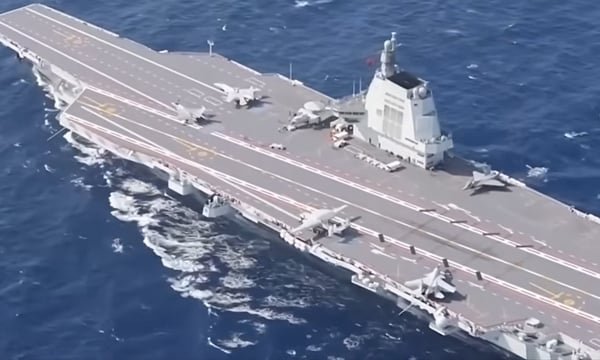
The June 23 transit of China's third aircraft carrier, the Fujian, through the Taiwan Strait represents a notable demonstration of Beijing's expanding naval reach. Taiwan's Ministry of National Defense confirmed the passage and activated joint intelligence, surveillance, and reconnaissance measures, releasing a high-altitude image showing no carrier-based aircraft on deck. Chinese authorities described the movement as routine training, signaling that similar operations would continue.
This event occurs alongside intensified Chinese maritime activities around Taiwan, including coast guard deployments. The Fujian's southward trajectory suggests potential future focus on the South China Sea, possibly coordinating with the Shandong carrier group. Such movements underscore Beijing's experimentation with integrated pressure tactics across naval, air, and law-enforcement domains.
Structural Constraints on China's Three-Carrier Force
Despite possessing three carriers—the Liaoning, Shandong, and Fujian—the People's Liberation Army Navy faces significant operational limitations. The Liaoning recently completed over 40 days of Western Pacific operations before returning to Qingdao. Yet the overall pool of carrier-based aircraft, qualified pilots, deck crews, and maintenance personnel remains insufficient for simultaneous full-scale deployments of all three vessels.
China's "small steps, fast running" modernization strategy has produced two incompatible carrier aviation systems. The Liaoning and Shandong employ ski-jump launches, while the Fujian uses electromagnetic catapults. This duality requires separate training pipelines, maintenance protocols, and operational doctrines, complicating efforts to achieve genuine three-carrier combat readiness. Industrial capacity for building airframes does not equate to the human capital needed for high-tempo sea-based aviation under divergent launch-and-recovery regimes.
Strategic Implications for the Korean Peninsula
China's carrier developments directly influence the military balance on the Korean Peninsula. North Korean planners monitor these advancements as indicators of shifting regional power, potentially adjusting their own missile and asymmetric strategies in response. A more capable Chinese carrier force could complicate U.S. and Republic of Korea contingency planning by threatening sea lines of communication and introducing additional variables into any conflict scenario involving the North.
Historical precedents, such as past Chinese naval exercises near the peninsula, illustrate how Beijing's maritime posture can indirectly embolden Pyongyang. The Fujian's transit, even if Taiwan-focused, signals growing Chinese ability to project power northward, affecting inter-Korean dynamics and deterrence calculations in Seoul.
Effects on the US-ROK Alliance
The limitations and ambitions evident in China's carrier program reinforce the centrality of the US-ROK alliance. Joint naval exercises between the United States and South Korea have increasingly incorporated carrier strike group integration to maintain credible deterrence. The coexistence of ski-jump and electromagnetic systems in China's fleet highlights persistent interoperability challenges that alliance planners can exploit through superior training and technology sharing.
Seoul's defense procurement decisions, including investments in Aegis-equipped destroyers and submarine capabilities, reflect awareness of these evolving threats. The alliance must now account for potential Chinese carrier presence in waters adjacent to the peninsula, necessitating enhanced real-time intelligence sharing and coordinated responses under the Mutual Defense Treaty framework.
Broader Northeast Asian Security Dynamics
China's carrier trajectory reshapes security interactions across Northeast Asia. Japan has accelerated its own Izumo-class conversions and F-35B acquisitions partly in response to Chinese naval expansion. This trilateral dynamic among the United States, South Korea, and Japan gains added urgency as Beijing develops multiple carrier ecosystems that could eventually support operations in the East China Sea or near Korean waters.
Regional institutions and bilateral dialogues, including those involving the Republic of Korea's Ministry of National Defense, must grapple with the strategic significance of these platforms. The Fujian transit illustrates both progress and constraints, suggesting that full operational maturity remains years away, yet the trajectory already influences alliance burden-sharing and arms control discussions.
Long-Term Outlook and Policy Considerations
China's carrier program will continue to test the resilience of Northeast Asian security arrangements. While the current personnel and training shortfalls prevent immediate three-carrier combat capability, incremental advances in pilot qualification and deck operations could narrow these gaps over time. For the Korean Peninsula, sustained alliance adaptation remains essential to preserve stability amid these developments.
Policy responses should prioritize realistic assessments of Chinese limitations rather than assuming rapid parity with established carrier powers. This measured approach allows the US-ROK alliance to focus resources on high-impact areas such as integrated air and missile defense while monitoring Beijing's evolving maritime posture.
Source: The Diplomat
By Prof. David Park, Staff WriterThis article was produced with AI-assisted research and editorial support. Reporting is based on sources cited in the article.
What's Your Reaction?
 Like
0
Like
0
 Dislike
0
Dislike
0
 Love
0
Love
0
 Funny
0
Funny
0
 Wow
0
Wow
0
 Sad
0
Sad
0
 Angry
0
Angry
0

East Asia/Technology Correspondent at Global1.News. Seoul-based voice covering Korean politics, technology, business, and culture. Analyzes how technology and geopolitics intersect across East Asia.














Comments (0)