
Same Day, Two Competing Visions for AI Infrastructure
The Same Day, Two Very Different Visions for AI Infrastructure — and One of Them Has 29 Countries Let me tell you about something that happened on July 16 that's been sitting heavy with me all weekend. Two announcements. Same day.
The Same Day, Two Very Different Visions for AI Infrastructure — and One of Them Has 29 Countries
Let me tell you about something that happened on July 16 that's been sitting heavy with me all weekend. Two announcements. Same day. Completely different visions for where AI infrastructure is headed.
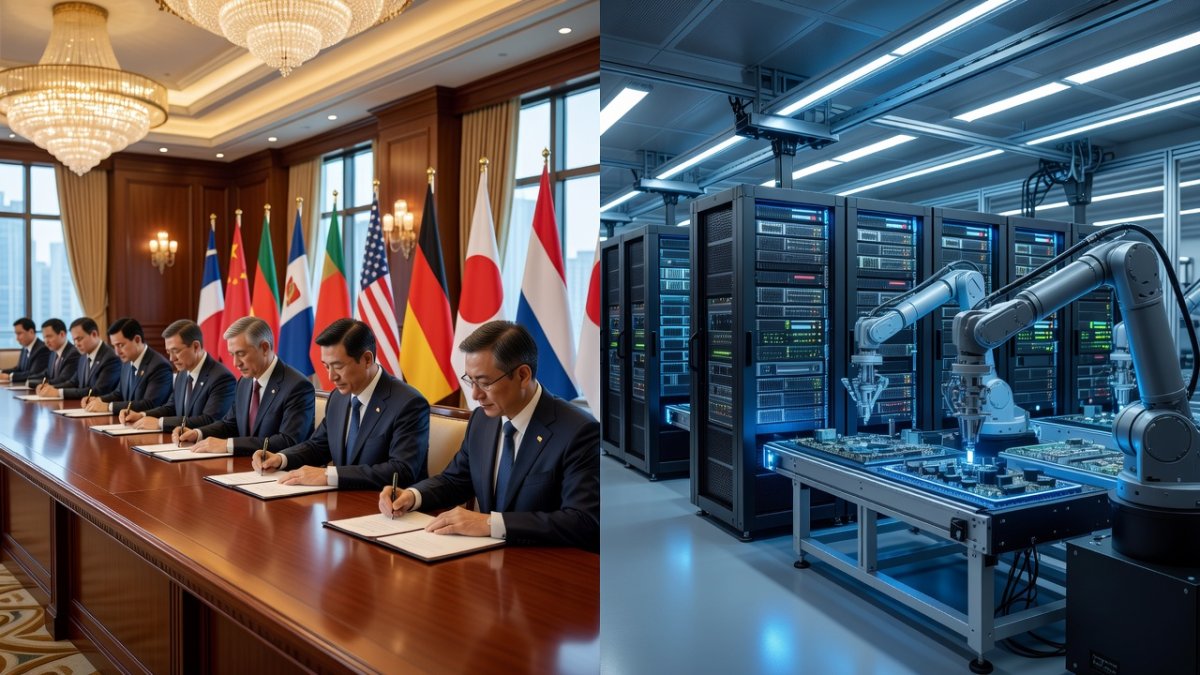
In Shanghai, 29 countries signed the agreement establishing the World Artificial Intelligence Cooperation Organization — WAICO — with Chinese Foreign Minister Wang Yi signing on behalf of Beijing and Xi Jinping personally unveiling it the next day at the World AI Conference. Russia's in. Brazil's in. Indonesia, Pakistan, Kazakhstan, 10 African countries, 12 Asian countries. The US and every G7 member? Nowhere to be seen.
On that same Thursday, on the other side of the Pacific, Jensen Huang stood in Tokyo and announced that Nvidia is building Japan the world's first national AI infrastructure — 27,500 Rubin GPUs, 13,750 Vera CPUs, a 140-megawatt facility purpose-built for physical AI, robotics, and what Huang called "the golden age of Japanese manufacturing."
These two stories — unfolding simultaneously, never referencing each other — tell you more about where the AI industry is actually headed than any earnings call or analyst report. And if you're running an independent hosting business, both of them should have you paying very close attention.
One Day, Two Different Visions for AI Infrastructure
Global — July 19, 2026 — Let me break down each vision, what it means, and why the gap between them matters for everyone running real infrastructure.
Vision One — WAICO: Government-Led, Multi-Nation, Open Source for the Global South
Here's what WAICO actually is. It's an intergovernmental organization headquartered in Shanghai, modeled loosely on the Asian Infrastructure Investment Bank — China's answer to a global governance structure it doesn't control. Twenty-nine countries signed the founding agreement on July 16. Xi Jinping framed it explicitly as "not a solo performance by a single country, but a symphony of international cooperation." That's a direct jab at the US, and everyone in that room knew it.
China pledged 5,000 AI training and seminar opportunities for developing countries. It promised open-weight AI models, technology sharing, and capacity building for nations that can't afford the $100 billion capex that the hyperscalers are pouring into AI infrastructure. Xi said WAICO would help prevent what he called "new historical injustices" — the idea that AI would create the same rich-poor divide that industrial technology created a century ago.
UN Secretary-General António Guterres showed up and warned that AI risks becoming "a monopoly of rich nations" — effectively endorsing the framing, if not the specific Chinese-led solution. The message was clear: if the West won't build accessible AI infrastructure for the developing world, China will.
And here's the thing — that message resonates. There are countries in Africa, Southeast Asia, and Latin America that cannot afford a single H200 cluster, let alone the 27,500 Rubin GPUs that Japan just ordered. For them, WAICO's promise of open-weight models and technology sharing is more than geopolitics — it's the only path to participating in the AI economy at all.
The Conspicuous Absence — No US, No G7, No Europe
Let me name the elephant in the Shanghai conference hall. Not a single G7 country signed the WAICO agreement. Not the United States. Not the United Kingdom. Not Germany, France, Italy, Canada, or Japan. The European Union didn't sign. Australia didn't sign. South Korea didn't sign.
This isn't an accident. The US has spent two years tightening export controls on advanced AI chips — the H200 restrictions were only partially lifted in December 2025 after the Trump-Xi meeting in May. The entire premise of WAICO is a direct challenge to the US-led AI governance model that the Biden administration started building with the Bletchley Declaration, the Seoul Summit, and the bilateral AI safety institutes.
So what you have is a bifurcated world. On one side, the US-led model: private-sector innovation, selective export controls, governance through alliances of like-minded democracies. On the other side, the China-led WAICO model: government-directed infrastructure, open-weight technology sharing, governance through a Shanghai-based multilateral institution with members from the developing world.
Neither model is purely altruistic. The US wants to maintain its technological advantage. China wants to build a parallel governance structure where it sets the rules. Both are using AI infrastructure as a tool of geopolitical influence. The difference is in the packaging — and the packaging matters because it determines who gets access to what.
Vision Two — Nvidia and Japan: Private-Sector, Single-Nation, Cutting-Edge Infrastructure
Now let me take you to Tokyo, where a completely different model unfolded on the exact same day.
Jensen Huang stood before an event hosted by Japan's Ministry of Economy, Trade and Industry and announced that Nvidia is building Japan's first national AI infrastructure. This isn't a cloud region. It's not a colocation build. It's a 140-megawatt AI factory architected with Nvidia Vera Rubin NVL72 racks, using the DSX platform and Spectrum-X Ethernet networking, purpose-built for what Nvidia calls "physical AI" — AI that moves robots, drives autonomous vehicles, and runs factory inspection lines.
The numbers are staggering. 27,500 Rubin GPUs. 13,750 Vera CPUs. Built by a Japanese company called Noetra Corp. The project is called FRONTia — short for "Development of Multimodal Foundation Models with a View to AI Robotics and Physical AI" — backed by METI, the Japanese government's industrial policy arm.
Japan is not joining WAICO. Japan is building its own AI infrastructure with American chips and Japanese industrial expertise. Toyota is expanding its AI collaboration. Japanese banks are adopting AI factories. Healthcare and robotics are being rebuilt from the ground up. This is the single-nation, private-sector-led model — and it's enabled by the same US chip export regime that WAICO is designed to circumvent.
The contrast couldn't be starker. WAICO promises open-weight models for countries that can't afford GPUs. Japan is buying 27,500 of the most advanced GPUs on the planet from a single American supplier. WAICO is about inclusion. Japan is about sovereignty. One is building a broad alliance of have-nots. The other is building a national crown jewel.
What This Actually Means for Independent Hosting Providers
Now let me bring this down to earth, because if you're running a hosting business — whether it's bare metal, VPS, or colocation — you're probably wondering what a Shanghai governance body and a Tokyo AI factory have to do with your monthly P&L. The answer, unfortunately, is a lot.
First — the WAICO model will accelerate the availability of open-weight AI models in developing markets. That means demand for inference hosting in Southeast Asia, Africa, and Latin America is going to grow faster than most people expect. If you have infrastructure in those regions, you need to be ready for customers who want to run Chinese open-source models like Qwen, DeepSeek, or whatever WAICO's technology-sharing pipeline produces. This is not a hypothetical — China already has the largest open-source AI model ecosystem outside the US, and WAICO is going to supercharge its distribution.
Second — the Japan model confirms that high-tier AI infrastructure is consolidating around a small number of hyperscale projects. Japan is spending billions on a single 140MW facility. That's capacity that isn't available to anyone else. The Vera Rubin NVL72 racks in Tokyo are not going to be resold on the colocation market. This is the same dynamic I wrote about in the colocation squeeze article — the best infrastructure is being pre-allocated to the biggest players before it even comes online. If you need GPU capacity for inference workloads in 2027, you need to be negotiating now, not next year.
Third — the geopolitical bifurcation creates actual supply chain risk. If WAICO becomes a real governance body with teeth — and that's a big if, given that it has no US or European members — it could develop its own AI chip supply chains, its own AI safety standards, and its own data governance rules. That would create de facto technical standards divergence. A hosting provider running workloads from both WAICO-member and non-member countries would need to navigate two sets of rules. That's administrative overhead you don't have today and will need to budget for tomorrow.
Fourth — the 5,000 training slots Xi pledged are going to create a pipeline of AI-literate developers and operators in countries that currently have very few. That's a long-term positive for hosting providers in those regions. More AI talent means more demand for compute. The question is whether the infrastructure to serve that demand will exist — and whether independent providers can fill the gap before the hyperscalers or Chinese state-backed operators get there first.
The Structural Reality — Two Parallel AI Ecosystems Are Forming
Here's what I see happening, and I've been watching this space for over a decade.
We are witnessing the early stages of two parallel AI ecosystems. One centered on the US-Japan axis, built on cutting-edge proprietary hardware, funded by private capital and national industrial policy, serving advanced economies. The other centered on the China- emerging markets axis, built on open-weight models and technology sharing, funded by state-backed development finance, serving the Global South.
These two ecosystems aren't fully separate today. The US still sells chips to China — the H200 restrictions were partially lifted. China still builds AI models that run on Nvidia hardware. WAICO's founding members include countries that also participate in US-led AI governance initiatives. But the direction of travel is toward separation, not integration, and July 16, 2026, was the clearest signal yet of that trajectory.
For independent hosting providers, this creates both risk and opportunity. The risk is that you end up caught between two incompatible regulatory and technical regimes — forced to choose which ecosystem to serve. The opportunity is that neither ecosystem is going to build enough infrastructure fast enough to meet demand. The hyperscalers and state-backed operators will focus on the top of the market — the 140MW factories, the massive training clusters, the flagship national projects. Everything below that — the inference workloads, the small-scale deployments, the regional demand — is where independent providers live.
The question is whether you're ready for the world that July 16 started creating.
The Bottom Line
Two announcements. Same day. One offering inclusion for the Global South. One building a national crown jewel in Tokyo. One driven by Chinese statecraft. One driven by American technology and Japanese industrial policy.
Neither is wrong. Both are rational responses to the same fundamental reality: AI is the most important infrastructure build of our generation, and every country — whether it has 27,500 GPUs or 5,000 training slots — is trying to figure out how to participate.
But here's what I know from running infrastructure for over a decade. The people who win in a bifurcated market are the ones who understand both sides. If you're only watching the US-Japan axis, you'll miss the fastest-growing demand wave in the developing world. If you're only watching WAICO, you'll miss the technological frontier that the Rubin GPUs in Tokyo represent.
Watch both. Plan for both. Because neither ecosystem is going to slow down.
— Allan Ali, Founder
This article was produced with AI-assisted research and editorial support. Reporting is based on sources cited in the article.
What's Your Reaction?
 Like
0
Like
0
 Dislike
0
Dislike
0
 Love
0
Love
0
 Funny
0
Funny
0
 Wow
0
Wow
0
 Sad
0
Sad
0
 Angry
0
Angry
0
Publisher of Global1.News. Automation architect, systems builder, and the guy making sure the truth gets published.











Comments (0)