
Detroit AQI 222: Canadian Wildfire Smoke Crisis Hits US
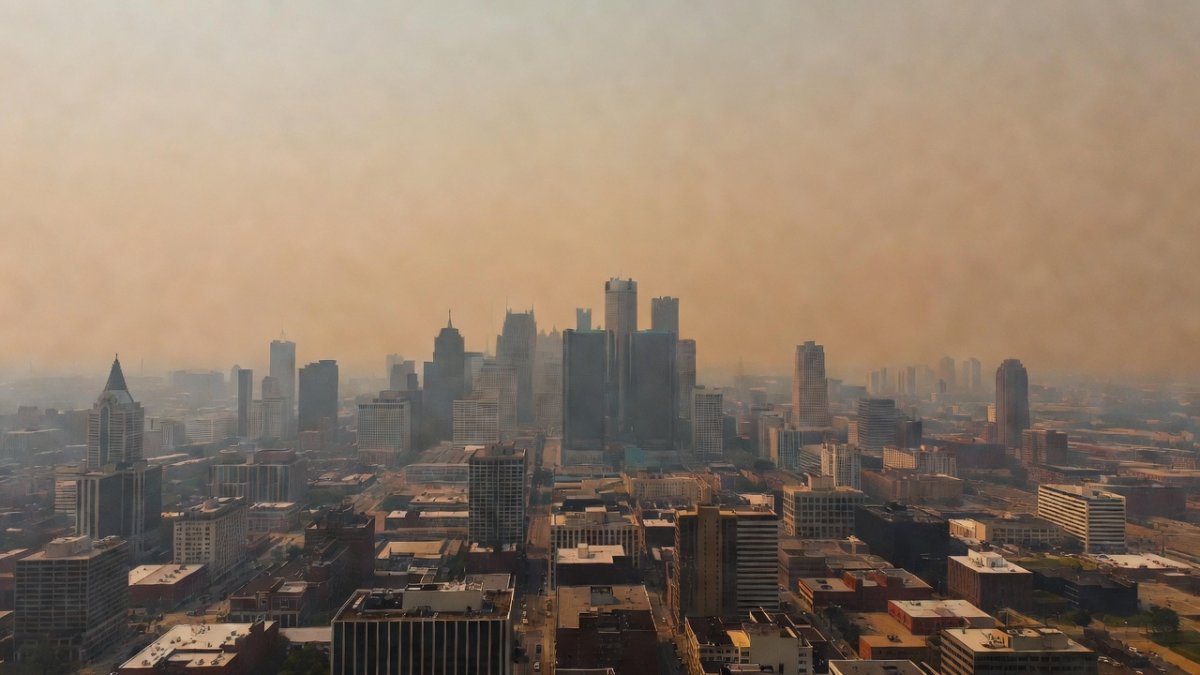
Detroit, Michigan has recorded the worst air quality of any city on Earth, with an Air Quality Index (AQI) of 222 on July 17, 2026, as smoke from more than 850 active wildfires burning across Canada blankets the US Midwest and East Coast. Over 190 fires in Ontario alone have turned skies an apocalyptic orange from Michigan to New York, triggering Code Purple health alerts and forcing millions of Americans to shelter indoors. The crisis has also sparked a diplomatic row, with President Donald ...
Detroit, Michigan has recorded the worst air quality of any city on Earth, with an Air Quality Index (AQI) of 222 on July 17, 2026, as smoke from more than 850 active wildfires burning across Canada blankets the US Midwest and East Coast. Over 190 fires in Ontario alone have turned skies an apocalyptic orange from Michigan to New York, triggering Code Purple health alerts and forcing millions of Americans to shelter indoors. The crisis has also sparked a diplomatic row, with President Donald Trump threatening to add the cost of the pollution to tariffs on Canada.
Detroit, Michigan – July 19, 2026 —
Detroit Records Worst Air Quality Globally as Canadian Wildfire Smoke Blankets US Midwest and East Coast
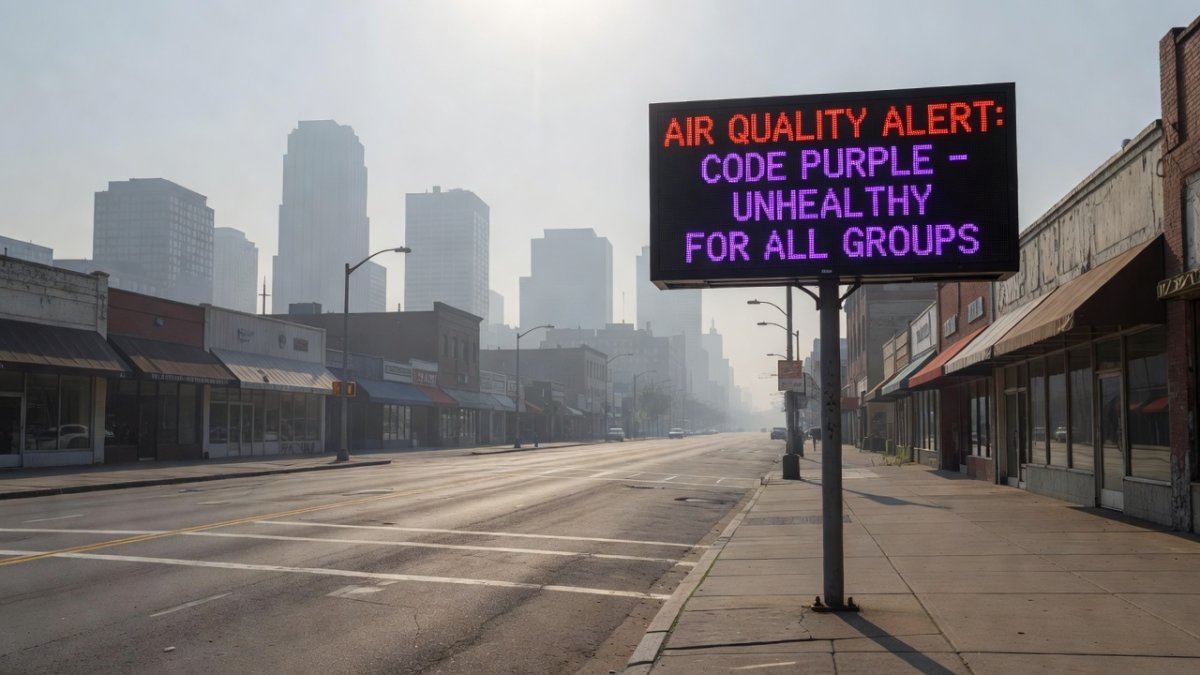
Detroit, Michigan – July 19, 2026 — The city of Detroit recorded an Air Quality Index (AQI) of 222 on July 17, 2026, the worst reading of any city in the world according to Swiss air quality monitoring firm IQAir. The hazardous conditions were caused by thick smoke from over 850 active wildfires burning across Canada, with 113 of those listed as out of control. The smoke travelled south across the US border, blanketing major cities including Chicago, Washington DC, and New York, triggering Code Purple air quality alerts and forcing millions indoors. Washington DC reached 175 (Code Purple 'very unhealthy'), Chicago hit 136 (Code Orange 'unhealthy for sensitive groups'), while New York improved to 88 (Code Yellow 'moderate'). BBC meteorologist Jason Samenow described the event as 'probably one of the worst smoke pollution episodes on record for the area'. New York City distributed free N95 masks at libraries, police precincts, and firehouses, limiting recipients to two per person. Flights faced delays at major airports due to low visibility. The World Cup final between Argentina and Spain at MetLife Stadium in New Jersey on July 19 drew close White House monitoring amid the crisis.
The Scale of the Crisis: 850 Wildfires and Counting
As of July 16, 2026, the Canadian Interagency Forest Fire Centre reported more than 850 active wildfires nationwide. Ontario alone accounts for over 190 fires, while British Columbia has 59 active fires — 31 of which are out of control and 39 of which started in the preceding 24 hours. The Namaygoosisagagun First Nation in northern Ontario saw its community 'completely levelled' by the flames, with residents forced to self-evacuate via small boats. The scale of destruction is such that entire boreal forest complexes are burning, with fire danger expected to remain highest across Canada's Northwest Territories, Nunavut, northern Manitoba and the Hudson Bay region. Experts note that better forest management cannot prevent fires across Canada's vast remote boreal forest ecosystem. University of Toronto researcher Patrick James emphasised that 'Weather doesn't care about international borders', underscoring how smoke plumes ignore political lines much like pollution flows from Punjab and Haryana stubble burning into Delhi-NCR each winter.
Health Emergency: PM2.5 and Respiratory Risks
Wildfire smoke contains PM2.5 fine particulate matter — particles less than 2.5 micrometres in diameter that can penetrate deep into the lungs and enter the bloodstream. Dr Gillian Goobie, a respiratory researcher at the University of British Columbia, told the BBC that 'very, very robust data' shows that AQI readings above 100 are associated with risk of death and adverse heart and lung outcomes. In Detroit, children, the elderly and individuals with pre-existing respiratory conditions faced the highest risk. The Michigan Department of Environment, Great Lakes, and Energy recommended limiting outdoor time, keeping windows closed and running central air conditioning with high-rated filters. Michigan Chief Medical Executive Dr Natasha Bagdasarian urged all residents to check the Air Quality Index regularly. These warnings parallel advisories from India's Ministry of Health and Family Welfare and studies from AIIMS Delhi's Department of Pulmonary Medicine on PM2.5 health impacts, where Delhi's winter 2025-26 AQI exceeded 400 on multiple days in the severe+ category.
Political Fallout: Trump Threatens Tariffs Over Smoke
US President Donald Trump escalated tensions with Canada by posting on Truth Social that the United States was being 'unnecessarily invaded by filthy, polluted, and unhealthy air'. Trump threatened to add the 'cost of this pollution' to existing tariffs on Canada. Ontario Premier Doug Ford responded sharply, saying: 'Maybe what you should do rather than complain is send support.' Canadian Prime Minister Mark Carney stated that fighting climate change is the responsibility of all countries, including the US. Experts said that blaming Canada misses the bigger picture — climate change is driving hotter, drier conditions that cause more severe wildfire seasons. University of Waterloo's Anabela Bonada noted that 'Climate change is a global issue', a point that resonates with India's cross-border pollution challenges from neighbouring agricultural practices in Punjab and Haryana.
Comparing the Crisis to India's Air Quality Challenges
For Indian readers, the scenes from Detroit and Washington DC are uncomfortably familiar. Delhi-NCR regularly records AQI readings above 300 during the winter months, driven by stubble burning in Punjab and Haryana, vehicular emissions and construction dust. India's National Clean Air Programme (NCAP), launched in 2019, aims to reduce particulate matter concentration by 40 per cent by 2026 compared to 2017 levels. The Union Budget 2025-26 allocated Rs 800 crore for NCAP expansion. The SAFAR (System of Air Quality and Weather Forecasting And Research) system, developed by the Indian Institute of Tropical Meteorology and operated under the Ministry of Earth Sciences, provides real-time AQI data for Indian cities — similar to IQAir's global monitoring. The Indian diaspora, particularly in Michigan, Illinois and New York, has been directly affected by the smoke, with many relying on N95 masks and indoor air purifiers — the same precautions recommended in Delhi every winter.
Impacts on Indian Diaspora Communities Across Michigan, Illinois and New York
Indian-origin residents in Detroit's metro area, Chicago suburbs and New York boroughs faced acute disruptions from the Canadian smoke. Families with children attending schools in Michigan districts reported increased asthma-related absences, mirroring patterns seen during Delhi's winter pollution peaks. Community organisations in Illinois distributed additional air purifiers funded through local remittances networks, while New York libraries became distribution points for N95 masks alongside their regular services. These communities draw on experiences from cities like Mumbai and Bengaluru, where SAFAR-style alerts guide daily decisions. Healthcare providers serving the diaspora noted spikes in respiratory consultations, echoing AIIMS Delhi findings on PM2.5 exposure. The episode highlights how transboundary pollution affects Indian professionals in US tech and healthcare sectors, prompting renewed calls for stronger bilateral environmental cooperation between India and North American nations.
Airport Disruptions, Major Events and Visibility Challenges
Low visibility from the smoke caused flight delays at Detroit Metropolitan Airport, Chicago O'Hare and New York-area facilities, affecting thousands of passengers including those travelling for business between India and the US. The scheduled World Cup final at MetLife Stadium prompted federal monitoring of conditions to ensure spectator safety. Similar visibility issues occurred when ash from Canadian wildfires affected European airspace in 2023. These operational halts parallel monsoon-related disruptions at Delhi's Indira Gandhi International Airport, where NCAP-linked monitoring helps mitigate risks. The economic ripple effects extend to Indian logistics firms handling US-India trade routes, underscoring the need for integrated air quality forecasting systems that link Canadian boreal fires with South Asian agricultural emissions.
The Bottom Line
The Detroit air quality crisis serves as a stark reminder that no nation is immune to climate-driven environmental health emergencies. As Canada's wildfire season continues through August, with conditions expected to remain elevated, millions across North America face weeks of compromised air quality. For India, the lesson is twofold: domestic air pollution control through programs like NCAP must continue, and global cooperation on climate change is not optional — it is a public health necessity. Coordinated action between nations remains essential to protect vulnerable populations from PM2.5 exposure on both sides of the Atlantic and the Indian subcontinent.
— By Dr. Raj Patel, Staff Writer
This article was produced with AI-assisted research and editorial support. Reporting is based on sources cited in the article.
What's Your Reaction?
 Like
0
Like
0
 Dislike
0
Dislike
0
 Love
0
Love
0
 Funny
0
Funny
0
 Wow
0
Wow
0
 Sad
0
Sad
0
 Angry
0
Angry
0

India/South Asia Correspondent at Global1.News. Analytical voice with a background in science and health journalism. Based in New Delhi, covering Indian politics, education, healthcare, technology, and policy. Breaks down complex data into clear, actionable reporting.













Comments (0)