
AI Workloads Are Eating the Colocation Market — and Independent Hosting Providers Are Caught in the Squeeze
Let me tell you something I've been watching unfold over the past six months that's keeping me up at night. The colocation market — the backbone of independent hosting — is getting squeezed from both sides, and the people caught in the middle are the same folks who've been running real infrastruc.
AI Workloads Are Eating the Colocation Market — and Independent Hosting Providers Are Caught in the Squeeze
Let me tell you something I've been watching unfold over the past six months that's keeping me up at night. The colocation market — the backbone of independent hosting — is getting squeezed from both sides, and the people caught in the middle are the same folks who've been running real infrastructure for the last decade.
On one side, you've got AI workloads demanding more power per rack than most colo facilities have ever delivered. On the other, you've got enterprise customers finally waking up to cloud repatriation after years of runaway AWS bills, looking for somewhere to put their workloads. And in the middle, you've got power prices spiking 76% in PJM's latest auction, a 6.8 gigawatt shortfall in capacity, and data center vacancy rates in Northern Virginia hovering at 0.3%.
Something has to give. And if you're running an independent hosting operation, you need to understand exactly what's happening — because the squeeze is coming for all of us.
The Colo Market Nobody's Talking About
Let me start with a number that should grab your attention: $370 per kilowatt per month. That's the average colocation price in Tier-1 markets like Northern Virginia, London, and Singapore as of Q1 2026. And it's going up.
That number comes from the 2026 colocation pricing guides, and it represents a significant jump from where we were even eighteen months ago. The reason is simple — demand is outstripping supply in every major data center market, and power is the hard constraint.
Northern Virginia, the world's largest data center market, is the canary in the coal mine. The latest PJM capacity auction cleared at the price cap of $325 per megawatt-day — and the grid still fell 6.8 gigawatts short of its reliability target. The independent market monitor reported that without that cap, prices would have been 70% higher in most of PJM's Pennsylvania and Virginia zones.
That's not a pricing fluctuation. That's a structural shift.
And when power prices go up, colocation prices follow. Every colo operator in PJM territory is looking at their power contracts right now and doing the math on what happens when their current term expires. If you're an independent operator locked into a long-term power agreement, you might have another year or two of breathing room. But the renewal is coming.
AI Workloads Are Paying 40-200% Premiums — and Crowding Out Everyone Else
Here's the part that doesn't get enough attention. AI workloads aren't just consuming power — they're consuming it at densities that standard colocation wasn't designed for.
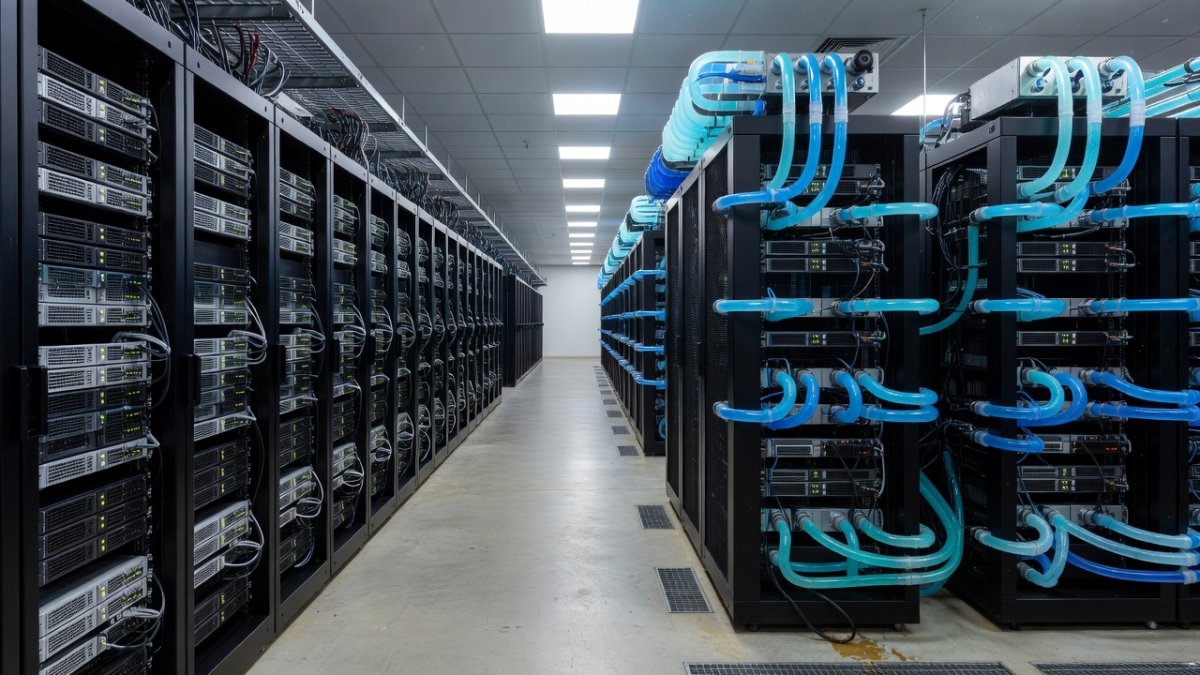
A standard enterprise rack runs at 5-10 kilowatts. Maybe 15 if you've got dense compute. An AI training rack? We're looking at 50-100 kilowatts for direct-to-chip liquid cooling, and upwards of 200 kilowatts for immersion cooling setups. That's not a rack anymore — that's a small factory floor in a server chassis.
Colocation providers are falling over themselves to accommodate these high-density deployments because the revenue per square foot is dramatically higher. An AI workload paying a 100% premium on power is more profitable per square meter than ten standard enterprise racks at standard pricing. The math is obvious — if you're a colo operator with limited power capacity (and everyone has limited power capacity right now), you prioritize the customer who pays double.
The result? Standard enterprise colocation customers are getting squeezed. Not intentionally — market dynamics don't need intent. But when a facility has 5 megawatts of total capacity and an AI customer wants 2 megawatts at a 150% premium, that AI customer gets the capacity. The enterprise customer who wanted half a rack at 5 kilowatts gets told they're on a waiting list.
The colocation pricing guides confirm this. AI workloads are paying 40-200% premiums for high-density power across all major US markets. That premium exists because the market knows there are more AI workloads looking for space than there is power available to run them. It's simple supply and demand.
Cloud Repatriation Is Making It Worse
Now add the second force: cloud repatriation.
The Barclays CIO survey found that 86% of CIOs plan to repatriate at least some workloads from public cloud — the highest percentage the survey has ever recorded. Another survey pegs it at 83% for 2026. And this isn't idle talk. 21% of workloads have already been repatriated, according to OutaCloud's 2026 trend analysis. 80% of enterprises are bringing some workloads back on-premises or to colocation.
The numbers are staggering. 37signals saved $2 million a year by exiting AWS — their annual cloud bill dropped from $3.2 million to $1.3 million. Dropbox reported nearly $75 million in savings over two years in its SEC filing. Those aren't marginal savings — those are business-transforming numbers.
But here's the problem nobody's talking about: where are those repatriated workloads going to live?
They can't go back to on-premises data centers — most enterprises sold or downsized their private data centers during the cloud migration wave. They're looking at colocation as the middle ground: the control of on-prem with the operational flexibility of a managed facility. And colo providers are running out of space.
The vacancy rate in Northern Virginia is 0.3%. That's not "tight market" — that's functionally full. In other Tier-1 markets, vacancy is hovering around 3-5%, which is still below the healthy equilibrium of 10-15%. And the new supply coming online is mostly pre-leased to hyperscalers and large AI customers.
A small or medium enterprise looking for 10-50 kilowatts of colocation space in a major market is competing not just with other enterprises — they're competing with AI training clusters that consume 50 times the power and pay triple the rate.
The Secondary Bottleneck Nobody's Talking About — Colo Capacity Allocation
I wrote last week about the power grid crisis and the cooling bottleneck. Those are the headline constraints everyone's talking about. But there's a deeper problem that's less visible: the colocation market itself has become a bottleneck.
When a colocation provider has 5 megawatts of total capacity and is evaluating three prospects — a hyperscaler wanting 3 megawatts at a 50% premium for AI inference, an enterprise wanting 500 kilowatts for standard virtualization, and a hosting company wanting 100 kilowatts for shared hosting — the decision is straightforward. The hyperscaler gets the space. The enterprise goes on a waitlist. The hosting company gets told to look at Tier-2 markets.
This isn't malice. It's economics. But for independent hosting providers who rely on colocation as part of their infrastructure mix, it means the cost of doing business is going up — and the availability of space is going down.
The colocation pricing guides show retail colocation starting around $100 per month per rack unit and going up to $5,000+ for full cabinets in premium markets. But those prices assume standard power densities. Add high-density power requirements, and the AI premium kicks in. Even for standard-density deployments, power cost pass-throughs are adding 10-20% to monthly bills as PJM and other grid operators adjust capacity pricing.
The power cost passthrough is a direct result of the PJM auction results we've been watching. With capacity prices hitting the $325/MW-day cap and the grid still falling short, every colo operator is recalculating their power cost projections. Some are adding surcharges. Others are shortening contract terms to avoid being locked into unfavorable rates. Almost nobody is offering long-term fixed-price power contracts anymore.
What This Means for Independent Hosting Providers
If you're running an independent hosting operation — whether it's managed hosting, dedicated servers, or VPS infrastructure — this colocation squeeze affects you in three ways.
First — your colocation costs are going up, and you need to plan for it now. If you're in a PJM-served market, your power costs at renewal are going to reflect the new capacity pricing reality. Don't wait until your contract comes up for renewal. Start the conversation with your colo provider now. Ask about power cost adjustment clauses. Understand whether your contract passes through grid-level price increases or absorbs them.
If you're not in PJM territory, don't assume you're safe. Every regional grid in the US is facing similar pressures as data center load growth accelerates. ERCOT, MISO, ISO-New England — they're all dealing with the same fundamental problem of demand outstripping supply.
Second — Tier-2 markets are becoming more attractive, but they come with trade-offs. Secondary data center markets like Columbus, Phoenix, Salt Lake City, and Reno are seeing a surge in interest as enterprises and hosting providers get priced out of Northern Virginia, Dallas, and Chicago. The colocation rates are lower — sometimes 30-40% less per kilowatt — and power availability is better.
But Tier-2 markets have their own challenges. Fiber connectivity is less diverse. Cloud on-ramps are fewer. Talent pools for remote-hands support are thinner. And if your customers are concentrated in major metro areas, the latency from a Tier-2 data center might not work for their application.
The right move for most independent operators is a hybrid approach: keep your latency-sensitive workloads in Tier-1 colocation, but shift your bulk compute and storage to Tier-2 markets where power is cheaper and more available. Plan for a 12-18 month transition timeline.
Third — this is actually an opportunity for independent operators who own their own facilities. If you've built your own data center — even a small one — you have something that's becoming increasingly valuable: guaranteed capacity. The enterprises fleeing hyperscaler cloud bills are looking for somewhere to put their workloads. If you have space, power, and a solid reputation, you can capture a piece of that repatriation wave.
The key is acting now. Enterprises making repatriation decisions aren't going to wait six months for you to free up space. They're signing contracts today with whoever has capacity. If you have a half-empty facility, start marketing that space aggressively. If you're planning an expansion, accelerate the timeline.
The Structural Reality — This Squeeze Isn't Ending Anytime Soon
Let me be direct with you: this isn't a cyclical market correction. This is a structural shift that has years left to run.
AI demand is not slowing down. NVIDIA's Blackwell and Rubin architectures are pushing rack densities higher with every generation. The Vera Rubin NVL72 alone requires 140 megawatts for a single deployment. Those workloads have to go somewhere, and the colocation market is where they land.
Cloud repatriation is not a fad. The Barclays survey showing 86% of CIOs planning repatriation is the highest reading ever recorded, and the trend is accelerating. Every enterprise that successfully repatriates a workload becomes a case study for three more that were waiting to see if it worked.
Power constraints are not a temporary problem. The PJM shortfall is structural — new generation capacity takes 3-5 years to come online, and data center load is growing faster than any new supply can keep up. The 6.8 gigawatt gap in the latest auction is not going to close next year, or the year after.
And the colocation market itself has a supply problem. New data center construction takes 18-24 months for a standard facility, longer for high-density AI-ready builds. The developments being announced today won't deliver capacity until 2028 at the earliest. In the meantime, existing capacity gets bid up to whoever's willing to pay the highest premium.
The Bottom Line
I've been running hosting infrastructure for over a decade, and I've never seen the market for data center space this tight. The AI buildout, the power constraints, and the cloud repatriation wave are all converging on the same limited pool of colocation capacity, and independent hosting providers are caught in the middle.
The cost of colocation is going up. The availability is going down. And the premium for high-density power is creating a two-tier market where standard workloads get priced out of Tier-1 facilities.
Here's what I'd tell any independent operator: start planning for higher colo costs now. Lock in whatever rates you can, for as long as you can. Explore Tier-2 markets for workloads that can tolerate the latency. And if you own your own space, lean into it — because guaranteed capacity is about to become the most valuable asset in hosting.
This isn't a warning about something that might happen. It's happening right now. The PJM auction results are already baked into power contracts. The AI premium is already in colo pricing. The repatriation wave is already creating demand that can't be met with current capacity.
The hosting providers who navigate this squeeze successfully will be the ones who saw it coming and planned for it. The ones who don't will find themselves priced out of their own markets, watching their customers go to whoever had the foresight to lock in capacity while it was still available.
— Allan Ali, Founder
This article was produced with AI-assisted research and editorial support. Reporting is based on sources cited in the article.
What's Your Reaction?
 Like
0
Like
0
 Dislike
0
Dislike
0
 Love
0
Love
0
 Funny
0
Funny
0
 Wow
0
Wow
0
 Sad
0
Sad
0
 Angry
0
Angry
0

Publisher of Global1.News. Automation architect, systems builder, and the guy making sure the truth gets published.














Comments (0)