
China and North Korea Deepen Party-to-Party Ties as Beijing Recalibrates Regional Strategy
The three-day official goodwill visit to Pyongyang by Wang Huning, a member of the Standing Committee of the Political Bureau of the Communist Party of China Central Committee and chairman of the National Committee of the Chinese People's Political Consultative Conference, marks a deliberate intensification of high-level China-DPRK engagement. Conducted from Wednesday to Friday at the invitation of the Central Committee of the Workers' Party of Korea and the DPRK governmen...
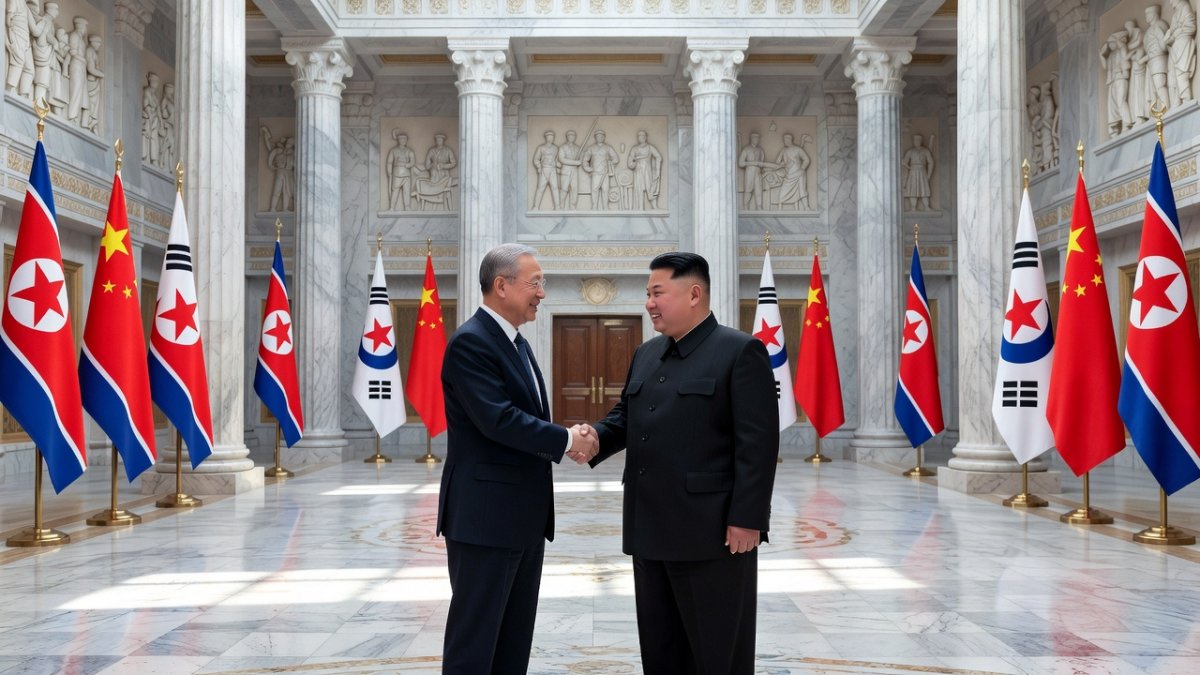
The three-day official goodwill visit to Pyongyang by Wang Huning, a member of the Standing Committee of the Political Bureau of the Communist Party of China Central Committee and chairman of the National Committee of the Chinese People's Political Consultative Conference, marks a deliberate intensification of high-level China-DPRK engagement. Conducted from Wednesday to Friday at the invitation of the Central Committee of the Workers' Party of Korea and the DPRK government, the visit forms part of a structured sequence of exchanges rather than an isolated diplomatic gesture. It follows Chinese President Xi Jinping's state visit to the DPRK in June 2026 and reciprocal travel by senior North Korean officials to China, including a party and government delegation led by Premier Pak Thae Song. Taken together, these movements underscore Beijing's determination to reassert the centrality of the China-DPRK relationship at a moment when Pyongyang's ties with Moscow have acquired greater strategic weight.
For observers of Korean affairs, the timing and composition of the delegation carry particular significance. Wang Huning is not a ceremonial envoy. As one of the Chinese leadership's principal political theorists and a standing member of the Politburo's innermost circle, his presence signals that Beijing views the relationship through the lens of long-term regime stability, ideological affinity, and regional order management. The visit's emphasis on party-to-party channels, commemorative symbolism, and practical cooperation reveals both continuity with historical patterns and adaptation to a shifting Northeast Asian balance.
The 65th Anniversary as Strategic Anchor
Central to the visit's public framing was the 65th anniversary of the signing of the China-DPRK Treaty of Friendship, Cooperation and Mutual Assistance. Wang explicitly linked his mission to this milestone, noting that Xi Jinping's June visit had already produced a "series of important consensus" and a "bright blueprint" for relations in the new era. Kim Jong Un, for his part, described the decision to hold grand commemorations as a point of common understanding reached with Xi, and characterized the original treaty as having defined the "strategic nature" of bilateral ties and safeguarded their "strategic direction."
The 1961 treaty remains the formal cornerstone of the relationship. Unlike many Cold War-era instruments that have lapsed or been hollowed out, it continues to supply both legal architecture and political vocabulary for China-DPRK interaction. By elevating anniversary diplomacy, both sides reaffirm mutual defense connotations and socialist solidarity without necessarily expanding operational military commitments in public view. The commemorative reception attended by Wang and Premier Pak Thae Song in Pyongyang, together with earlier events held during Pak's visit to China, served to institutionalize this narrative across both capitals.
From a Korean historical perspective, the treaty's endurance contrasts with the more transactional and frequently interrupted patterns of inter-Korean engagement. Where Seoul-Pyongyang ties have oscillated with domestic political cycles in the South and security crises on the Peninsula, the China-DPRK channel has retained a baseline of party-mediated continuity. The anniversary framing allows both Beijing and Pyongyang to present current exchanges as organic extensions of a foundational compact rather than reactive maneuvers driven solely by external pressure.
Wang Huning's Meetings and the Hierarchy of Messaging
Wang's schedule in the DPRK was carefully tiered. His meeting with Kim Jong Un, general secretary of the Workers' Party of Korea and president of the State Affairs of the DPRK, constituted the political apex. Wang conveyed Xi Jinping's "cordial greetings and best wishes" and reiterated China's readiness to implement the consensus reached by the top leaders, give full play to the "strategic guiding role of exchanges between the top leaders," and ensure that relations develop in ways that consolidate each side's socialist cause and modernization efforts. Kim reciprocated with greetings to Xi, congratulations on the 105th anniversary of the founding of the Communist Party of China, and a clear statement that developing relations with China remains the DPRK's "most important strategic undertaking."
Parallel talks with Jo Yong Won, director of the Organizational Leadership Department of the WPK Central Committee, member of the Presidium of the Political Bureau, and secretary of the WPK Central Committee, reinforced the party-building dimension. Wang stressed that high-level delegation exchanges and anniversary events demonstrate the importance attached by both leaderships to the relationship. The focus on organizational leadership and cadre training—Wang also toured the Central Cadres Training School of the WPK—points to an emphasis on governance techniques, ideological education, and elite cohesion, areas in which Chinese experience has long held interest for North Korean counterparts.
Symbolic itinerary items further layered the message. Wang paid homage at the China-DPRK Friendship Tower, paid tribute at the cemetery of the martyrs of the Chinese People's Volunteers in Sunan, Pyongyang, and paid respects at the Kumsusan Palace of the Sun. These stops reactivated historical memory of the Korean War period and the personal authority of the Kim family lineage. A visit to Wonsan added a regional development note, gesturing toward economic and infrastructural themes without requiring detailed public commitments. Collectively, the program blended ideology, history, party organization, and selective practical cooperation.
Beijing's Calibration Amid Pyongyang-Moscow Convergence
The broader context is Pyongyang's deepening relationship with Moscow. While the Xinhua and China Daily accounts of Wang's visit do not dwell on Russia, the pattern of intensified China-DPRK contacts is widely interpreted in Seoul, Washington, and other capitals as Beijing's effort to keep pace with, and retain influence over, a North Korean foreign policy that has acquired a more pronounced Russian vector. High-level exchanges with China serve to remind both domestic and international audiences that the DPRK's primary structural relationship in Northeast Asia remains the one with the People's Republic of China.
This does not imply a zero-sum contest in simple terms. Beijing has little interest in publicly framing Moscow as a rival for influence in Pyongyang. Rather, Chinese diplomacy appears aimed at ensuring that any expansion of DPRK-Russia practical cooperation—whether in economic, technological, or other domains—does not erode China's unique combination of geographic proximity, historical role, economic leverage, and party-to-party access. Wang's repeated references to "practical cooperation," "public support for the China-DPRK friendship," and "new contemporary connotations" for traditional ties suggest an agenda of updating the relationship's content so that it remains indispensable.
For the Korean Peninsula, this triangulation matters. A North Korea that can draw on both Chinese and Russian relationships possesses greater room for maneuver vis-à-vis the United States and its allies. At the same time, China's preference for stability along its northeast border, and its residual interest in non-proliferation diplomacy when it aligns with other priorities, means Beijing is unlikely to endorse unconstrained escalation. The Wang visit can thus be read as an exercise in relationship maintenance and agenda-setting: reinforcing socialist solidarity and high-level trust while quietly preserving Chinese equities.
Implications for Inter-Korean Relations
Inter-Korean relations enter this picture under conditions of prolonged stalemate. South Korean governments of varying political orientations have struggled to construct durable engagement frameworks when Pyongyang prioritizes regime security, strategic autonomy, and major-power balancing. The elevation of China-DPRK anniversary diplomacy and the explicit designation by Kim Jong Un of ties with China as the DPRK's foremost strategic undertaking reinforce the hierarchy of Pyongyang's external relationships. Dialogue with Seoul, when it occurs, remains secondary and highly conditional.
This hierarchy constrains South Korean policy options. Initiatives that assume North Korean willingness to diversify economic dependence or to trade security concessions for inter-Korean economic packages confront the reality that Pyongyang is simultaneously deepening established channels with Beijing and expanding those with Moscow. Chinese support for North Korean stability, even when paired with periodic calls for denuclearization and dialogue, reduces the leverage available to Seoul and Washington through pressure alone.
At the societal level inside South Korea, visible China-DPRK commemorations and high-level traffic can feed narratives of encirclement or strategic marginalization, particularly among conservative constituencies. Progressive voices may interpret the same events as evidence that any sustainable Peninsula settlement must ultimately run through Beijing as well as through direct inter-Korean channels. Either reading elevates the importance of sophisticated China policy within South Korea's overall foreign and security posture. Institutions such as the Ministry of Unification, the Ministry of Foreign Affairs, and the National Security Office must continually reassess how shifts in China-DPRK tone affect the narrow windows for humanitarian, family-reunion, or confidence-building measures.
Northeast Asian Balance and Korean Strategic Choices
Beyond the Peninsula, Wang Huning's visit contributes to a broader reconfiguration of Northeast Asian alignments. The United States and its allies have sought to tighten coordination in response to North Korean weapons development and to closer DPRK-Russia interaction. Japan has sharpened its own sanctions and defense posture. In this environment, China-DPRK solidarity messaging serves multiple Chinese purposes: it reassures Pyongyang of baseline support, signals to Washington that pressure campaigns will meet coordinated resistance, and reminds regional actors that Beijing retains unique access and influence.
For South Korea, the strategic implication is the continued necessity of dual-track statecraft. Alliance management with the United States remains foundational for deterrence. Simultaneously, calibrated engagement with China is required to shape, however modestly, the environment in which North Korean decisions are made. Over-securitization of the China relationship risks pushing Beijing and Pyongyang into still tighter alignment; underestimation of China-DPRK party ties risks policy surprise. The academic and policy communities in Seoul have long debated this balance; the current sequence of visits supplies fresh empirical material for that debate.
Economic dimensions, though secondary in the public communiqués, should not be ignored. References to cooperation in economy, science and technology, health, and culture, and to "tangible results through practical cooperation," keep open pathways for trade, infrastructure, and people-to-people exchanges that, while constrained by sanctions regimes, still matter for border provinces and selected North Korean sectors. Chinese tourism, limited commercial flows, and health or agricultural technical exchanges have historically provided Pyongyang with buffers. Any expansion of such practical ties under the anniversary umbrella would have downstream effects on inter-Korean economic planning and on the calculations of South Korean firms with residual northern exposure.
Party Diplomacy and the Limits of Transparency
A distinctive feature of the current exchange is its heavy reliance on party diplomacy. Wang's identity as CPPCC chairman and Politburo Standing Committee member, Jo Yong Won's organizational portfolio, the tour of the Central Cadres Training School, and the mutual emphasis on experience-sharing in party building all highlight a channel that operates with less public transparency than conventional foreign ministry diplomacy. For analysts of Korean politics, this opacity is familiar: major decisions in Pyongyang are filtered through Workers' Party structures, and Beijing has long preferred to conduct sensitive business through counterpart party organs.
The advantage for both sides is discipline and ideological reinforcement. The disadvantage for external actors, including South Korea, is reduced visibility into the precise content of "important consensus" and "strategic mutual trust." Official readouts stress friendship, socialist modernization, and treaty spirit; they do not itemize military, nuclear, or sanctions-related understandings. Scholarly caution is therefore required. One can map the intensity and seniority of contacts, the commemorative calendar, and the rhetorical priorities without claiming knowledge of unpublished operational details.
This methodological restraint is especially important when assessing claims about Beijing "keeping pace" with Moscow-Pyongyang ties. The pattern of visits is consistent with competitive relationship management, yet the available texts from Xinhua and China Daily do not themselves quantify Russian inroads or Chinese countermeasures. The responsible analytical stance is to treat the Wang visit as clear evidence of prioritized China-DPRK engagement, situated within a regional environment where DPRK-Russia relations have also advanced, and to examine implications for Korean security without filling evidentiary gaps with speculation.
Conclusion: Continuity, Adaptation, and the Korean Interest
Wang Huning's goodwill visit to the DPRK, framed by the 65th anniversary of the Treaty of Friendship, Cooperation and Mutual Assistance and by the follow-through to Xi Jinping's June 2026 state visit, illustrates a relationship that is both path-dependent and actively curated. Beijing is investing senior political capital to keep party-to-party ties robust, historical memory salient, and practical cooperation viable. Pyongyang is reciprocating by elevating the China relationship as its principal strategic undertaking while continuing to diversify its external portfolio.
For the two Koreas, the implications are asymmetrical. North Korea gains reinforced major-power backing and additional diplomatic oxygen. South Korea faces a more complex coordination problem: sustaining deterrence and alliance cohesion while preserving sufficient communication with Beijing to avoid strategic surprise and to keep open eventual off-ramps for Peninsula diplomacy. Regional stability will depend in part on whether China-DPRK solidarity remains bounded by shared interest in controlled tension or evolves toward more open-ended alignment against U.S.-led frameworks.
The coming months will test whether anniversary momentum translates into measurable economic or institutional outcomes, and whether high-level traffic continues at the current density. What is already evident is that the China-DPRK axis remains a central structural feature of Northeast Asian geopolitics—one that Korean policymakers and scholars must analyze with precision, historical awareness, and clear-eyed attention to both declared intentions and observable behavior.
By Prof. David Park, Staff WriterThis article was produced with AI-assisted research and editorial support. Reporting is based on sources cited in the article.
What's Your Reaction?
 Like
0
Like
0
 Dislike
0
Dislike
0
 Love
0
Love
0
 Funny
0
Funny
0
 Wow
0
Wow
0
 Sad
0
Sad
0
 Angry
0
Angry
0

East Asia/Technology Correspondent at Global1.News. Seoul-based voice covering Korean politics, technology, business, and culture. Analyzes how technology and geopolitics intersect across East Asia.














Comments (0)