
Russia's Massive Missile and Drone Attack on Kyiv Kills at Least 27
In a recent BBC News report, Russia launched what Ukrainian officials are calling the "most massive attack" on the Ukrainian capital since the start of the full-scale war, killing at least 27 people and injuring 91 in an 11-hour barrage of missiles and drones that struck residential buildings across all districts of Kyiv. "Most Massive" Attack on Kyiv: Russia's 11-Hour Barrage
In a recent BBC News report, Russia launched what Ukrainian officials are calling the "most massive attack" on the Ukrainian capital since the start of the full-scale war, killing at least 27 people and injuring 91 in an 11-hour barrage of missiles and drones that struck residential buildings across all districts of Kyiv.
"Most Massive" Attack on Kyiv: Russia's 11-Hour Barrage Kills at Least 27
Kyiv, Ukraine — Russian forces launched a devastating overnight assault on Ukraine's capital on Wednesday, deploying 74 missiles and 496 long-range drones in an 11-hour attack that struck apartment buildings, an ambulance station, and a Ukrainian Red Cross humanitarian warehouse. Mayor Vitaly Klitschko described it as the worst Russian attack on Kyiv during the entire war, with 20 apartment buildings damaged across all districts of the capital.
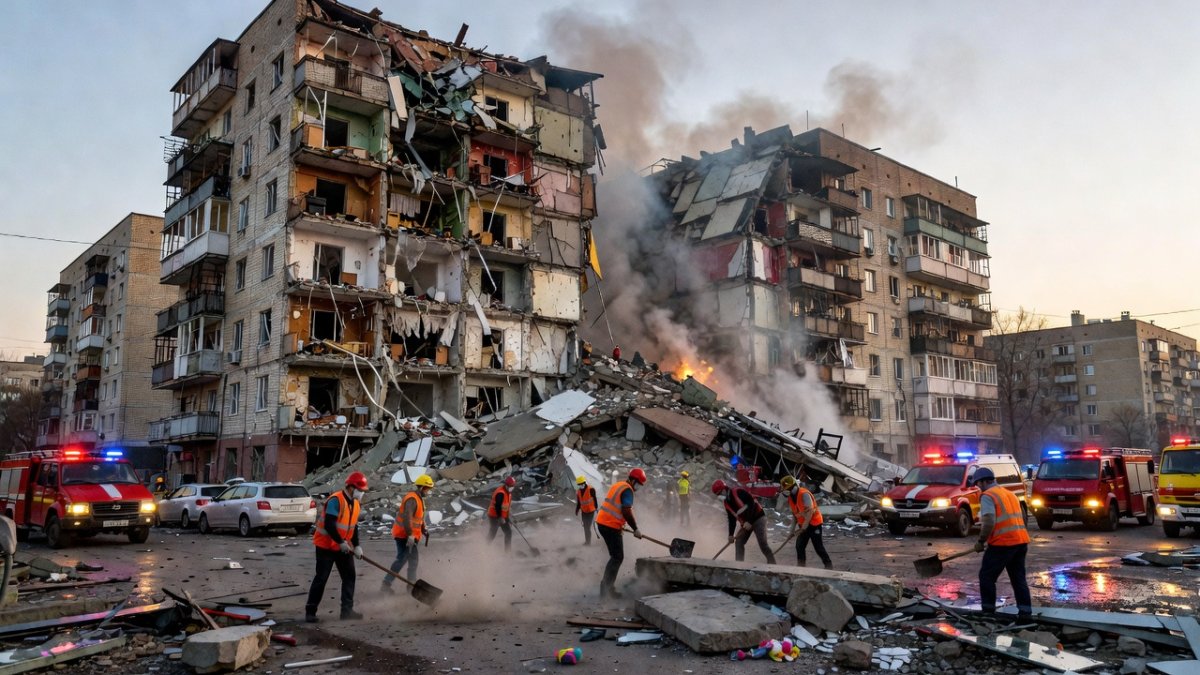
The Attack — An 11-Hour Barrage on the Capital
The assault on Kyiv unfolded in several coordinated waves beginning late Wednesday evening. A drone strike first hit the city's historic quarter, setting off a fire in a hotel in the city centre. At approximately 01:00 local time (23:00 GMT), dozens of ballistic and cruise missiles were fired toward the capital. After a brief lull, another dozen cruise missiles struck at 03:00, followed by a swarm of drones that continued targeting the capital until dawn.
Ukraine's Air Force reported that Russia launched 74 missiles and 496 long-range drones during the attack, most of which targeted Kyiv. The barrage deployed the largest number of weapons on the capital in a single assault, hitting locations over a wide area rather than concentrating on specific infrastructure targets.
The attack came just hours after Ukrainian President Volodymyr Zelensky warned that intelligence indicated Russia was preparing another large-scale assault. "Today there is unpleasant information about the next preparation for such a massive Russian attack," Zelensky had said, according to reports cited by international media.
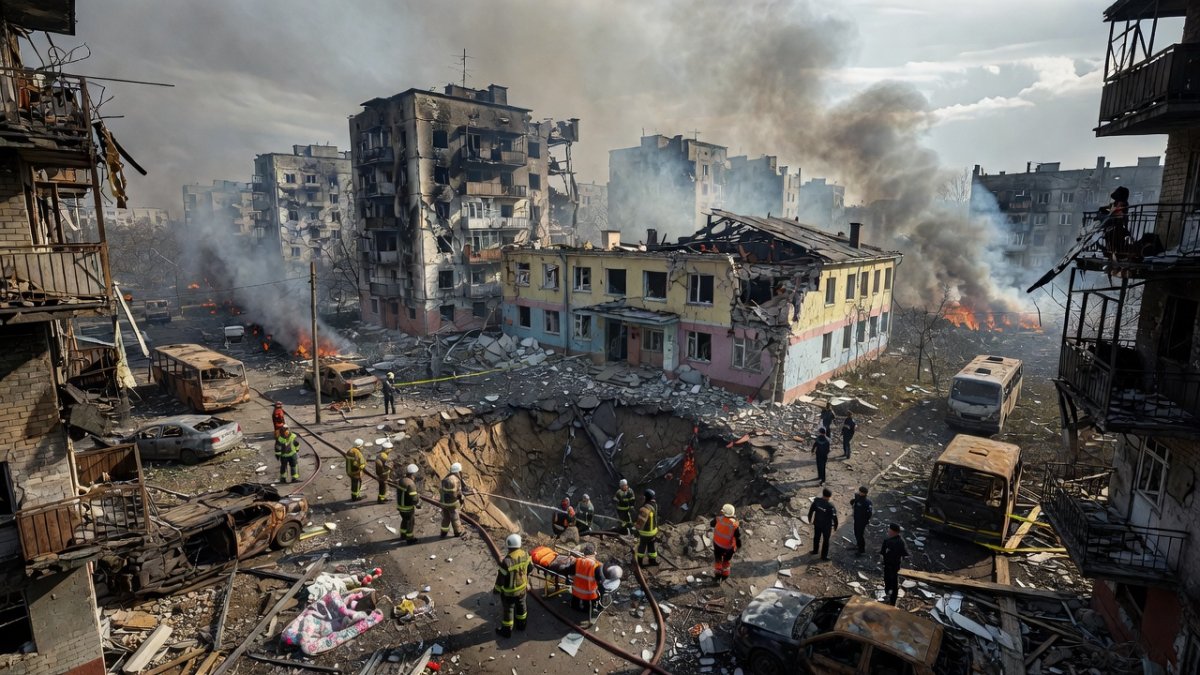
Civilian Toll and the Human Cost
At least 27 people were killed and 91 injured in the attack, according to Timur Tkachenko, the head of Kyiv's military administration. The dead included residents of a nine-storey apartment block in the Darnitskyi district of south-east Kyiv, where two missiles struck within steps of each other. One missile left a giant crater next to a kindergarten, the buildings all around gutted by fire with their metal balconies twisted beyond recognition. The second missile hit the end of the residential block, collapsing it into a heap of concrete.
Rescue workers spent hours digging through the rubble to reach residents who may have been sheltering in the basement. Relatives watching nearby were in tears, fearing the worst. One local told the BBC that several people were still missing and may have been trapped in the basement when the building collapsed.
Kyiv's metro authorities reported that 52,500 people, including 4,500 children, sheltered in underground stations overnight — the highest number recorded in recent years. An ambulance station was also among the locations hit, Mayor Klitschko confirmed, raising questions about whether medical infrastructure was deliberately targeted.
Witness Accounts — Life Under the Barrage
Svitlana, a resident living next to the building that was struck, told the BBC she was hiding in the corridor during the air raid and heard the explosions. "It wasn't scary," she shrugged, "because I've been through it all before." She then revealed a devastating personal history — badly injured in another Russian strike on a different town, an attack that killed her mother. Two years later, her son was killed in action fighting for Ukraine.
Oleksiy, his face covered in cuts and blood, told the BBC he had stepped outside to smoke after hearing the first missile, then the second one landed and he was hit by flying glass. "This is not retaliation by Russia for Ukrainian strikes," he said, dismissing Moscow's explanation for the latest attack. "They started this war. This is a residential area. And they targeted it."
Residents of Kyiv who have lived through four-and-a-half years of war say they have perceived a change in the pattern of Russia's assaults on the capital over the last two months. Attacks now happen less frequently — albeit still every few days — but last longer, appear more powerful, and strike across a wider geographical area.
Humanitarian Devastation — Red Cross Warehouse Destroyed
The Ukrainian Red Cross reported that its warehouse in Kyiv was completely destroyed in the overnight strikes, with a loss of supplies worth more than £1.3 million (79 million Ukrainian Hryvnia). In a statement shared on X in English, the charity said that approximately 320,000 relief items were lost — supplies that would have been critical for emergency response and humanitarian operations across Ukraine.
The destruction of the Red Cross warehouse compounds an already dire humanitarian situation in Ukraine, where winter operations, medical evacuations, and civilian displacement require constant logistical support. International aid organisations have repeatedly warned that attacks on humanitarian infrastructure violate international law, regardless of the stated military justification.
Moscow's Justification and Escalation Rhetoric
Moscow said its forces had hit what it called military production plants in retaliation for Ukrainian strikes on Russian civilian infrastructure. Kremlin spokesman Dmitry Peskov told reporters on Thursday that Russia would "continue to increase pressure on the Kyiv regime in order to achieve our set goals." The statement was notable for its lack of specific military objectives, instead framing the attack as part of a broader campaign of pressure.
Ukraine accused Moscow of deliberately targeting civilian areas and said it would be wrong to equate the actions of the "aggressor and a country defending itself." The distinction is critical in the context of international law, where deliberate attacks on civilian infrastructure constitute war crimes under the Geneva Conventions.
Analysts suggest that Russia's decision to launch such a large-scale attack on Kyiv specifically — rather than on military targets along the front lines — reflects a strategic choice to inflict psychological and political pressure on Ukraine's leadership and population. The timing, just hours after Zelensky's public warning about Russian preparations, also appears designed to demonstrate that Russian intelligence can bypass Ukrainian warnings and strike at will.
Analysis — What the Attack Signals About Russian Strategy
The scale and nature of the July 2 attack on Kyiv suggests several shifts in Russian military strategy. First, the combined use of 74 missiles and 496 drones represents a significant logistical investment, indicating that Russia's defence industry is maintaining or increasing its production capacity despite Western sanctions. Second, the deliberate targeting of residential areas — 20 apartment buildings across all districts — suggests a strategy of collective punishment rather than precision military strikes.
The attack also comes at a critical juncture in the war. After four-and-a-half years of conflict, Ukraine's air defence capabilities have been stretched thin by the sheer volume of Russian projectiles. The 11-hour duration of the assault — far longer than typical Russian barrages — appears designed to exhaust air defence systems and exploit gaps in coverage.
International reaction has been predictably strong, with Western governments condemning the attack and reiterating their support for Ukraine's defence. However, with war fatigue evident in several key NATO capitals, the question of whether Ukraine can sustain the level of Western military assistance needed to counter this scale of attack remains open.
As Kyiv buries its dead and digs through the rubble of the Darnitskyi district, the message from both Moscow and Kyiv is clear: there is no end in sight to this war. Russia's willingness to launch attacks of this scale against civilian areas suggests a strategy of attrition designed to break Ukrainian morale rather than achieve tactical military objectives. For the 52,500 people who spent Wednesday night in Kyiv's metro stations, the question is not whether the next attack will come — but when.
Russian Power Structures and Long-Term Objectives
Within the Kremlin, decisions of this magnitude reflect the consolidated authority of President Vladimir Putin and his inner circle of security officials. Dmitry Peskov's remarks on Thursday underscore how the Russian leadership frames the conflict as an existential struggle against what it terms the "Kyiv regime," a narrative reinforced through state media to maintain domestic support. This approach draws on post-Soviet dynamics where control over information and suppression of dissent allow sustained military operations without immediate political backlash at home.
Energy politics also play a central role. Russia has historically leveraged its position as a major energy supplier to exert influence across Europe, and the current assault coincides with ongoing disputes over gas transit routes through Ukraine. By targeting civilian infrastructure in Kyiv, Moscow signals its readiness to escalate pressure on Ukraine's economy and society, aiming to weaken resolve ahead of potential winter shortages. Such tactics echo earlier phases of the conflict where energy facilities were prioritised, illustrating a consistent pattern in Russian strategic thinking that prioritises long-term attrition over immediate battlefield gains.
Western sanctions have not halted Russia's ability to produce and deploy large numbers of drones and missiles, as evidenced by the 496 drones and 74 missiles used in this single operation. Analysts note that parallel import schemes and domestic manufacturing adaptations have allowed the Russian defence sector to sustain output, even as the broader economy faces constraints. This resilience enables repeated large-scale strikes on Ukrainian cities, prolonging the war and testing the limits of Ukrainian air defences and international support mechanisms.
The humanitarian implications extend beyond immediate casualties. Destruction of the Red Cross warehouse, with its 320,000 relief items valued at over £1.3 million, disrupts aid distribution at a time when displaced populations require sustained assistance. International organisations continue to document these incidents, highlighting violations of protocols protecting humanitarian assets. In this context, the attack serves not only military purposes but also as a demonstration of Russia's capacity to impose costs on civilian life, reinforcing its negotiating position through demonstrated endurance.
Ukraine's response, articulated by officials including President Zelensky and Mayor Klitschko, emphasises the distinction between defensive actions and aggression. This framing seeks to maintain international backing while addressing domestic needs for protection and reconstruction. As the conflict enters its fifth year, the interplay between Russian strategic persistence and Ukrainian resilience defines the trajectory, with no clear resolution on the horizon.
By Irina Volkov, Staff Writer
This article was produced with AI-assisted research and editorial support. Reporting is based on sources cited in the article.
What's Your Reaction?
 Like
0
Like
0
 Dislike
0
Dislike
0
 Love
0
Love
0
 Funny
0
Funny
0
 Wow
0
Wow
0
 Sad
0
Sad
0
 Angry
0
Angry
0

Russia/Eastern Europe Correspondent at Global1.News. Covering Russian politics, energy, security, and the shifting dynamics of the post-Soviet space. Provides clear-eyed analysis on one of the world's most opaque regions.















Comments (0)