
Amazon Burned Area Plunges 80% in 2025, MapBiomas Data Shows
Brazil's Amazon recorded its smallest burned area since 1985 — 3.1 million hectares in 2025, down 80% from 15.8 million in 2024. The MapBiomas report shows a 31% drop below the historical average, giving President Lula a boost ahead of October's election. But researchers warn climate conditions could reverse the trend, and critics highlight the contradiction of Lula approving oil exploration at the Amazon river mouth.
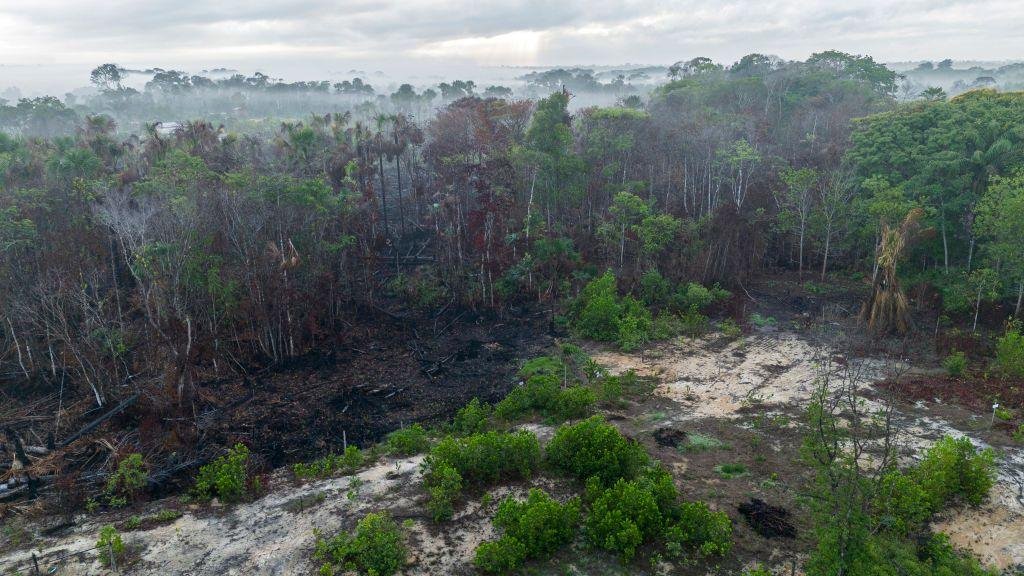
The Amazon rainforest recorded its smallest burned area in four decades during 2025, with just 3.1 million hectares affected in Brazil's Amazon region according to MapBiomas data, marking the lowest figure since records began in 1985. This dramatic reduction from 15.8 million hectares in 2024 signals that sustained policy interventions and favorable weather patterns can reverse years of escalating fire damage. The development arrives as President Luiz Inácio Lula da Silva campaigns for re-election, positioning environmental gains as a key achievement. Experts caution that the improvement may prove temporary without continued enforcement amid shifting climate cycles.
Amazon Burned Area Plunges 80% in 2025, MapBiomas Data Shows
São Paulo, Brazil — The area burned across Brazil's Amazon region in 2025 reached just 3.1 million hectares, a sharp decline from the 15.8 million hectares recorded in 2024, according to data released by the deforestation monitoring group MapBiomas. This figure marks the smallest burned area since the organization's records began in 1985. The drop reflects fewer fires overall, with the Amazon seeing its lowest number of fires in 41 years. Vera Arruda, a researcher at the Amazon Environmental Research Institute and coordinator at MapBiomas, described the results as significant evidence that reductions in burned land remain possible through sustained efforts.
Record Low Burned Area in the Amazon Brings Hope
The 3.1 million hectares burned in 2025 represents a dramatic turnaround from the previous year's 15.8 million hectares, which had set a record high. Official data from Brazil's National Institute for Space Research (INPE) show peak fire seasons in 2020 and 2021 exceeded 1.3 million hectares each under the previous administration, driven by weakened enforcement of environmental laws and expanded agricultural frontiers. This measurable reduction has provided Lula with concrete evidence to bolster his October re-election bid, framing the Amazon as a restored national priority rather than an extractive resource.
Lula's Campaign Gains Momentum Ahead of October Vote
President Luiz Inácio Lula da Silva made protecting the Amazon a central pledge during his campaign four years ago, and these latest figures offer a clear boost as he seeks re-election in October. On his first day in office in January 2023, Lula stated his goal of achieving zero deforestation in the Amazon. The reduction in burned areas stands in contrast to the policies under his predecessor Jair Bolsonaro, during whose term deforestation rose 75 percent three years into his presidency. Bolsonaro had promoted expanded farming and mining in the region as a path to reduce poverty, a stance that drew sharp criticism from environmental groups across Latin America. Broader deforestation rates, tracked separately from burned areas, fell by 49 percent between 2023 and 2025 compared with the Bolsonaro period, dropping from an annual average of 11,500 square kilometers to roughly 5,900 square kilometers. INPE satellite monitoring attributes much of this shift to renewed funding for Ibama inspections and the reactivation of the Amazon Fund, which had been largely dormant. States such as Pará and Mato Grosso registered the steepest improvements, with Pará alone cutting deforestation by 62 percent through targeted operations against illegal logging corridors, while Amazonas saw a more modest 34 percent reduction amid persistent challenges in remote municipalities. Lula's campaign platform now prominently features these 2025 metrics as proof that environmental protection and economic growth can coexist, with speeches in Belém and Manaus highlighting job creation in sustainable forestry and ecotourism. Opposition leaders from the Liberal Party have challenged the figures, claiming INPE methodologies undercount fires on private lands and arguing that the gains remain fragile without structural reforms to land titling. They point to continued high rates in border zones as evidence that Lula's approach prioritizes optics over lasting enforcement.
Broader Declines Across All of Brazil
The MapBiomas report reveals that burned areas fell nationwide in 2025, with roughly 12.7 million hectares affected compared to 30 million hectares in 2024. The previous national high occurred in 2007, when 30.7 million hectares burned. These numbers cover multiple biomes and highlight how the Amazon's improvement contributed to the countrywide trend. Arruda noted a 31 percent drop relative to the historical average, driven mainly by conditions in the Amazon, yet she cautioned that the results do not yet confirm a lasting pattern or justify reduced prevention work by federal agencies.
Weather Shifts and Persistent Climate Pressures
The 2025 improvement partly stems from cooler La Niña conditions that eased the extreme fires of 2024, which the Copernicus Climate Change Service linked to climate extremes combined with human activity. MapBiomas warned that a return to El Niño patterns could lengthen the dry season and raise fire risks in coming months. Tropical rainforests such as the Amazon absorb large amounts of carbon dioxide when healthy, supporting global climate stability, yet decades of land clearance for agriculture and logging have increased vulnerability. These pressures mirror challenges faced in neighboring countries like Peru and Colombia, where similar economic demands test regional conservation commitments. The 2025 La Niña phase suppressed fire activity by increasing regional rainfall by an estimated 15-20 percent above the long-term mean, particularly during the critical July-October window when ignition risk peaks. In contrast, strong El Niño events like those in 2015-2016 and 2023-2024 intensify drought stress, lowering canopy moisture and extending the dry season by up to six weeks, which multiplies the probability of uncontrolled fires. These oscillations directly influence fuel loads, with La Niña years allowing vegetation recovery that reduces flammability in subsequent seasons. Prolonged drought stress alters forest structure by increasing tree mortality and leaf shedding, creating continuous fine-fuel layers on the forest floor that carry fire more readily than intact moist forests. Researchers at the National Institute of Amazonian Research have documented how repeated water deficits weaken the Amazon's natural fire resistance, turning once-resilient ecosystems into tinderboxes during even moderate dry spells. This dynamic explains why 2025's gains may prove temporary if an El Niño develops by mid-2026, as current NOAA forecasts indicate a 65 percent chance of neutral-to-warm conditions returning. Neighboring countries experienced parallel but less pronounced declines. Colombia reported a 31 percent drop in Amazonian fires, Peru a 27 percent reduction, and Bolivia a sharper 44 percent fall, all benefiting from the same La Niña moisture surplus. However, Bolivia's savanna-forest transition zones remain especially vulnerable to rapid rebound in fire activity once rainfall patterns shift, underscoring the regional nature of the climate driver rather than isolated national policy success.
Tensions Between Protection and Economic Priorities
Lula's administration has faced criticism for approving oil exploration at the mouth of the Amazon river, a move activists argue conflicts with his zero-deforestation pledge. This decision highlights the ongoing friction between environmental goals and development needs in Brazil's northern states, where communities depend on both resource extraction and forest health. Indigenous groups and local organizations in the region continue to advocate for stronger enforcement, drawing parallels to struggles in other Latin American nations balancing growth with ecosystem preservation. The burned-area data shows progress is achievable, but sustained federal action remains essential to address these competing demands. The proposed oil exploration zone lies in the Foz do Amazonas basin, roughly 500 kilometers offshore from Amapá state in waters averaging 2,500 meters deep. Petrobras submitted its environmental impact assessment in late 2024, and as of early 2026 IBAMA has yet to issue a final drilling license, citing incomplete baseline studies on deep-sea currents and spill response capacity. The agency's technical review remains ongoing amid legal challenges from federal prosecutors. Greenpeace Brazil and WWF-Brazil have condemned the project as a direct contradiction of Lula's climate pledges, organizing protests in Macapá and filing lawsuits that argue the basin's biodiversity hotspots and migratory routes for endangered species warrant permanent protection. Local Amazon movements, including the Movement of People Affected by Dams, have joined these efforts, warning that even exploratory drilling risks irreversible damage to fisheries that sustain thousands of coastal communities. This tension echoes broader Latin American debates, from Ecuador's 2023 referendum halting Yasuní oil extraction to Colombia's ongoing restrictions on new fracking contracts. Indigenous groups in Amapá, including the Waiãpi and Galibi, have issued formal statements opposing the venture, citing risks to ancestral fishing grounds and demanding prior consultation under ILO Convention 169. Their position highlights the gap between federal development rhetoric and territorial rights on the ground.
Looking Ahead to Sustained Amazon Stewardship
While the 2025 figures demonstrate that targeted policies can curb fire damage, experts at MapBiomas and IPAM stress the need for continued vigilance. The Amazon's role as a carbon sink and biodiversity hotspot affects not only Brazil but the wider Latin American economy and climate resilience. As the October elections approach, voters in Amazonian states will weigh these environmental gains against promises of economic opportunity. Lula's record on reversing prior deforestation trends now faces direct tests from both natural weather cycles and policy choices that could shape the rainforest for years to come. The Amazon biome absorbs an estimated 1.5 billion metric tons of carbon dioxide annually through photosynthesis while releasing roughly 0.8 billion tons through natural respiration and decomposition, yielding a net sink of about 0.7 billion tons under stable conditions. The 2025 fire season, however, released an additional 180 million tons, narrowing that margin and illustrating how even reduced burning erodes the forest's climate mitigation capacity. These figures come from the Global Carbon Project's latest regional assessments. Scientists continue to warn that crossing a 20-25 percent cumulative deforestation threshold could trigger a tipping point, converting large portions of the southern and eastern Amazon into savanna-like ecosystems that become net carbon emitters. The 2025 data, while encouraging, still leave the biome near 18 percent total loss, keeping the region within a narrow safety margin according to models published in Nature Climate Change. Brazil's updated Nationally Determined Contribution under the Paris Agreement relies heavily on these Amazon reductions to meet its 2030 target of a 50 percent emissions cut from 2005 levels. At COP31, Lula cited the 2025 numbers to secure renewed international financing. Meanwhile, states such as Amazonas, Pará, and Acre have advanced jurisdictional programs offering payments for ecosystem services, demonstrating that standing forest can generate higher long-term economic returns through carbon markets and certified timber than one-time clearing for soy or cattle. By Elena Vasquez, Staff Writer
This article was produced with AI-assisted research and editorial support. Reporting is based on sources cited in the article.
What's Your Reaction?
 Like
0
Like
0
 Dislike
0
Dislike
0
 Love
0
Love
0
 Funny
0
Funny
0
 Wow
0
Wow
0
 Sad
0
Sad
0
 Angry
0
Angry
0

Latin America Correspondent at Global1.News. Based in Mexico City, covering politics, economics, energy, and culture across the region. Brings an on-the-ground perspective to stories spanning from the Rio Grande to Patagonia.















Comments (0)