
AMD Just Put $5 Billion Into Anthropic, and the GPU Market Just Shifted Under Our Feet
AMD invests $5 billion in Anthropic in a landmark deal deploying 2GW of Instinct MI450 GPUs in Helios racks. The partnership reshapes the GPU market, challenges Nvidia's monopoly, and signals a new era of diversified AI infrastructure investment.
AMD Just Put $5 Billion Into Anthropic, and the GPU Market Just Shifted Under Our Feet
Let me tell you something that landed in my feed this morning and I haven't stopped turning over in my head since. AMD — the company that's spent the last two years trying to convince the world it's a credible alternative to Nvidia in AI — just made the most aggressive move I've seen from a challenger in this space. They're investing up to $5 billion in Anthropic. Not as a customer buying chips. As an investor. Equity. They're putting their own money into the Claude developer, and in return, Anthropic is committing to deploy up to 2 gigawatts of AMD's Instinct MI450 Series GPUs in Helios rack-scale systems starting in the first half of 2027.
Now, I've been running hosting infrastructure for over a decade. I've watched GPU pricing go from sensible to insane. I've watched Nvidia's allocation system turn into something that resembles a Soviet bread queue more than a functional market. And I've been writing for days about how the AI infrastructure buildout is hitting structural constraints — power, water, debt, community consent. But this deal is different. This isn't about a constraint. This is about a crack in the monopoly. And cracks, when they appear in monopolies, have a way of spreading fast.
AMD Bets $5 Billion on Breaking Nvidia's AI Grip — Anthropic Signs On for 2 Gigawatts of Instinct MI450 GPUs
Santa Clara, California — July 22, 2026 — AMD and Anthropic announced a strategic partnership this morning that fundamentally reshapes the AI chip landscape. Under the terms, AMD has committed to a strategic equity investment of up to $5 billion in Anthropic — the first time AMD has invested directly in an AI lab at this scale. In return, Anthropic will deploy up to 2 gigawatts of AMD Instinct MI450 Series GPUs in AMD Helios rack-scale solutions, with the first gigawatt coming online in the first half of 2027.
Let me stop here and say something about that structure, because it matters. AMD is not just selling chips. They're becoming a shareholder in their own customer. That's a fundamentally different relationship than Nvidia has with anyone. Nvidia sells you a chip, takes your money, and maybe — maybe — gives you priority allocation if you're a hyperscaler. AMD is saying: we're in this together. Our success is tied to yours. That changes the incentive structure in ways that matter for pricing, allocation, and long-term commitment.
The Deal — What They Actually Announced
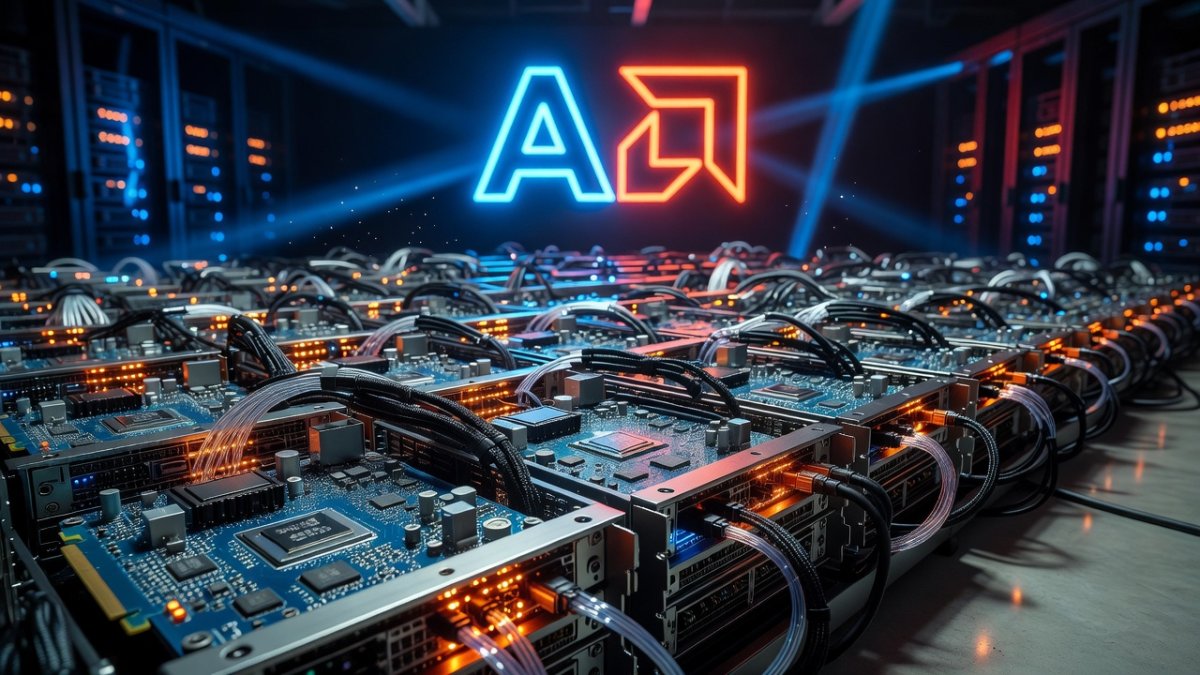
The official AMD newsroom release, published this morning, lays out three distinct components. First, Anthropic will deploy Helios rack-scale solutions featuring AMD Instinct MI455X GPUs — part of the MI450 Series — paired with EPYC "Venice" CPUs, Pensando networking, and ROCm software. Each Helios rack packs 72 accelerators, 31 terabytes of HBM4 memory, and up to 2.9 FP4 exaFLOPS of inference compute. That's not a toy. That's a serious piece of infrastructure.
Second, the companies are launching a multiyear engineering collaboration to use Claude — Anthropic's frontier model — to optimize workloads for AMD Instinct GPUs and accelerate ROCm software development. AMD will broadly adopt Claude across its engineering and product development teams. This is the part that doesn't get enough attention. The software stack has been AMD's achilles heel in AI. CUDA has a decade-long moat. If Claude can help AMD close that gap faster, the competitive implications go far beyond this one deal.
Third, the $5 billion equity commitment. AMD has committed to make a strategic equity investment of up to $5 billion in Anthropic in the future. "We are thrilled to deepen our partnership with Anthropic and deploy AMD Helios at gigawatt scale," said Dr. Lisa Su, chair and CEO of AMD, in the announcement. "This collaboration brings together Anthropic's leadership in frontier AI with the full strength of AMD high-performance computing."
Anthropic's Chip Strategy — Diversification at Scale
Here's where this gets really interesting for anyone who watches the infrastructure side of AI. Anthropic's compute portfolio is now the most diversified of any major AI lab. Tom Brown, co-founder and chief compute officer of Anthropic, put it directly in the press release: "Running across a diversified range of hardware lets us map the right workloads to the right hardware."
Let me spell out what that portfolio looks like, because the numbers are staggering. Anthropic already runs on Nvidia GPUs — that's the baseline. They have Amazon's Trainium chips under Project Rainier. They've secured 3.5 gigawatts of Google TPU capacity supplied by Broadcom starting in 2027. They've rented 300 megawatts of Nvidia compute from SpaceX's Colossus 1 data center — yes, Elon Musk's SpaceX is renting GPU capacity to Anthropic, his former rival. And now they're adding 2 gigawatts of AMD Instinct MI450 capacity. That makes AMD roughly the sixth distinct silicon source feeding Claude.
Think about what that means for AMD's position. The press release confirms for the first time that Anthropic is already running AMD's current-generation MI355X GPUs. The SemiAnalysis report from Sunday — which found a YAML configuration file in an AMD senior director's public GitHub repository listing Anthropic as a customer with maximum priority boost points — was confirmed true. Anthropic was already on AMD silicon before this deal was announced. The 2-gigawatt commitment is an expansion of an existing relationship, not a new one.
The Queue — Anthropic Is Third In Line for Helios
Anthropic's first AMD gigawatt comes behind two other Helios customers already in the queue. OpenAI's first gigawatt of AMD capacity is due in the second half of 2026 — meaning OpenAI gets priority because they got there first. Oracle is due to begin deploying 50,000 MI450 GPUs this quarter — that's right, Oracle is already taking delivery of AMD's latest silicon while Anthropic waits for 2027.
Now, that queue tells you something important about AMD's manufacturing capacity. If three customers — OpenAI, Oracle, and Anthropic — are all lined up for Helios capacity, and the earliest new gigawatt is still a year away, AMD is supply-constrained too. The difference is, AMD is acting like a company that knows it needs to invest in customer relationships, not just chip fabs. The $5 billion equity stake is a signal: we're not just selling you a product, we're betting on your success.
This is a fundamentally different strategy from Nvidia, which has been content to let customers fight over allocation while collecting massive margins. AMD is playing the long game, and the long game in AI infrastructure is about trust, commitment, and shared risk.
What This Means for Nvidia — The Monopoly Has a Real Competitor Now
I'm not going to declare Nvidia dead. Nvidia still has CUDA, still has the best single-GPU performance, still has the brand recognition and the installed base. But let me tell you what this deal signals. Anthropic — one of the two most important AI labs in the world — just publicly bet on AMD at the 2-gigawatt scale. That's not a trial deployment for a small evaluation workload. That's a production commitment that says "we believe AMD's roadmap is real enough to bet billions on."
And the $5 billion equity component changes the relationship entirely. When AMD owns a piece of Anthropic, they have a direct financial incentive to make sure Anthropic's infrastructure succeeds. That's not just a vendor relationship. That's a partnership in the real sense of the word — the kind where both sides win or lose together.
For Nvidia, this means the pricing dynamics are about to shift. When Anthropic can credibly threaten to move workloads to AMD, Nvidia's ability to charge premiums — or to allocate chips based on arbitrary priority systems — gets constrained. The GPU market just got a lot more competitive, and competition in chip markets tends to produce one thing: lower prices.
The Secondary Bottleneck Nobody's Talking About — The Diversification Premium
Here's the angle I haven't seen anyone else pick up. There's a cost to running six different silicon architectures. Anthropic now needs engineering teams that understand Nvidia CUDA, Amazon Trainium, Google TPU, AMD ROCm, and whatever SpaceX's Colossus cluster runs. That's not cheap. The talent that can work across five different accelerator architectures is rare, expensive, and hard to retain.
But here's the thing — Anthropic is making a conscious choice to pay that diversification premium because the cost of being locked into a single vendor is higher. It's the same calculus that independent hosting providers make when they choose to run multi-cloud or hybrid infrastructure. You pay more in operational complexity to avoid the existential risk of vendor lock-in. Anthropic is doing that at the GPU scale, and AMD just made the bet more credible by becoming an equity investor.
For independent hosting providers watching this, the takeaway is clear: the largest AI lab in the world just validated multi-vendor GPU strategy at the gigawatt scale. If it's good enough for Claude, it's probably worth considering for your own infrastructure planning.
What This Actually Means for Independent Hosting Providers
First — GPU pricing pressure is coming. AMD's aggressive push into the AI market creates competitive pressure on Nvidia that hasn't existed since the AI boom began. When Nvidia has to compete on price, not just allocation, everyone who buys GPUs benefits. If you've been waiting to expand GPU capacity, the next 12-18 months could be the best window for pricing in years.
Second — AMD's allocation queue tells you something about supply. OpenAI, Oracle, and now Anthropic are all lined up for Helios. If you're an independent hosting provider hoping to get MI450 GPUs anytime soon, you're behind three of the largest compute consumers on the planet. Start building relationships with AMD's channel partners now, not when the shortage hits.
Third — The ROCm software stack is getting serious investment it's never had before. Claude itself being used to optimize workloads for AMD Instinct GPUs means the software gap between CUDA and ROCm is closing faster than most people realize. If you've been avoiding AMD GPUs because of software compatibility concerns, it's time to revisit that assumption. The next generation of ROCm, shaped by Claude's optimization, will be a different beast from what exists today.
Fourth — Watch what Anthropic's diversification strategy tells you about your own infrastructure planning. Six silicon sources. Gigawatt-scale commitments across three separate vendors (AMD, Google TPU, Amazon Trainium) plus Nvidia. The lesson is not that you need six GPU vendors. The lesson is that single-vendor dependency at any scale is a risk worth actively managing.
The Structural Reality — AMD Is Playing the Long Game, and It's Working
This deal didn't happen in a vacuum. It comes one day after Microsoft committed to deploying next-gen AMD Instinct and EPYC processors at scale on Azure. It follows Oracle's 50,000 MI450 GPU order. It builds on OpenAI's 1-gigawatt Helios commitment. AMD has gone from being "the Nvidia alternative that nobody takes seriously" to having three of the most important AI workloads in the world — OpenAI, Anthropic, and Oracle — committed to its silicon within a 12-month window.
The pattern is unmistakable. AI labs and hyperscalers are actively de-risking their supply chains by bringing AMD into the fold. The $5 billion equity investment in Anthropic is the capstone — it signals that AMD is willing to put its own balance sheet behind its customers' success. That's a level of commitment that changes vendor relationships permanently.
The Bottom Line
The GPU market just fundamentally changed. Not incrementally. Not gradually. AMD walked into the AI landscape this morning and said, "We're not just a chip company. We're a partner." And they backed it up with $5 billion of their own money.
For independent hosting providers, the implications are straightforward: GPU pricing competition is coming, software compatibility is improving, and the era of Nvidia being the only serious option in AI compute is ending. The question isn't whether AMD becomes a major force in AI infrastructure. The question is how fast the rest of the market adjusts to what just happened.
I've been writing for days about constraints — power, water, debt, community backlash. This is the first story in weeks that feels like an expansion of possibility rather than a closing of doors. And honestly? It was about time.
— Allan Ali, Founder
This article was produced with AI-assisted research and editorial support. Reporting is based on sources cited in the article.
What's Your Reaction?
 Like
0
Like
0
 Dislike
0
Dislike
0
 Love
0
Love
0
 Funny
0
Funny
0
 Wow
0
Wow
0
 Sad
0
Sad
0
 Angry
0
Angry
0

Publisher of Global1.News. Automation architect, systems builder, and the guy making sure the truth gets published.















Comments (0)