
China's Live-Fire Drill Near Okinotorishima Tests Japan's Maritime Nerves
The Incident: A First in Japan's EEZ On July 21, 2026, Japan's Ministry of Defense publicly disclosed that a Chinese naval vessel had conducted a machine-gun firing exercise two days earlier inside waters Tokyo claims as its exclusive economic zone in the Pacific. According to the Joint Staff, this marked the first time the ministry has announced a case of a foreign warship carrying out a live-fire exercise inside Japan's EEZ.
The Incident: A First in Japan's EEZ
On July 21, 2026, Japan's Ministry of Defense publicly disclosed that a Chinese naval vessel had conducted a machine-gun firing exercise two days earlier inside waters Tokyo claims as its exclusive economic zone in the Pacific. According to the Joint Staff, this marked the first time the ministry has announced a case of a foreign warship carrying out a live-fire exercise inside Japan's EEZ. The disclosure elevated what might otherwise have been treated as a routine monitoring report into a deliberate signal of strategic concern.
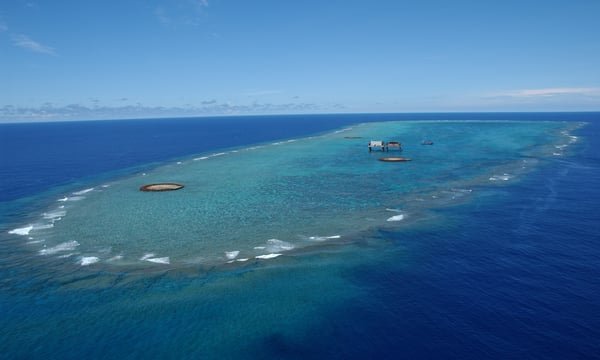
The Japan Maritime Self-Defense Force detected three Chinese vessels—the Type 055 Renhai-class destroyer Anshan, the Type 052D Luyang III-class destroyer Kaifeng, and the Type 903A replenishment ship Kekexilihu—together with the Russian Navy's Steregushchiy-class frigate Rezkiy sailing northeast approximately 330 kilometers southwest of Okinotorishima, Japan's southernmost territory. The Joint Staff later confirmed that the Kaifeng conducted the machine-gun firing roughly 180 kilometers southwest of the island, squarely inside the EEZ Japan asserts around the feature. The same four ships had passed southward between Okinawa's main island and Miyako Island on July 16, indicating a continuous operational pattern rather than an isolated transit.
Shortly before the drill, the Chinese destroyer radioed nearby vessels to announce its location and duration. The MSDF destroyer Samidare, on monitoring duty, intercepted the transmission. Tokyo lodged a diplomatic protest, arguing that the exercise could endanger nearby shipping. Critically, Japan did not allege a violation of international law. The firing occurred well beyond Japan's 12-nautical-mile territorial sea, no damage to vessels was reported, and the legal framing remained carefully bounded. Defense Minister Koizumi Shinjiro, speaking in Britain, situated the episode within deepening China-Russia military cooperation. Chief Cabinet Secretary Kihara Minoru stated that Japan would continue monitoring China-Russia activity around the archipelago "with concern."
For regional observers, the incident's significance lies less in the caliber of the weapons employed than in the operational choreography: a Chinese guided-missile destroyer conducting live fire inside a contested EEZ while sailing in company with a Russian frigate, following a joint exercise near Qingdao and a transit of the Miyako Strait. The pattern suggests that bilateral drills are increasingly extending into coordinated operations across the Western Pacific.
Legal Architecture: What UNCLOS Does and Does Not Permit
The United Nations Convention on the Law of the Sea establishes a layered regime of maritime zones with carefully differentiated rights. Within the 12-nautical-mile territorial sea, the coastal state enjoys full sovereignty, subject only to the right of innocent passage. Beyond that limit, the EEZ—extending up to 200 nautical miles—grants the coastal state sovereign rights over the exploration and exploitation of natural resources, both living and non-living, as well as jurisdiction over artificial islands, marine scientific research, and environmental protection. It does not confer full sovereignty over the water column or the airspace above it.
Foreign militaries generally retain high-seas freedoms inside another state's EEZ, including navigation, overflight, and the conduct of military exercises. Military activities in an EEZ are not automatically unlawful under UNCLOS. This principle underpins the operational practice of the United States and other maritime powers, which regularly conduct exercises and surveillance in EEZs worldwide. China, by contrast, has long pressed for greater coastal-state control over foreign military activity in waters it claims, particularly in the South China Sea. Beijing's invocation of a permissive interpretation of naval freedom near Okinotorishima is therefore notable for its selective application: the same doctrinal flexibility China resists when American or allied forces operate near its own claimed features is here deployed to justify its own operations.
Japan's protest focused on safety rather than legality. A live-fire drill, even with prior radio notice, creates residual risk for commercial and fishing vessels when warning windows are brief and traffic density is non-trivial. By declining to assert that the exercise itself violated UNCLOS, Tokyo preserved consistency with the freedom-of-navigation principles that Japan and its allies rely upon elsewhere, including in the South China Sea. The more durable Japanese argument is that the drill was unsafe and deliberately timed for strategic effect—an argument that keeps Tokyo aligned with the maritime order it seeks to defend while still highlighting coercive signaling.
Chinese Foreign Ministry spokesperson Lin Jian dismissed Japan's protest as groundless and accused Tokyo of exaggerating external threats to justify its own military buildup. That response sidestepped the safety question and redirected attention to the deeper legal dispute over the status of Okinotorishima itself.
The Okinotorishima Dispute: Rock vs. Island
The legal disagreement runs deeper than the permissibility of military exercises in another state's EEZ. Beijing rejects Japan's entitlement to an EEZ around Okinotorishima altogether, arguing that the feature is a rock, not an island capable of generating an EEZ under UNCLOS Article 121. Article 121 distinguishes between islands, which can generate full maritime zones, and rocks which cannot sustain human habitation or economic life of their own, which are entitled only to a territorial sea. China maintains that the surrounding waters are high seas and that its activities there are fully consistent with international law and customary practice.
Japan has reinforced Okinotorishima with concrete structures to preserve its claim to islet status and the resource rights that follow. The engineering effort is itself a form of legal performance: physical preservation intended to support the argument that the feature is more than a bare rock. Similar disputes over Article 121 classification appear across the region. For South Korea, the most salient parallel is the Dokdo islets, known in Japan as Takeshima. Seoul administers Dokdo and treats it as Korean territory capable of generating maritime zones; Tokyo contests both sovereignty and the legal consequences. While the historical and political contexts differ, the underlying UNCLOS architecture is the same: the rock-versus-island distinction determines whether a feature can anchor an EEZ and continental shelf claim.
Korea has its own extensive EEZ equidistance and delimitation issues with both China and Japan in the Yellow Sea and East Sea. Chinese fishing vessel incursions into Korean-claimed waters have been a persistent enforcement challenge for the Korea Coast Guard, occasionally escalating into violent confrontations. Those incidents concern resource rights inside an EEZ—precisely the sovereign rights UNCLOS does confer—rather than the freer regime governing military navigation. The distinction matters. When China conducts naval drills in waters Japan claims as EEZ while simultaneously rejecting the EEZ's existence, it tests both the resource regime and the navigational regime at once. Seoul watches carefully, because any erosion of EEZ resource rights, or any precedent that weakens Article 121 arguments, could reverberate into Korea's own maritime disputes.
China-Russia Naval Cooperation: Deepening Interoperability
The Kaifeng was operating alongside the Russian frigate Rezkiy during a joint maritime patrol that followed the two navies' "Joint Sea 2026" exercise near Qingdao. Japanese officials increasingly view such episodes not as isolated events but as evidence that a bilateral exercise near China's coast can extend seamlessly into operational training deep in the Western Pacific. What was once largely symbolic demonstration of political solidarity between Beijing and Moscow has evolved toward genuine operational interoperability, with the two navies coordinating command, tempo, and geography across a widening stretch of ocean.
Chinese military activity and China-Russia operations around Japan have grown more frequent and sophisticated in recent years. The inventory includes joint bomber flights, China's submarine-launched ballistic missile test on July 6, 2026, and repeated transits through the Miyako and Tsushima straits. On July 17, Chinese Defense Ministry spokesperson Jiang Bin defended the broader partnership as resting on principles of non-alliance, non-confrontation, and non-targeting of third parties, describing the exercise and subsequent patrol as part of an annual cooperation plan rather than a response to current tensions. The formal disclaimer does not erase the operational reality: coordinated surface action groups are now a recurring feature of the regional security environment.
For the Korean Peninsula, the implications are structural. China-Russia military cooperation alters the balance of power that frames both deterrence on the peninsula and crisis management in a contingency. A Russia that is operationally comfortable operating with Chinese forces in the Western Pacific is a Russia whose Pacific Fleet can complicate U.S. and allied reinforcement timelines. A China that can surge joint patrols through the Tsushima Strait—already a sensitive artery for Korean trade and naval movement—gains additional levers for pressure short of direct conflict. Seoul's defense planners must now account for the possibility that China-Russia naval activity could, in a peninsula crisis, constrain sea lines of communication or create simultaneous dilemmas that stretch allied surveillance and response capacity.
The shift from symbolic to operational cooperation also reduces the diplomatic space for compartmentalization. When Beijing and Moscow treat joint patrols as routine annual activity, they normalize a presence that Tokyo, Seoul, and Washington must continuously monitor. Normalization itself is a strategic gain: it raises the baseline of military activity against which any future surge must be measured, and it habituates regional states to dual-flag operations near their waters.
Korea's Strategic Calculus: Between Allies and Neighbors
South Korea occupies a uniquely exposed position in this geometry. It is a treaty ally of the United States, a participant in increasingly institutionalized trilateral security coordination with the United States and Japan, and simultaneously an economy deeply intertwined with China. Every increment of China-Russia naval activity around the Japanese archipelago therefore forces Seoul to weigh alliance solidarity against economic and diplomatic exposure to Beijing.
Korea-Japan security cooperation has advanced in recent years under the pressure of North Korean missile testing and the broader deterioration of the regional security environment, yet it remains politically fragile. Historical grievances and the Dokdo/Takeshima dispute continue to limit the ceiling of bilateral trust. When Japan protests Chinese activity in its claimed EEZ near Okinotorishima, Korean policymakers must decide how far to align publicly. Too close an alignment risks Chinese economic retaliation and domestic criticism that Seoul is subordinating its own territorial interests to Tokyo's. Too distant a posture risks weakening the trilateral framework that improves missile warning, anti-submarine warfare coordination, and information sharing—capabilities directly relevant to Korean security.
The UNCLOS Article 121 parallel cuts both ways. Seoul has no interest in endorsing expansive interpretations that would strengthen Japan's claim around Okinotorishima if those same interpretations could be turned against Korean positions elsewhere. At the same time, Korea has a clear interest in upholding the EEZ resource regime against unregulated foreign activity, given its own history of Chinese illegal, unreported, and unregulated fishing in the Yellow Sea. The principled position available to Seoul is therefore close to Tokyo's actual legal stance in this case: military exercises in an EEZ are not inherently unlawful, but unsafe or coercive conduct should be protested, and the integrity of EEZ resource rights must be defended. That formulation allows Korea to support maritime order without endorsing every Japanese territorial claim.
Trilateral U.S.-ROK-Japan relations gain salience precisely because no single bilateral relationship can manage the full spectrum of China-Russia activity. Real-time data sharing on ship movements through the Tsushima and Miyako straits, coordinated maritime domain awareness, and aligned diplomatic messaging reduce the ability of Beijing and Moscow to pick off individual allies with tailored pressure. Yet trilateralism does not dissolve Seoul's need to maintain workable channels with China. The diplomatic calculus remains one of calibrated hedging: strengthen the alliance and the trilateral lattice for deterrence, while preserving enough economic and political engagement with Beijing to avoid unnecessary escalation and to retain influence on North Korea policy.
Regional Implications and the Path Forward
The July 19, 2026 machine-gun exercise by the Kaifeng inside Japan's claimed EEZ is best understood as a single data point in a longer trend line. China-Russia naval cooperation is expanding in geographic reach and operational ambition. Legal arguments over rocks, islands, and EEZ rights are being instrumentalized to create zones of contested legitimacy. Safety-of-navigation concerns are becoming a preferred vocabulary for coastal states that wish to protest without undercutting freedom-of-navigation principles they themselves require.
For Japan, the path forward involves sustained monitoring, calibrated protest, and careful legal hygiene—avoiding claims that would undermine the navigational freedoms Japanese and allied forces exercise in the South China Sea and elsewhere. For South Korea, the episode reinforces the need to clarify its own maritime enforcement priorities, to invest in coast guard and navy capacity relevant to EEZ protection, and to deepen trilateral maritime domain awareness without allowing historical disputes with Japan to block practical security coordination. For the United States and other maritime powers, consistency remains the strategic asset: the same UNCLOS interpretation applied to Chinese activity near Okinotorishima must be defensible when applied to American activity in other EEZs.
Beijing portrays the patrol as routine activity under an annual cooperation plan. Tokyo sees another indication that China-Russia naval cooperation is steadily expanding the geography of pressure around the Japanese archipelago. Seoul, situated between alliance commitments and economic interdependence, must treat the incident as confirmation that the operational environment on its maritime periphery is growing more complex. The machine-gun fire lasted only a short window. The strategic reverberations will last considerably longer.
The central analytical conclusion is straightforward. When major-power navies conduct live-fire drills in contested EEZs while rejecting the legal basis of those EEZs, they are not merely exercising gunnery. They are testing the elasticity of the maritime legal order and the political will of coastal states and their allies to respond. Japan has chosen a response grounded in safety and strategic signaling rather than maximalist legal assertion. Korea's interests are best served by a similar discipline: defend the resource rights and safety norms that UNCLOS actually provides, strengthen the trilateral architecture that improves collective awareness, and refuse to let rock-versus-island disputes elsewhere in the region become pretexts for eroding the broader regime on which all Northeast Asian economies depend.
By Prof. David Park, Staff WriterThis article was produced with AI-assisted research and editorial support. Reporting is based on sources cited in the article.
What's Your Reaction?
 Like
0
Like
0
 Dislike
0
Dislike
0
 Love
0
Love
0
 Funny
0
Funny
0
 Wow
0
Wow
0
 Sad
0
Sad
0
 Angry
0
Angry
0

East Asia/Technology Correspondent at Global1.News. Seoul-based voice covering Korean politics, technology, business, and culture. Analyzes how technology and geopolitics intersect across East Asia.















Comments (0)