
North Korea's Quiet Campaign for Nuclear Legitimacy: Language, Law, and the Collapse of Sanctions
North Korea's Quiet Campaign for Nuclear Legitimacy: Language, Law, and the Collapse of Sanctions The Collapse of Universal Sanctions Oversight The 2024 Russian veto at the United Nations Security Council terminated the mandate of the Panel of Experts, which had operated since 2009 as the primary mechanism for monitoring implementation of sanctions against North Korea. This dec
The Collapse of Universal Sanctions Oversight
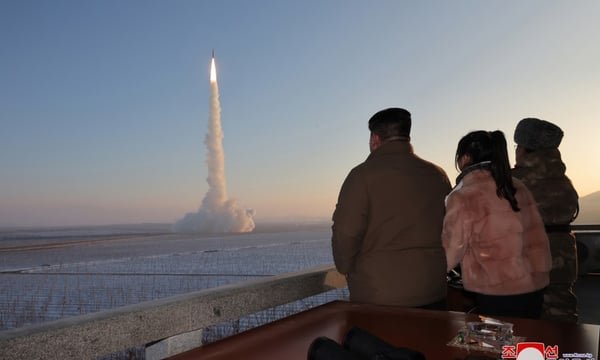
The 2024 Russian veto at the United Nations Security Council terminated the mandate of the Panel of Experts, which had operated since 2009 as the primary mechanism for monitoring implementation of sanctions against North Korea. This decision removed the only body with a universal mandate to investigate violations across all member states. In its place, an 11-state coalition formed the Multilateral Sanctions Monitoring Team, yet this group operates without Security Council authorization and relies solely on voluntary reporting from participating governments.
The MSMT has estimated that North Korea obtained approximately $1.6 billion through cryptocurrency theft operations between 2017 and 2023. These figures derive from national intelligence assessments rather than a centralized UN process. Because the team lacks a Security Council mandate, its communiqués carry no binding legal weight and cannot compel cooperation from non-member states.
Russia and China have begun to dispute any findings issued outside the former UN framework, arguing that such reports lack procedural legitimacy. This stance effectively shields North Korean procurement networks from coordinated international pressure. The resulting fragmentation forces individual governments to decide whether to act on coalition data without the cover of universal consensus.
For the Republic of Korea, the absence of a UN-mandated monitoring body complicates enforcement of its own unilateral sanctions measures. Seoul must now coordinate with the MSMT while navigating Chinese and Russian objections at the Security Council. This environment requires the Yoon administration to strengthen bilateral intelligence-sharing arrangements with the United States and Japan to compensate for the lost multilateral channel.
Linguistic Strategies in Korean State Media
North Korean state media consistently employs the phrase 책임 있는 핵보유국, which translates literally as "responsible nuclear weapons state." English renderings frequently omit the adjective "responsible," thereby stripping the term of its normative claim that Pyongyang exercises restraint and deserves recognition. This omission obscures the deliberate effort to position North Korea as a mature nuclear actor rather than a proliferator.
The distinction between 핵억제력 and 핵무기 further embeds legitimacy claims within Korean-language discourse. 핵억제력 frames the arsenal as a defensive capability necessary for survival, whereas 핵무기 denotes the physical weapons themselves. Analysts relying solely on English translations often miss how the former term normalizes the program as an enduring element of national defense policy.
Pyongyang has also revived the rhetoric of "horizontal proliferation" to accuse the United States and its allies of spreading nuclear technology while deepening its own military cooperation with Russia. This inversion allows state media to present North Korea as a defender of non-proliferation norms even as it transfers conventional arms and ballistic missile components. The nuance remains largely invisible to English-language audiences who encounter only the surface-level condemnation.
Foreign analysts who overlook these lexical choices underestimate the sophistication of Pyongyang's legitimacy campaign. Korean-language monitoring reveals a coherent strategy that seeks to shift the Overton window within elite discourse in Beijing and Moscow. Without sustained attention to original texts, external assessments risk understating the durability of North Korea's narrative positioning.
The 2022 Nuclear Law and Its Strategic Codification
In September 2022 the Supreme People's Assembly enacted a statute that formally codified North Korea's status as a nuclear weapons state and outlined conditions under which nuclear weapons might be used. The law removed any textual reference to the program serving as a temporary bargaining instrument. This legislative step occurred after Russian and Chinese vetoes in May 2022 blocked further tightening of sanctions, thereby ending two decades of great-power consensus on the issue.
By embedding the nuclear arsenal within permanent national security legislation, Pyongyang signaled that future negotiations would address only arms control rather than denuclearization. The statute also established domestic legal procedures for command and control, reinforcing the impression of an institutionalized deterrent force. Such codification raises the domestic political cost for any future leadership contemplating rollback.
The Yoon administration in Seoul responded by reaffirming that the Republic of Korea would never recognize North Korea as a nuclear weapons state. This position aligns with the 1992 Joint Declaration on the Denuclearization of the Korean Peninsula yet faces increasing diplomatic isolation as other capitals adjust to the new legal reality in Pyongyang. Seoul has therefore intensified trilateral coordination with Washington and Tokyo to maintain a unified stance against status recognition.
Analysts note that the 2022 law effectively closed the window on the "complete, verifiable, irreversible denuclearization" formula that had guided previous rounds of talks. The statute's permanence clause now serves as a legal bulwark against external pressure. South Korean policymakers must therefore recalibrate expectations for any future dialogue while preserving the principle of non-recognition.
Inverting the Non-Proliferation Narrative
North Korea's rhetorical inversion of horizontal proliferation accusations has accelerated since the Panel of Experts disbanded. State media now routinely charges the United States with enabling proliferation through extended deterrence arrangements while simultaneously expanding conventional arms transfers to Russia. This dual posture seeks to erode the moral authority of the non-proliferation regime without directly challenging its formal texts.
Evidence of North Korean artillery shells and missile components appearing on the battlefield in Ukraine has intensified scrutiny of the deepening Pyongyang-Moscow partnership. The absence of a UN monitoring body has reduced the political cost of such cooperation. Russia's veto power at the Security Council further insulates these transactions from formal censure.
The NPT framework faces mounting strain as a recognized nuclear weapons state openly engages in military trade with a permanent Security Council member. Regional stability suffers because South Korea and Japan must now account for the possibility that North Korean systems tested in Ukraine will return with combat-derived improvements. This feedback loop accelerates the very capability growth that sanctions were intended to slow.
For the Republic of Korea, the shifting narrative complicates diplomatic positioning between Washington, Beijing, and Moscow. Seoul cannot easily isolate the nuclear issue from broader great-power competition. Maintaining pressure therefore requires careful calibration of economic measures that avoid provoking Chinese countermeasures while preserving alliance cohesion with the United States.
Implications for Inter-Korean Relations
Pyongyang's legitimacy campaign narrows the space for future inter-Korean dialogue by redefining the baseline from which negotiations might begin. Seoul's longstanding refusal to recognize nuclear status remains formally intact, yet the fragmentation of international consensus makes this stance increasingly difficult to sustain in practice. Any future talks will likely confront demands that South Korea address North Korea's deterrent as a permanent reality rather than a reversible program.
The linguistic campaign influences the terms of negotiation by introducing concepts such as "responsible nuclear weapons state" into elite discourse. If Chinese and Russian officials begin echoing these phrases, Seoul may face pressure to accept limited arms-control discussions that implicitly grant status. This development would mark a significant departure from the denuclearization-first approach maintained since 1992.
Analysts should monitor several concrete metrics to gauge the campaign's traction. The frequency of the term "responsible" in Rodong Sinmun editorials provides one indicator of narrative emphasis. The tone of Chinese and Russian responses to MSMT reports offers another signal of whether great-power consensus is eroding further. Finally, the regularity and detail of MSMT reporting cycles will reveal whether the coalition can sustain credible documentation without a UN mandate.
Should these indicators show continued North Korean gains, Seoul may need to develop new diplomatic instruments that preserve the non-recognition principle while engaging Pyongyang on risk-reduction measures. Such instruments could include military confidence-building protocols that do not require formal status acknowledgment. The sustainability of Seoul's current posture will depend on whether the Yoon administration can rally sufficient international support to offset the loss of universal sanctions oversight.
The Road Ahead: Monitoring Without Mandate
The MSMT's own members have formally requested that the Security Council reconstitute the Panel of Experts, an implicit acknowledgment that voluntary coalitions cannot replicate the authority of a UN mandate. Documentation produced by the team remains valuable for national policy but lacks the enforcement mechanisms that once accompanied Security Council resolutions. This gap underscores the distinction between information gathering and actual sanctions implementation.
As enforcement authority fragments, the contest over language and legal framing gains rather than loses importance. North Korea's ability to embed legitimacy claims in Korean terminology and domestic statute now operates with fewer external constraints. South Korean analysts must therefore treat linguistic monitoring as a core component of strategic assessment rather than a secondary academic exercise.
For the Republic of Korea, tracking Korean-language signals alongside institutional developments at the United Nations and within the MSMT coalition is essential for calibrating both deterrence posture and dialogue readiness. The Yoon administration has already increased resources devoted to open-source analysis of Rodong Sinmun and other official publications. Sustained investment in this domain will help Seoul anticipate shifts in Pyongyang's negotiating posture before they appear in English-language reporting.
Ultimately, the erosion of universal oversight does not eliminate the possibility of renewed multilateral pressure, but it does raise the threshold for achieving such pressure. South Korea's foreign policy must therefore combine robust alliance coordination with independent analytical capacity to navigate an environment in which North Korea's legitimacy campaign proceeds largely unchecked by institutional mechanisms.
By Prof. David Park, Staff WriterThis article was produced with AI-assisted research and editorial support. Reporting is based on sources cited in the article.
What's Your Reaction?
 Like
0
Like
0
 Dislike
0
Dislike
0
 Love
0
Love
0
 Funny
0
Funny
0
 Wow
0
Wow
0
 Sad
0
Sad
0
 Angry
0
Angry
0
East Asia/Technology Correspondent at Global1.News. Seoul-based voice covering Korean politics, technology, business, and culture. Analyzes how technology and geopolitics intersect across East Asia.













Comments (0)