
Bafana Bafana Qualify for 2026 World Cup After 3-0 Win
**Meta Description:** Bafana Bafana ended a 24-year World Cup absence by beating Rwanda 3-0 at Mbombela Stadium to top Group C. Thalente Mbatha, Oswin Appollis and Evidence Makgopa scored while Hugo Broos masterminded the historic night. (158 chars) **Keywords:** Bafana Bafana, 2026 World Cup, Hugo Broos, Oswin Appollis, Mbombela Stadium, South Africa football, FIFA World Cup q
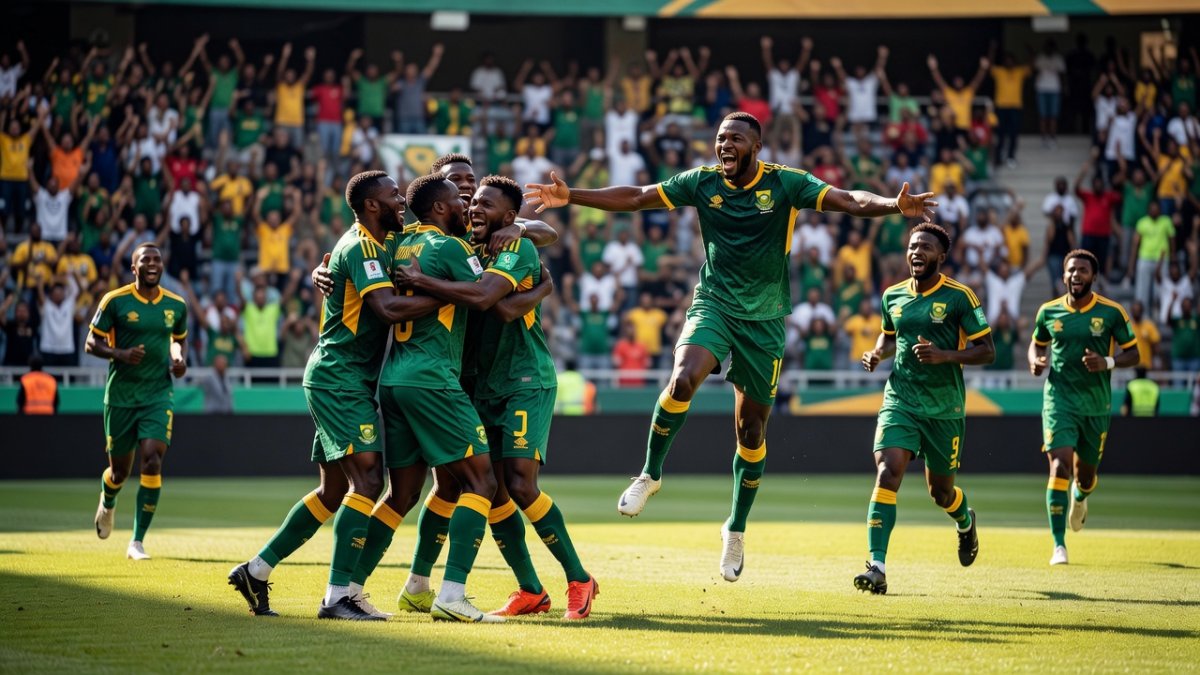
Bafana Bafana Qualify for 2026 World Cup After 3-0 Rwanda Win
On 14 October 2025, Mbombela Stadium in Nelspruit witnessed history as Bafana Bafana defeated Rwanda 3-0 to secure top spot in Group C and qualify for the 2026 FIFA World Cup. The 3-0 scoreline ended South Africa’s 24-year absence from the global showpiece, last achieved in 2002. Captain Ronwen Williams led a largely PSL-based squad that delivered a performance of maturity and clinical finishing. Coach Hugo Broos, appointed in May 2021, watched his side dominate from the opening whistle. The result also confirmed South Africa’s place ahead of Nigeria, who beat Benin 4-0 in Uyo on the same night. For a nation starved of major-tournament football, the victory represented far more than three points; it marked a collective national resurgence.
Tags: Bafana Bafana, 2026 World Cup, Hugo Broos, Oswin Appollis, Mbombela Stadium, South Africa football, FIFA World Cup qualification, Ronwen Williams, Evidence Makgopa, Thalente Mbatha, AFCON 2025, PSL, Gayton McKenzie
The Night Bafana Roared Back
Mbombela Stadium was alive with anticipation as thousands of South African supporters packed into the stands. The atmosphere crackled with nervous energy mixed with genuine belief that this could finally be the night the 24-year drought ended. Flags in green and gold waved from every corner while drums pounded in the stands, creating a soundtrack that echoed across the Lowveld. Hugo Broos had set his team up in a disciplined 4-2-3-1 that emphasised quick transitions and high pressing. Ronwen Williams organised the backline from his Mamelodi Sundowns base, ensuring every player knew their defensive responsibilities before the first whistle. From the opening exchanges Bafana dominated possession, moving the ball with purpose through midfield. The crowd responded instantly to every completed pass, their voices rising each time Oswin Appollis received the ball on the left. The first half belonged entirely to South Africa. Rwanda struggled to escape their own half as Broos’s side pressed with intensity rarely seen in recent years. Supporters sensed the breakthrough was imminent, and the energy inside the stadium only grew louder as the minutes ticked by.
How the Goals Unfolded
The opening goal arrived just five minutes in, and it was worth the wait. Thalente Mbatha collected a loose ball thirty yards from goal and unleashed a low, swerving drive that arrowed into the bottom corner. The Mbombela crowd erupted as the 23-year-old midfielder wheeled away in celebration, his first international goal arriving at the perfect moment. Oswin Appollis had already begun his influential evening by winning the initial turnover that led to the strike. Twenty-one minutes later Appollis turned provider into goalscorer. Collecting a pass on the edge of the box, he shifted the ball onto his stronger foot and curled a precise finish beyond the goalkeeper. The 26th-minute strike gave Bafana a two-goal cushion and confirmed Appollis’s involvement in every goal of the night. In the 72nd minute he delivered a pinpoint corner that Evidence Makgopa met with a powerful header. The striker’s 72nd-minute goal sealed the 3-0 victory and sparked wild celebrations across the stadium. Each moment showcased the blend of youth and tactical discipline Broos has instilled since 2021.
The Road to North America
With qualification secured, attention now turns to what awaits Bafana Bafana at the 2026 FIFA World Cup. Drawn in Group A alongside hosts Mexico, South Korea and the winner of a European play-off, South Africa will open their campaign against the Mexicans in a match that promises both opportunity and challenge. The expanded 48-team format offers more matches but also demands greater squad depth. Broos will need to manage the physical demands of playing in North America during summer conditions while maintaining the high-pressing style that delivered qualification. Most of the current squad ply their trade in the PSL, giving them familiarity with one another but limited exposure to the intensity of European or South American opposition. The guaranteed prize money of $11 million will provide vital resources for preparation. Facing Mexico first presents a chance to make an early statement, yet the presence of South Korea’s organised midfield will require careful tactical adjustments. The road ahead is long, but the foundation built at Mbombela Stadium offers genuine hope.
A Nation United — Political and Social Impact
When the final whistle blew at Mbombela Stadium, the celebrations extended far beyond Nelspruit. Minister of Sport, Arts and Culture Gayton McKenzie captured the national mood when he declared: “You did not just win a football match, you made a powerful statement about what is possible when South Africans believe, unite and fight together. Halala Bafana Bafana!” His words resonated across provinces where football remains a unifying force. The victory highlighted the continued importance of the PSL in developing talent, with the majority of the squad already established at domestic level. Transformation efforts at grassroots level now gain renewed momentum as young players see a clear pathway to the national team. The result also reinforces the need for sustained investment in coaching structures and facilities outside major cities. For communities still recovering from economic pressures, the qualification offers a rare moment of collective pride that transcends everyday challenges. The political and social impact will be measured not only in headlines but in renewed participation numbers at schools and amateur clubs across the country.
From Hugo Broos to World Cup Glory
When Hugo Broos took over as Bafana Bafana head coach in May 2021, few could have predicted this rapid rise. The Belgian inherited a side that had failed to reach the 2022 World Cup and immediately began a patient rebuild focused on youth and tactical clarity. He identified and blooded talents such as Oswin Appollis, Thalente Mbatha and the emerging attacking options that now form the spine of the team. Broos’s philosophy of compact defending and quick, vertical attacks has transformed the side from reactive to proactive. His relationship with SAFA has remained steady despite occasional public scrutiny, allowing him the time needed to implement long-term plans. Captain Ronwen Williams has been central to that stability, providing leadership both on and off the pitch from his Mamelodi Sundowns base. The 3-0 win over Rwanda represented the culmination of three years of deliberate work rather than a single lucky night. Broos has repeatedly stressed that qualification is only the beginning, yet the journey from 2021 to 2024 already stands as one of the most successful coaching tenures in recent South African football history.
What This Means for South African Football
Bafana Bafana’s return to the World Cup stage sends ripples far beyond the national team. The PSL now carries added prestige as the primary development pathway, encouraging clubs to invest further in academies. Grassroots programmes across provinces can point to Mbatha, Appollis and Makgopa as proof that domestic pathways lead to international success. Preparation for the 2025 AFCON in Morocco will serve as an important warm-up, allowing Broos to test squad depth against stronger African opposition. The $11 million guaranteed prize money provides SAFA with resources for improved training camps, medical support and scouting networks ahead of 2026. Long-term legacy depends on maintaining momentum rather than resting on one result. Schools football and amateur leagues stand to benefit from increased sponsorship interest following the qualification. If the federation channels funds wisely, the Mbombela night could mark the start of sustained competitiveness rather than another isolated peak in South African football history.
What to Watch For
The celebrations will continue across South Africa, but the work has only just begun. Friendlies against strong European and South American sides are already being arranged to prepare the squad for the demands of the expanded World Cup. The 2025 AFCON in Morocco offers a chance to build further confidence before the main event. Key players to monitor include Oswin Appollis, whose creativity was decisive against Rwanda, Thalente Mbatha, whose long-range threat adds a new dimension, Evidence Makgopa’s aerial presence, and captain Ronwen Williams’s organisational leadership. The road ahead includes a challenging group-stage opener against Mexico and the need to manage expectations at home. For South African fans the message is clear: qualification is the platform, not the destination. With Hugo Broos still at the helm and a young core maturing together, the next chapter of Bafana Bafana football promises to be the most exciting in a generation.
By Dante Williams, Staff Writer
This article was produced with AI-assisted research and editorial support. Reporting is based on sources cited in the article.
What's Your Reaction?
 Like
0
Like
0
 Dislike
0
Dislike
0
 Love
0
Love
0
 Funny
0
Funny
0
 Wow
0
Wow
0
 Sad
0
Sad
0
 Angry
0
Angry
0

Breaking News and Investigations Correspondent at Global1.News. Based in London, covering global breaking news, security, and investigative stories. Known for digging deeper and connecting the dots across continents.









Comments (0)