
Japan Fry to Fly Program Boosts SAF from Used Cooking Oil
Japan's SAF Production Targets and Domestic Sourcing Strategy Japan, the world's fourth-largest economy, has set a clear benchmark for sustainable aviation fuel adoption. Government estimates indicate a requirement of approximately 1.7 million kiloliters of SAF by 2030 to support decarbonization in the aviation sector. The strategy prioritizes domestic sourcing, particularly th
Japan's SAF Production Targets and Domestic Sourcing Strategy
Japan, the world's fourth-largest economy, has set a clear benchmark for sustainable aviation fuel adoption. Government estimates indicate a requirement of approximately 1.7 million kiloliters of SAF by 2030 to support decarbonization in the aviation sector. The strategy prioritizes domestic sourcing, particularly through conversion of used cooking oil, to reduce reliance on imports and align with broader energy security objectives under METI oversight.
This approach integrates with Japan's national climate commitments and the aviation industry's need to lower lifecycle emissions. Officials have outlined a replacement target of 10 percent of domestic jet fuel consumption with SAF by 2030, projecting an expected supply level of 1.92 million kiloliters to provide a buffer above minimum needs.
The Fry to Fly Collection Program and Household Engagement
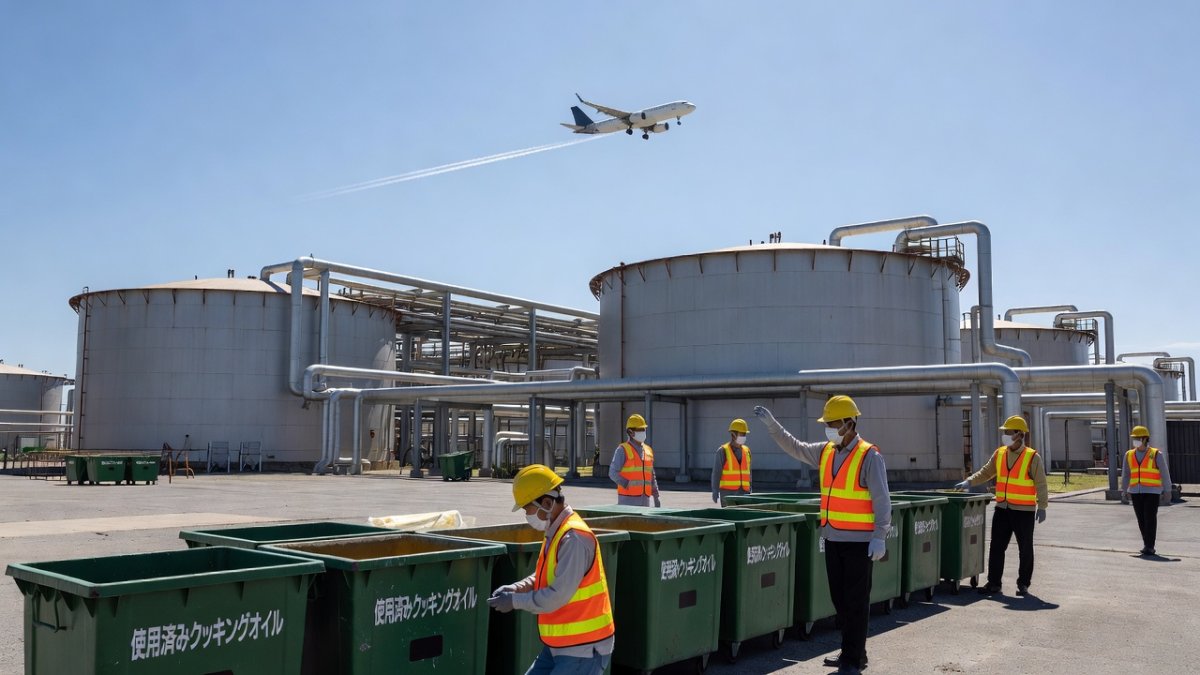
The "Fry to Fly" program represents a practical mechanism for gathering feedstock at scale. It enlists households and businesses to donate used cooking oil, with roughly 300 collection points established nationwide. Participants such as homemaker Maki Watanabe contribute directly, channeling waste oil into the SAF supply chain rather than disposal routes.
Collection infrastructure remains modest in geographic coverage but is designed for expansion. The program emphasizes accessibility for ordinary citizens, creating a distributed network that supplements industrial sources. Early participation data suggest steady uptake, though precise volume metrics from the initial rollout phase are still being compiled by program administrators.
Cosmo Energy's Sakai Refinery Operations and Output Goals
Cosmo Energy, Japan's third-largest oil refiner, operates dedicated SAF production at its Sakai refinery in western Japan. The facility converts used cooking oil into drop-in sustainable aviation fuel that meets international certification standards. Major Japanese carriers have already begun receiving refills of this domestically produced SAF.
Takeshi Takada, General Manager of New Business Development at Cosmo Energy, has stated the company's objective: "Our goal is to increase SAF supply to 300,000 kiloliters by 2030 through both domestic production and imports." This target forms a significant portion of the national supply picture and reflects parallel efforts to secure additional feedstock volumes abroad where domestic collection falls short.
Feedstock Economics and Technical Advantages of Used Cooking Oil
Used cooking oil offers a cost-effective feedstock relative to other SAF pathways such as power-to-liquid or advanced biomass routes. Its established collection logistics and lower processing complexity support faster scaling within existing refinery configurations. Cosmo Energy's Sakai operations demonstrate how legacy infrastructure can be adapted without requiring entirely new capital-intensive plants.
Nevertheless, volume limitations remain inherent. Even with expanded household participation, used cooking oil alone cannot satisfy the full 1.7 million kiloliter requirement. Policymakers therefore anticipate a blended supply model that combines domestic waste oil with imported SAF and alternative feedstocks in later phases of the 2030 timeline.
Integration with METI Aviation Decarbonization Policy
METI has coordinated the SAF initiative as part of Japan's wider energy transition framework. The 10 percent replacement goal by 2030 links directly to international aviation agreements and domestic net-zero pathways. Policy instruments include production incentives, feedstock certification standards, and collaboration with airlines to ensure offtake agreements that de-risk refinery investments.
Corporate Japan, including refiners and carriers, participates through public-private working groups. These forums address supply chain bottlenecks and monitor progress against the 1.92 million kiloliter expected supply figure. The measured pace of implementation reflects recognition that infrastructure build-out and collection network growth require phased advancement rather than immediate full-scale enforcement.
Outlook for Japanese Carriers and Regional Supply Chains
Japanese airlines now incorporate domestically produced SAF from waste cooking oil into regular operations at select airports. This marks an operational milestone that validates the end-to-end chain from household collection to aircraft refueling. Continued growth depends on increasing collection density beyond the current 300 points and securing consistent volumes from both households and commercial kitchens.
Regional supply chains will likely evolve to include additional refineries and import terminals. Cosmo Energy's dual-track approach of domestic output plus imports provides a template other Japanese energy firms may follow. The overall trajectory supports Japan's position in global aviation decarbonization while reinforcing energy resilience through localized feedstock use.
Tags: sustainable aviation fuel, Japan SAF 2030, used cooking oil collection, Fry to Fly, Cosmo Energy Sakai, METI policy, Takeshi Takada, aviation decarbonization
By Kenji Tanaka, Staff Writer
This article was produced with AI-assisted research and editorial support. Reporting is based on sources cited in the article.
What's Your Reaction?
 Like
0
Like
0
 Dislike
0
Dislike
0
 Love
0
Love
0
 Funny
0
Funny
0
 Wow
0
Wow
0
 Sad
0
Sad
0
 Angry
0
Angry
0

Japan Correspondent at Global1.News. Tokyo-based voice covering Japanese politics, technology, economy, and culture. Tracks the intersection of tradition and innovation in one of the world's most dynamic societies.














Comments (0)