
Decanters and Deepfakes: How AI-Generated Videos Are Reshaping Ontario's Political Landscape
Decanters and Deepfakes: How AI-Generated Videos Are Reshaping Ontario's Political Landscape Ontario politics has long embraced sharp satire, from newspaper cartoons lampooning premiers in the nineteenth century to modern television programmes such as This Hour Has 22 Minutes that skewer federal and provincial figures alike. In June 2026 a new form of critique has emerged, one
Decanters and Deepfakes: How AI-Generated Videos Are Reshaping Ontario's Political Landscape
Ontario politics has long embraced sharp satire, from newspaper cartoons lampooning premiers in the nineteenth century to modern television programmes such as This Hour Has 22 Minutes that skewer federal and provincial figures alike. In June 2026 a new form of critique has emerged, one that harnesses generative artificial intelligence to produce music videos and fabricated speeches with startling speed and low cost. These creations, ranging from whimsical LEGO animations to realistic deepfakes of Mayor Olivia Chow, are forcing voters, journalists and lawmakers to reconsider how political messages travel and how citizens can distinguish fact from invention in an increasingly crowded information environment.
Tags: AI deepfakes, Ontario politics, Doug Ford, generative AI, political satire, Marit Stiles, deepfake videos, Toronto mayor, Ebrahim Bagheri, Alex Huot, Canadian democracy, IntegrityTO, media literacy, Suno AI, Flashbulb monitoring
The Gravy Plane Parody and Its Political Details
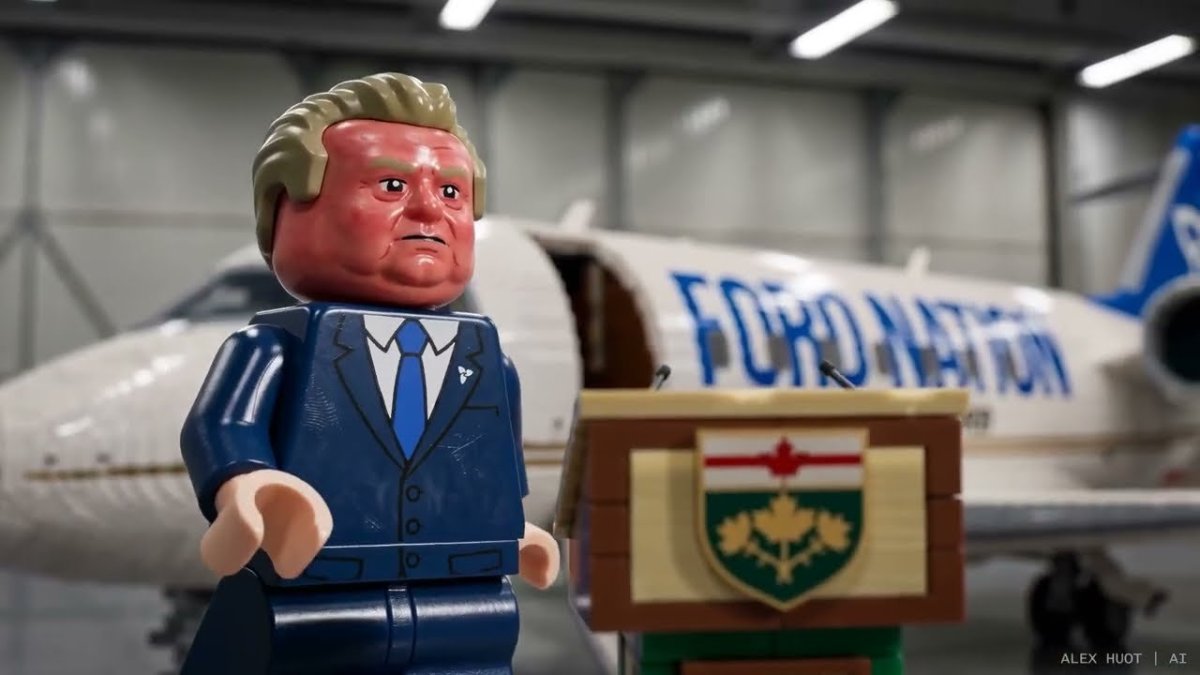
Toronto, Ontario — June 6, 2026 — A crystal decanter of amber whiskey, two lowball tumblers, a small mirror tray and a gold chain set the scene inside a private jet where a LEGO minifigure of Premier Doug Ford, complete with puffy flushed face and sandy blonde combed-over hair, lounges while a country-music soundtrack mocks the government’s brief dalliance with a twenty-nine-million-dollar aircraft. The video titled The Gravy Plane has accumulated hundreds of thousands of views across YouTube, TikTok, Instagram, X and Facebook since its release, embedding subtle references such as a buzzing cellphone displaying a court order for records and a hospital bed parked in a hallway, details familiar only to attentive followers of Ontario health-care debates. These visual Easter eggs transform a simple parody into a layered commentary that rewards political knowledge while entertaining casual viewers who may simply enjoy the catchy tune and absurd LEGO aesthetic.
The production required roughly four hundred words of carefully crafted prompts fed into several artificial-intelligence systems, a process that would appear incoherent to human readers yet yields coherent three-dimensional scenes once interpreted by the models. Historical Canadian political satire, whether through editorial cartoons during the conscription crises or televised sketches during the sponsorship scandal, always relied on skilled artists or writers; here the barrier to entry has collapsed dramatically. The result is a piece of content that circulates rapidly among Ontario residents already sceptical of the Progressive Conservative government’s spending choices, amplifying existing grievances without requiring traditional media gatekeepers.
Creator Alex Huot: An Accidental Political Satirist
Alex Huot, originally from Ottawa and now based in Switzerland after leaving the Canadian restaurant industry twenty-five years ago, describes himself as an AI storyteller rather than a partisan operative. He estimates that the Miami Vice meets Etobicoke interior scenes inside the jet demanded a dozen iterative attempts before the lighting, reflections and minifigure expressions aligned with his vision, yet the entire project from lyric writing to final edit consumed only one week. Huot pays several hundred dollars monthly out of pocket for subscriptions to Suno for music generation, Nano Banana for image refinement and Higgsfield for video synthesis, tools that allow a single individual to orchestrate sound, visuals and narrative without a studio or crew.
Huot insists no political party commissioned either The Gravy Plane or his follow-up video FOI, though he acknowledges the stories “write themselves” once the facts of the jet purchase and subsequent reversal surfaced. His method involves drafting text prompts and lyrics first, then entering a collaborative dance with the algorithms that sometimes surprise him with unexpected details. This solitary workflow stands in contrast to traditional Canadian political advertising, which historically required unionised labour, polling firms and broadcast buys; today an expatriate with a laptop can produce material that reaches hundreds of thousands of Ontario households within days.
Political Figures Take Notice at Queen's Park
Ontario NDP leader Marit Stiles, Interim Liberal leader John Fraser and Long-Term Care Minister Natalia Kusendova-Bashta have all begun following Huot on Instagram, signalling that Queen’s Park insiders recognise the reach of these AI creations even when they originate far from Toronto. A school-board trustee contacted Huot directly to request permission to play the FOI track during a public meeting, an honour the creator called humbling because it demonstrated the work crossing from social media into formal civic spaces. Such attention underscores how generative tools compress the distance between private satire and institutional discourse, allowing one person’s weekend project to influence agenda items at local education boards.
The phenomenon echoes earlier moments in Canadian political communication when new technologies altered power balances, from radio broadcasts during the 1935 federal election to social-media memes that shaped the 2015 campaign. Yet the speed and low cost of current AI systems introduce fresh variables: opposition researchers no longer need large budgets to produce polished attack material, while governing parties must decide whether to ignore, rebut or attempt to regulate content that may not even carry clear authorship. For Ontario voters the result is a noisier information environment in which distinguishing party messaging from independent satire becomes progressively more difficult.
The Democratic Promise and Peril of Generative AI
University of Toronto professor Ebrahim Bagheri, an expert in responsible artificial-intelligence deployment, argues that within the next year these tools will reach competitive parity, enabling average citizens to generate their own political videos rather than relying on well-funded campaigns. Bagheri notes that animated or LEGO-based works are immediately recognisable as creative expression, yet the same accessibility that empowers satire also lowers barriers for deceptive deepfakes that could mislead viewers about a candidate’s statements or actions. He cautions that authenticity concerns extend beyond elections into everyday societal trust, from workplace communications to neighbourhood discourse, making media literacy an urgent civic skill across Canada.
Bagheri’s analysis places Ontario’s experience within a broader federal conversation about digital regulation, including proposed amendments to election law that would require disclosure of AI-generated content during campaigns. While such measures aim to preserve democratic integrity, they must contend with the reality that many creators operate outside Canadian jurisdiction, as Huot does from Switzerland. The tension between open expression and protection against manipulation therefore demands nuanced policy that avoids stifling legitimate satire while deterring deliberate deception.
When Deepfakes Hit Toronto: The IntegrityTO Case
In early May the City of Toronto closed the Gardiner Expressway and Don Valley Parkway during a weekend already crowded with Lionel Messi’s visit, three Blue Jays games and Mother’s Day. IntegrityTO responded with a deepfake-style video posted on X that showed Mayor Olivia Chow delivering remarks she never uttered about the highway closures. Although the voice clearly did not match Chow’s and portions were framed satirically, the synchronised lip movements proved convincing enough to mislead some commenters, prompting swift criticism from both conservative and progressive observers. Executive director Daniel Tate defended the video as akin to a traditional political cartoon, insisting that anyone exercising common sense would recognise its artificial nature.
Tate’s comparison highlights how Canadian democratic culture has long tolerated exaggerated depictions of public figures, yet the photorealistic quality of generative video introduces new risks of confusion. Reactions to the IntegrityTO clip revealed fractures in public tolerance: some viewers appreciated the caricature while others viewed any realistic fabrication as an inherent threat to informed debate. The episode illustrates that even self-described satirical groups must now navigate heightened scrutiny regarding where artistic licence ends and potential misinformation begins.
Implications for Canadian Democracy
The spread of AI-generated political content carries direct consequences for Ontario voters who must now allocate additional cognitive effort to verify claims before sharing or acting upon them. Media-literacy programmes in schools and community centres, already present in several provinces, will require rapid expansion to cover prompt engineering, watermark detection and source triangulation. Federal election officials have begun studying how similar tools might affect the next national vote, particularly in ridings where tight margins could be influenced by last-minute fabricated clips circulating on encrypted messaging apps.
Practical implications also touch campaign finance rules, because inexpensive AI production reduces the monetary advantage traditionally held by major parties. Smaller candidates or citizen groups can now produce broadcast-quality material at minimal cost, potentially diversifying voices in the public square. At the same time, the absence of clear labelling standards creates opportunities for foreign or domestic actors to inject doubt into legitimate discourse, forcing news organisations and platforms to develop faster verification protocols that protect both free expression and factual accuracy.
What Happens Next
Stephen Taylor’s company Flashbulb already monitors television, radio, print and parliamentary proceedings, distilling vast quantities of content into digestible summaries that could soon incorporate AI-video detection as a standard feature. Platform policies at Meta, TikTok and X are evolving toward mandatory disclosure of synthetic media, yet enforcement remains inconsistent across jurisdictions. Huot continues refining his craft, experimenting with new tools while maintaining that his work remains independent commentary rather than coordinated political intervention.
Voter awareness campaigns organised by Elections Ontario and civic groups will likely emphasise healthy scepticism toward any video lacking verifiable sourcing, particularly those depicting candidates in unexpected settings or using unusual phrasing. The coming months will test whether Ontario’s political culture can absorb these technologies while preserving the robust, sometimes irreverent debate that has characterised Canadian democracy for generations. The decanter on the jet may be fictional, yet the questions it raises about truth, creativity and power are entirely real.
By Alex Thompson, Staff Writer
This article was produced with AI-assisted research and editorial support. Reporting is based on sources cited in the article.
What's Your Reaction?
 Like
0
Like
0
 Dislike
0
Dislike
0
 Love
0
Love
0
 Funny
0
Funny
0
 Wow
0
Wow
0
 Sad
0
Sad
0
 Angry
0
Angry
0

Canada Correspondent at Global1.News. Based in Toronto, covering Canadian politics, energy, trade, and US-Canada relations. Provides the Canadian perspective on North American and global affairs.















Comments (0)