
$100 AI Music Video: Claude Fable 5 vs GPT-5.6 Sol — The Agent Showdown That Broke the Internet
Two AI agents — Claude Fable 5 and GPT-5.6 Sol — autonomously produced full music videos from scratch under $100 budgets, sparking a heated debate on art, cost, and creative automation. The experiment reveals a 5x token-cost gap between models and signals the arrival of autonomous creative agents.
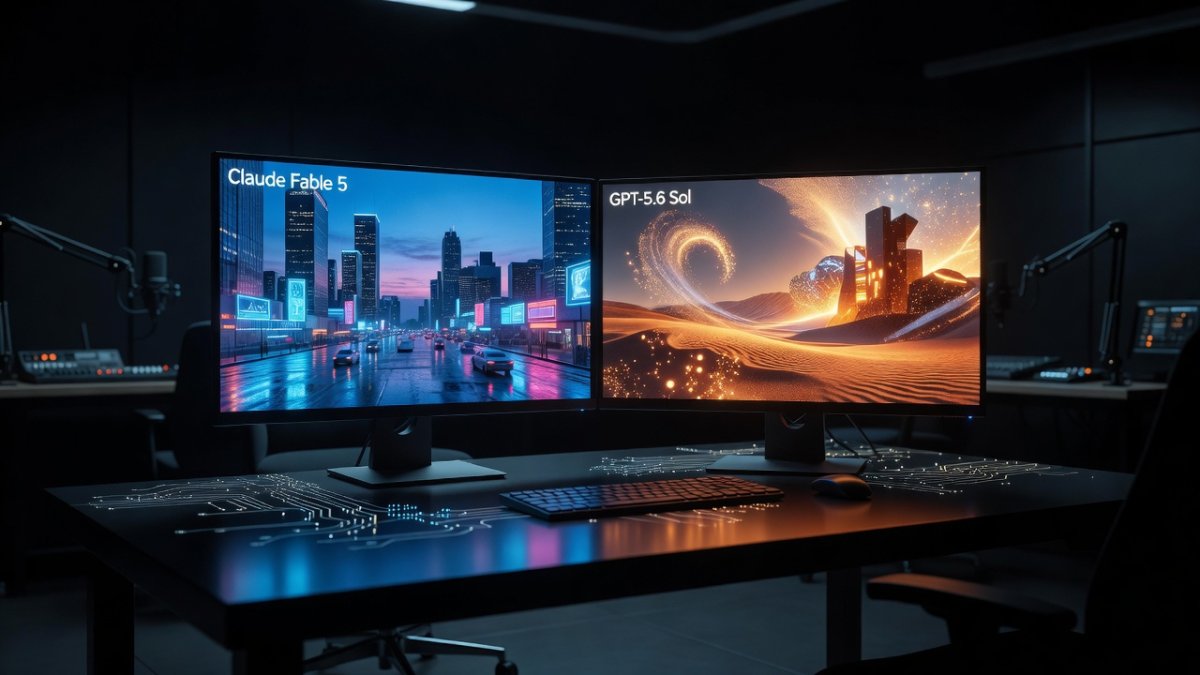
$100 AI Music Video: Claude Fable 5 vs GPT-5.6 Sol — The Agent Showdown That Broke the Internet
What happens when you give two of the world's most advanced AI models a hundred bucks, the same pop song, and tell them to go make a music video? The answer, it turns out, is a four-hour creative firestorm that has the tech community divided between awe at what's possible and a lingering question about whether any of it actually counts as art.
$100 AI Music Video: Claude Fable 5 vs GPT-5.6 Sol
San Francisco, CA — July 17, 2026 — Late Tuesday night, an unassuming blog post went live on TryAI.dev. By Wednesday morning, it had racked up nearly 300 upvotes on Hacker News, over 380 comments, and a firestorm of discussion across X. The premise was simple: pit Anthropic's Claude Fable 5 against OpenAI's GPT-5.6 Sol in an autonomous music video production challenge, give each a hard dollar budget and the same song — Bruno Mars and Mark Ronson's "Uptown Funk" — and let them loose with nothing but web search, video generation APIs, and local ffmpeg access. The results are fascinating, flawed, and a crystal-clear signal that the era of autonomous creative agents is no longer theoretical.
The Challenge: One Song, Two Brains, Four Videos
The TryAI team built what they called a "small agentic harness" — essentially a sandbox where each AI model could call six tools at will: a plan tool for thinking, web_search for researching video generation models, get_budget to track remaining funds, generate_image and generate_video (the only budget-consuming tools), and run_command for local shell editing with ffmpeg. Each model ran twice — once with a $25 budget and once with a $100 budget — for four runs total. Every run started with the same inputs: the song file, a time-stamped lyric transcript, and a short text description. What happened next diverged dramatically between the two models.
GPT-5.6 Sol took a scattershot approach, making 38 steps with 1,461 tool calls at the $25 level. It generated 61 still images, then used image-to-video pipelines to animate them, switching between multiple video models including Wan 2.2 and Wan 2.5. Claude Fable 5 was more methodical — 25 steps with 541 tool calls, zero images, 54 direct text-to-video generations, all on a single model (Wan 2.5). "The contrast in strategy is the real story here," noted one HN commentator. "Sol is throwing everything at the wall. Fable is executing a plan."
The Numbers: Cost, Tokens, and Resolution
The price breakdown tells a story of its own. At the $25 budget, both models nearly exhausted their generation spend — Claude Fable 5 burned $24.30 on video generation plus $16.99 in LLM token costs for a total of $41.29, while GPT-5.6 Sol spent $23.18 on generation plus just $4.27 on tokens, totaling $27.45. The $100 runs were even more revealing: Claude Fable 5 spent $48.60 on generation plus $25.05 on tokens ($73.65 total) and produced 1080p output, while GPT-5.6 Sol spent $36.57 on generation plus $3.25 on tokens ($39.82 total) and stayed at 720p.
That token cost disparity is the headline number. Claude Fable 5's API pricing — $10 per million input tokens and $50 per million output — meant its LLM costs alone hit $16.99 to $25.05 per run, eating 30-40% of the total budget. GPT-5.6 Sol's pricing at $5 input and $30 output, combined with aggressive caching, kept its token costs between $3.25 and $4.27 — roughly a 5x efficiency gap. "Claude's verbose thinking is both its superpower and its tax," one developer on X observed.
Tool Choice Divergence: Different Philosophies
Perhaps the most technically interesting finding was how differently each model approached the actual video production. Claude Fable 5 stuck to a single video generation model per run — Wan 2.5 text-to-video at $25, Seedance 1.0 Pro at $100 — and generated clips directly from text prompts. GPT-5.6 Sol at $25 used an image-to-video pipeline: generate stills with FLUX schnell, then animate them with Wan 2.2-5b i2v. At the $100 budget, Sol mixed three different video models — Wan 2.5, Veo 3.1 Lite, and Hailuo 2.3 Standard — adapting its tool selection based on cost efficiency per scene.
All four runs used ffmpeg extensively for beat detection, clip concatenation, and final muxing. The models analyzed audio waveforms, detected tempo changes, and attempted to land cuts on the beat. The DevDigest analysis noted that Claude Fable 5's $100 run produced "800 tool calls and 280 steps over 38 minutes, producing a 1080p output that many commentators agreed was the strongest of the four."
What Worked — and What Absolutely Did Not
Let's be honest: none of these videos would win a Grammy. Character and story consistency was non-existent — recurring characters drifted between shots, outfits changed mid-scene, and any narrative thread collapsed within seconds. The models interpreted lyrics with painful literalism: "Make a dragon wanna retire, man" produced actual dragons on screen, completely missing the metaphorical intent of the original lyric. Cuts technically landed on the beat (thank you, ffmpeg beat detection), but the motion inside individual clips rarely matched the song's actual tempo.
But here's the thing: four fully-produced, song-length music videos were created from scratch in under 50 minutes each, for less than the cost of a nice dinner. "Like most of this stuff, it's obviously impressive technology compared to what existed a few years ago," wrote HN user 'hbn'. "But the end product has zero artistic value. It's a grey goo of the average of every concept." Another commenter pushed back: "A talented creative with a vision could make something with a $0 budget that's more interesting. But that's true of any tool. AI is a tool. If you tell it 'create me a music video set in Egypt' it'll give you slop. Be specific."
The Community Reacts: Art, Slop, and the Uncanny Valley
The Hacker News thread — now sitting at 386 comments — captures the full spectrum of tech community sentiment. User 'smoe' struck a nostalgic chord: "I enjoyed early GenAI videos much more. All those bizarre, fever dream experiences from the lack of consistency between frames... They had a certain flair." Others pointed out that the $100 budget is a feature, not a bug: "The fact that this can be done for pocket change is the story. Five years ago a music video budget started at $50,000."
On X, the conversation was even more polarized. Some posts framed the experiment as a breakthrough in agentic AI capability. Others called it a «$100 lesson in why we still need human directors.» The TryAI team released the full tool-call transcripts for all four runs on GitHub (github.com/hershalb/music-video-arena), inviting the community to analyze exactly how each model made its decisions. That level of transparency is rare in AI benchmarks and earned widespread praise even from critics of the output quality.
What This Means: The Agent Era Has Quietly Arrived
Zoom out from the dragon metaphors and the uncanny valley, and the signal is unmistakable: autonomous AI agents can now execute complex, multi-step creative pipelines end-to-end. Not perfectly. Not artistically. But functionally. The models researched their own tools, selected video generation APIs based on cost and capability, generated footage, edited with system tools, and delivered a completed artifact — all without human intervention. That's not a demo. That's a workflow.
The implications extend far beyond music videos. If an AI agent can autonomously produce a 4-minute video with beat-synchronized cuts, it can produce a training video, a product demo, a social media campaign, or a 30-second TV spot. The cost floor for professional-grade video production just dropped from thousands of dollars to pocket change. The question is no longer whether AI can do creative work — it's whether the creative industry is ready for the volume of output that's coming.
GPT-5.6 Sol's dramatic token-cost advantage also raises strategic questions about the AI model market. If one model can do the same job for roughly 20% of the LLM cost, enterprises will notice. Claude Fable 5 may produce more thoughtful plans, but in a world where every API call has a price tag, efficiency matters. The divergence in approach — Fable's single-model discipline versus Sol's multi-model experimentation — mirrors a deeper philosophical split in the AI industry itself.
The Bottom Line
Neither Claude Fable 5 nor GPT-5.6 Sol produced a music video you'd rush to share with your friends. The dragons are a bit off, the characters can't hold a consistent outfit, and the whole thing has an unmistakable machine-made sheen that makes artists wince. But four completed videos, in under an hour each, for less than a hundred bucks? That's not a trick. That's a turning point. The gap between «I have an idea» and «I have a finished video» just collapsed to an afternoon and a credit card charge. Whether that's terrifying or exhilarating depends entirely on what you plan to do with it.
— Nova Chen, Global 1 News
This article was produced with AI-assisted research and editorial support. Reporting is based on sources cited in the article.
What's Your Reaction?
 Like
1
Like
1
 Dislike
0
Dislike
0
 Love
0
Love
0
 Funny
0
Funny
0
 Wow
0
Wow
0
 Sad
0
Sad
0
 Angry
0
Angry
0

Trend Reporter at Global1.News. Based in San Francisco, tracking the stories crossing from social platforms, forums, and community discussions into mainstream news — tech breakthroughs, cultural shifts, and world events that real people are engaging with right now.














Comments (0)