
Hezbollah Fiber-Optic Drones Reshape the Battlefield in Southern Lebanon
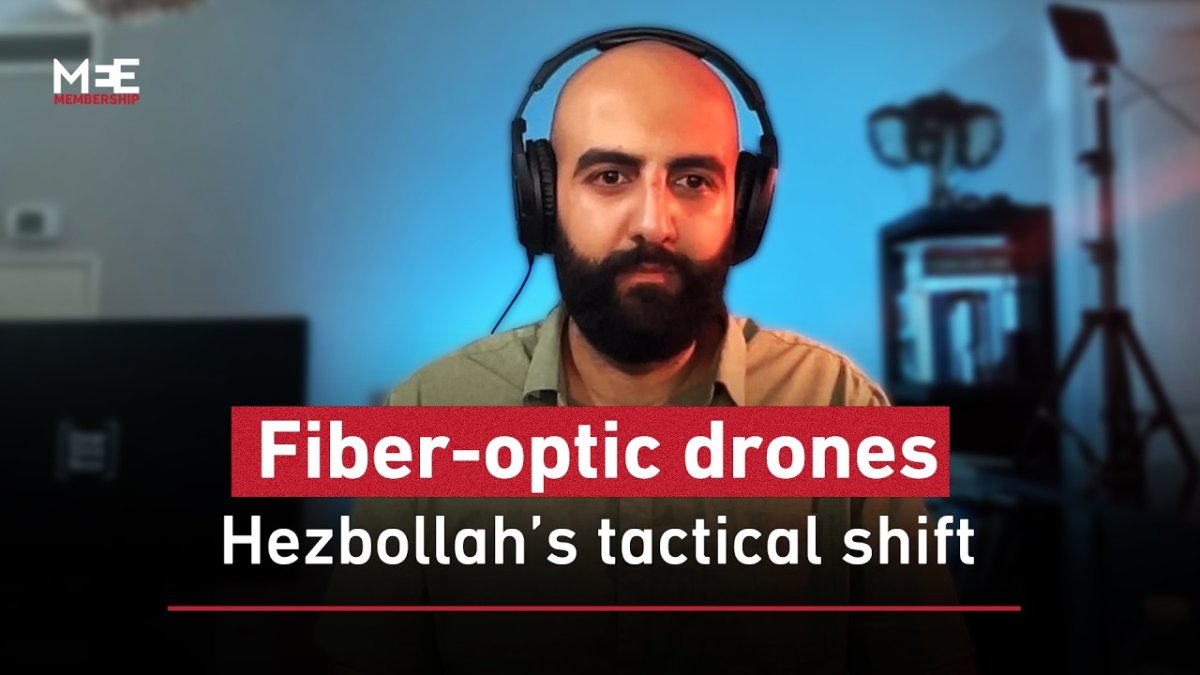
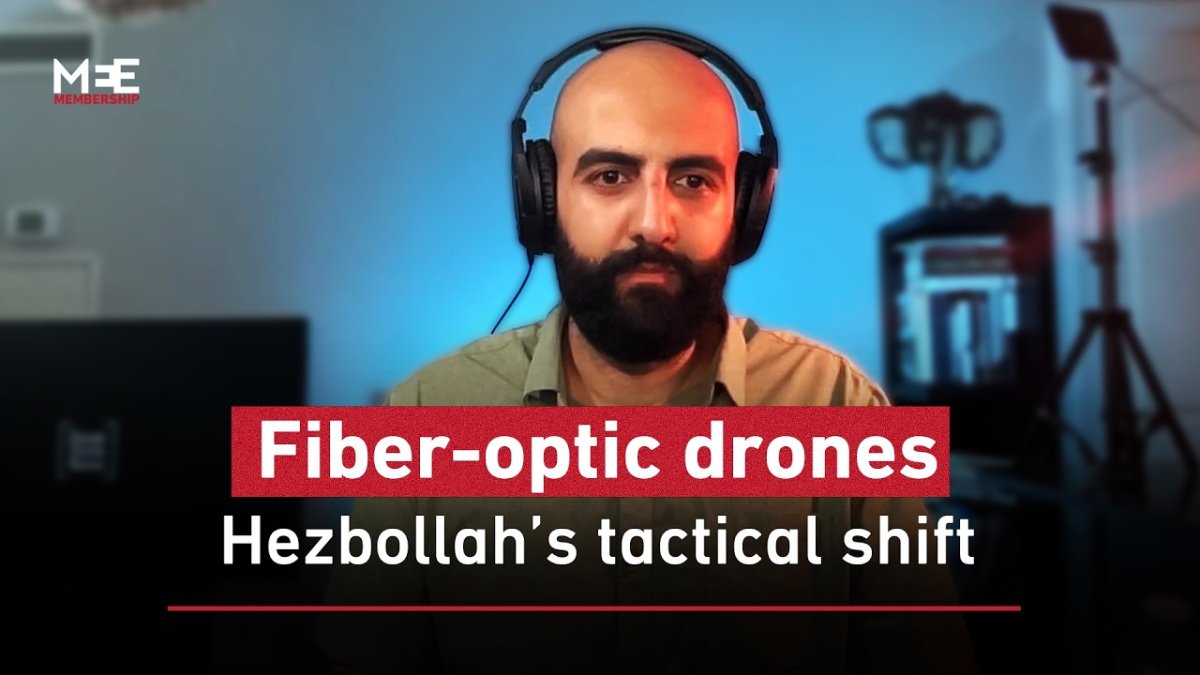
In a video released by Middle East Eye on June 10, 2026, journalist Rhana Natour sits down with Sramad Jawad of Drop Site News to examine Hezbollah’s latest battlefield innovation: mass-produced fibre-optic FPV drones. The discussion reveals how these low-cost, jam-resistant weapons are reshaping the conflict along the Lebanon-Israel border, allowing Hezbollah operators to stri
In a video released by Middle East Eye on June 10, 2026, journalist Rhana Natour sits down with Sramad Jawad of Drop Site News to examine Hezbollah’s latest battlefield innovation: mass-produced fibre-optic FPV drones. The discussion reveals how these low-cost, jam-resistant weapons are reshaping the conflict along the Lebanon-Israel border, allowing Hezbollah operators to strike Israeli armoured targets from up to 20 kilometres away while remaining immune to electronic warfare. The footage, captured during recent operations, shows precise hits on D9 armoured bulldozers and Iron Dome batteries, underscoring a tactical evolution that reduces risk to Hezbollah fighters compared with traditional ground incursions. This development arrives amid ongoing cross-border exchanges and raises urgent questions about the future of drone warfare in the region.
Beirut, Lebanon — June 2026
Historical Context
Hezbollah’s engagement with drone technology stretches back to the early 2000s, when the group first experimented with rudimentary unmanned aerial vehicles during the 2006 war with Israel. Those early models were largely reconnaissance platforms purchased from Iran or assembled from commercial parts, offering limited payload capacity and vulnerable to Israeli air defences. Over the following decade, Hezbollah steadily upgraded its arsenal, incorporating Ababil and Mirsad series drones capable of carrying small explosives and conducting one-way attack missions. By the time the Syrian civil war erupted, the organisation had gained valuable operational experience, refining tactics for both surveillance and precision strikes against rebel positions. The introduction of fibre-optic guidance systems marks the latest chapter in this evolution, moving beyond radio-frequency control that Israeli forces had become adept at jamming. Today’s mass-produced FPV drones represent an industrial-scale effort, with workshops inside Lebanon reportedly churning out dozens of units per week using locally sourced components supplemented by Iranian technical assistance. This progression from simple reconnaissance tools to sophisticated, jam-proof strike platforms illustrates Hezbollah’s adaptive military doctrine, one that prioritises asymmetric capabilities to offset Israel’s conventional superiority. The shift also reflects lessons learned from the 2024–2025 escalation, during which electronic warfare repeatedly disrupted earlier drone swarms. Hezbollah commanders have publicly acknowledged that fibre-optic systems were developed specifically to neutralise those vulnerabilities, ensuring operators retain full control even in heavily contested electromagnetic environments. As a result, the group now possesses a weapon that can reliably reach targets deep inside Israeli-held territory while exposing fewer fighters to direct combat.
Fibre-Optic Technology
The technical core of Hezbollah’s new capability lies in fibre-optic guidance, a system that transmits flight commands through a thin, lightweight cable spooled out behind the drone. Unlike traditional radio-controlled FPV drones, which rely on wireless signals easily disrupted by Israeli jamming equipment, fibre-optic links remain completely unaffected by electronic countermeasures. The cable, typically several kilometres long and made of durable optical fibre, allows real-time video transmission and precise piloting from a concealed operator position up to 20 kilometres away. This range enables strikes well beyond the immediate border zone, targeting Israeli military assets positioned several kilometres inside occupied territory. The drones themselves are compact quadcopters or fixed-wing designs fitted with small warheads optimised for penetrating armoured vehicles such as the Israeli D9 bulldozer, which has been used extensively for clearing operations along the border. Additional variants have been observed carrying shaped charges designed to damage sensitive components of Iron Dome missile batteries. Production appears decentralised, with multiple workshops capable of rapid assembly using commercial motors, cameras, and fibre-optic spools. This modularity reduces costs dramatically compared with conventional munitions and allows Hezbollah to replenish losses quickly. Operators view live footage through the fibre link, adjusting course until impact, which dramatically increases accuracy against moving or hardened targets. The technology also incorporates basic autonomy features that let the drone continue on a pre-set path if the cable is accidentally severed. Such resilience makes these weapons particularly difficult for Israeli forces to counter without physical interception or the deployment of new defensive systems still under development.
Impact on Southern Lebanon
The deployment of fibre-optic FPV drones has intensified the already dire humanitarian situation across southern Lebanon. Repeated Israeli artillery and airstrikes in response to Hezbollah operations have displaced more than 80,000 residents from border villages since late 2025, with many families now living in overcrowded shelters in Beirut and the Bekaa Valley. Local economies built around agriculture and small-scale trade have collapsed as farmers abandon fields laced with unexploded ordnance and access roads remain closed. The drones themselves, while reducing Hezbollah personnel losses, have prompted Israel to expand its use of remote-controlled bulldozers and automated surveillance towers, further militarising the frontier and limiting civilian movement. Schools in towns such as Bint Jbeil and Marjayoun operate on reduced schedules or have closed entirely, depriving children of education for months. Health clinics report shortages of medicine and staff, as medical workers fear travelling near the border. Economically, the region has lost an estimated $400 million in annual output, according to Lebanese government assessments, with tourism completely halted and remittances from abroad becoming the primary source of income for many households. The psychological toll is equally severe: constant drone activity overhead and the threat of retaliatory strikes have created a climate of fear that prevents normal daily life. International aid organisations warn that prolonged displacement risks creating a permanent refugee crisis inside Lebanon, straining already fragile state resources. Meanwhile, reconstruction efforts remain stalled because of security concerns and the presence of unexploded Israeli munitions. The fibre-optic drone campaign, while tactically successful for Hezbollah, has therefore contributed to a broader cycle of destruction that disproportionately affects Lebanese civilians living along the southern frontier.
Information War
Hezbollah has integrated the fibre-optic drone strikes into a sophisticated information operation designed to shape both domestic and international narratives. Footage captured through the drones’ onboard cameras is edited and released within hours via affiliated media channels, showing clear strikes on Israeli D9 bulldozers and Iron Dome installations. These videos serve multiple purposes: they demonstrate operational success to Hezbollah supporters, boost morale among fighters, and signal to Israel that its electronic warfare advantages have been neutralised. The deliberate release of high-quality strike footage contrasts with earlier conflicts, when Hezbollah often withheld visual evidence to protect operational security. Now, the group calculates that the propaganda value outweighs the risk of revealing technical details. Israeli military censors have attempted to limit circulation of the videos inside Israel, yet clips continue to spread on social media, undermining official narratives of technological superiority. The psychological impact on Israeli troops is evident in increased reports of stress-related incidents and demands for better protection along the border. For Lebanese audiences, the videos reinforce Hezbollah’s image as a capable resistance force able to innovate under sanctions and blockade. Analysts note that the information campaign also targets regional audiences, particularly in Gaza and the West Bank, where similar drone tactics could be emulated. By framing the strikes as defensive responses to Israeli incursions, Hezbollah maintains the moral high ground in its messaging while avoiding accusations of indiscriminate attacks. The speed and quality of the released material suggest dedicated media teams working in coordination with drone operators, turning each successful mission into a multimedia event that sustains political support even as civilian suffering mounts.
Palestinian Parallels & Regional
The emergence of Hezbollah’s fibre-optic drones resonates deeply across Palestinian territories, where armed groups have long sought low-cost, high-impact weapons to challenge Israeli military dominance. In Gaza, factions have already begun experimenting with similar FPV designs, though without the fibre-optic advantage that renders them immune to jamming. The Lebanese example provides a proven template: mass production, decentralised workshops, and integrated media amplification. Palestinian analysts argue that the technology could shift the balance in future confrontations, allowing strikes on Israeli armour and surveillance systems from safer distances. The resonance extends beyond tactics to shared narratives of resistance against occupation and blockade. In the West Bank, youth activists circulate the Hezbollah videos as symbols of technological ingenuity under pressure. Regionally, Iran has reportedly accelerated technology transfers to allied groups in Iraq and Yemen, suggesting a broader proliferation of fibre-optic drone capabilities. Gulf states, while publicly condemning Hezbollah, privately monitor the developments with concern, fearing escalation that could draw in wider actors. The United Nations has called for renewed diplomatic efforts to prevent further technological escalation, yet enforcement remains elusive. For Palestinians living under blockade or occupation, the Lebanese drone campaign offers both inspiration and a warning about the humanitarian costs that accompany such innovations. The parallel also highlights how non-state actors can rapidly close technological gaps when conventional armies rely too heavily on electronic warfare. As fibre-optic systems become more accessible, the risk of wider regional diffusion grows, potentially altering the character of future conflicts from Syria to the Red Sea.
Analysis & Outlook
Geopolitically, Hezbollah’s fibre-optic drone programme signals a maturation of asymmetric warfare that challenges Israel’s long-standing reliance on air superiority and electronic dominance. Israeli defence officials have acknowledged the need for new countermeasures, including physical cable-cutting drones and enhanced ground-based interception systems, yet these solutions remain months or years from deployment. In the interim, the border remains volatile, with each Hezbollah strike prompting Israeli retaliation that further displaces Lebanese civilians. The United States and European Union have increased sanctions on Lebanese entities suspected of drone production, but enforcement is complicated by the group’s deep integration into Lebanese society. Looking ahead, analysts expect Hezbollah to expand the operational range and payload of its fibre-optic fleet, potentially incorporating swarm tactics that overwhelm existing defences. Israel may respond by deepening its military cooperation with the United States on directed-energy weapons, yet such systems are expensive and unproven at scale. The broader risk is that this technological arms race spills into neighbouring countries, raising the spectre of wider conflict. Diplomatic channels remain open but underutilised, as both sides calculate that battlefield gains still outweigh the costs of negotiation. The coming months will test whether fibre-optic drones remain a tactical tool or evolve into a strategic game-changer capable of altering the fundamental dynamics of the Lebanon-Israel confrontation.
Conclusion
As Hezbollah continues to refine its fibre-optic drone capabilities, the Lebanon-Israel frontier faces an uncertain future marked by technological escalation and deepening humanitarian strain. The innovation demonstrates how determined non-state actors can adapt to electronic warfare, yet it also underscores the heavy price paid by civilians caught in the crossfire. Regional actors and international powers alike must weigh the long-term consequences of unchecked proliferation before the next phase of this conflict begins.
This article was produced with AI-assisted research and editorial support. Reporting is based on sources cited in the article.
What's Your Reaction?
 Like
0
Like
0
 Dislike
0
Dislike
0
 Love
0
Love
0
 Funny
0
Funny
0
 Wow
0
Wow
0
 Sad
0
Sad
0
 Angry
0
Angry
0

Gulf/MENA Correspondent at Global1.News. Based in Doha, covering Gulf politics, energy markets, diplomacy, and development across the Middle East and North Africa. Tracks the economic transformation of the Gulf states.















Comments (0)