
SpaceX Stock Tanks Below IPO, Wipes Out Trillion in Value
, folks – SpaceX just took a nosedive that has Wall Street reeling. The rocket company's stock slammed below its IPO price, erasing a cool trillion dollars in market value overnight. This isn't just a blip; it's a wake-up call for anyone betting on Musk's space dreams.
SpaceX Stock Tanks Below IPO, Wipes Out Trillion in Value
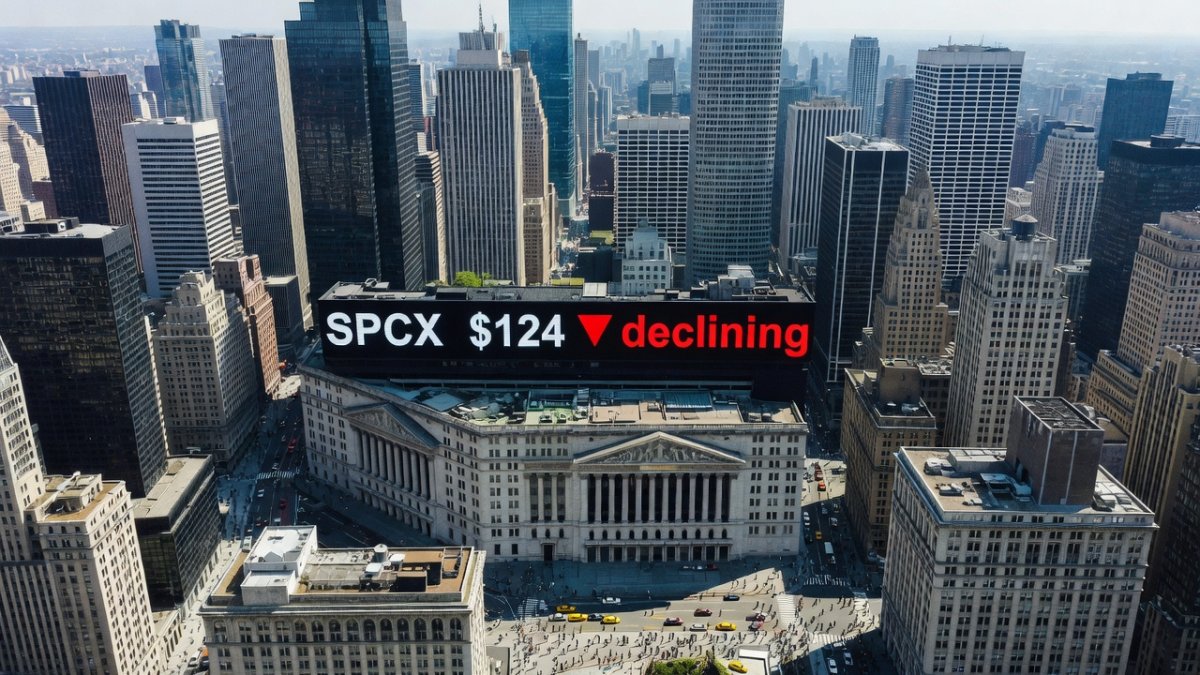
New York — July 18, 2026 — SpaceX shares closed at $124 on July 17, 2026, marking an 8% drop below the June 2026 IPO price of $135 and a staggering 45% slide from the post-IPO peak of $225. Bloomberg broke the news of the slump that same day, highlighting how the company founded by Elon Musk has now wiped out $1 trillion in market value from its all-time high. With a current market cap sitting at $1.63 trillion, the stock fell another 5.4% on July 17 alone, leaving investors questioning whether the space giant's valuation ever made sense in the first place.
The IPO That Promised the Moon
SpaceX went public on NASDAQ under the ticker SPCX back in June 2026 at $135 a share. At the time, the offering looked like a rocket launch itself, riding the hype around Starlink's satellite internet rollout and Starship development. Investors piled in expecting explosive growth from NASA contracts and global broadband expansion. But that initial pop to $225 quickly proved fleeting, as reality set in about sky-high multiples and mounting execution risks.
Right from the start, the IPO priced SpaceX at a 94 times revenue multiple based on 2025 revenue of $18.67 billion. That's the kind of number usually reserved for early-stage tech darlings, not a company with real hardware in orbit and government deals on the books. Straight talk: anyone who bought at the open was essentially paying for future promises that haven't materialized fast enough.
Historical Context of High-Profile IPO Wipeouts
SpaceX's slide below its $135 IPO price echoes the brutal resets we've seen before, but the parallels to Rivian, Uber, and Snap only go so far. Rivian burned cash chasing EV hype with no profits in sight, Uber fought regulatory wars while losing billions on rides, and Snap never escaped its ad-platform limitations. Those companies floated on pure promise and paid the price when growth stalled. SpaceX, by contrast, already hauls real revenue from Starlink subscriptions and NASA contracts, yet the market still hammered it for the same sin: pricing in a future that hasn't arrived fast enough.
What sets this wipeout apart is the hardware reality mixed with an absurd valuation. At 94 times 2025 revenue, the IPO baked in Starship success and global broadband dominance that competitors are now actively contesting. Unlike the earlier busts where companies lacked tangible assets, SpaceX's orbital fleet and launch cadence give it staying power. Still, the trillion-dollar evaporation proves that even proven tech can't justify sky-high multiples when timelines slip and rivals close in.
From Peak to Pit: The Numbers Don't Lie
Let's break down the damage without sugarcoating it. From the $225 high, the stock has cratered 45%, taking $1 trillion off the table in market value. The July 17 close at $124 sits 8% under the IPO level, and that single-day 5.4% drop shows momentum is still heading south. Current market cap of $1.63 trillion reflects a company that's lost serious altitude in just weeks.
These aren't abstract figures. They represent real losses for funds, retail traders, and anyone who saw SpaceX as the next big thing in aerospace. Bloomberg's reporting nailed the timing, but the underlying math was always there for those willing to look past the hype.
Retail Investor Impact
Everyday traders on Robinhood and other platforms who piled into SPCX above $200 are now staring at losses that sting harder than any Wall Street fund manager feels. The democratization of trading turned SpaceX into a retail darling during the June pop, with small accounts chasing the Musk narrative and the Starlink growth story. Those positions now sit 45 percent underwater from the peak, wiping out savings, vacation funds, and retirement top-ups that people poured in expecting another Tesla-style moonshot.
This isn't just paper losses for hedge funds. Main Street investors who bought the hype at the open are facing margin calls and tough decisions about whether to average down or cut bait. The single-day 5.4 percent drop on July 17 hit those accounts especially hard, reminding everyone that accessible trading apps don't shield you from execution risk. Straight talk: when a company with real satellites still erases that much value, retail gets left holding the bag while insiders who cashed out early move on.
Valuation at 94 Times Revenue? That's Not Sustainable
Paying 94 times trailing revenue for any business is aggressive, even in a hot sector. SpaceX's 2025 revenue of $18.67 billion supported that IPO price, yet growth has to accelerate dramatically to justify it now. When the stock trades below the entry point, it signals the market no longer believes the story at those levels.
I've covered enough IPOs from Atlanta to know this pattern. High multiples work until they don't, and SpaceX hit that wall fast. The $1.63 trillion market cap still prices in massive future wins, but competition and execution delays are starting to bite into that narrative.
Insider Selling and the Musk Factor
Insider selling has added fuel to the fire. When early investors and executives start cashing out after the lockup, it tells the market the smart money sees limited upside. Musk's dual role running Tesla and SpaceX spreads attention thin, and that reality is hitting valuations across his empire.
Investors bought the vision of a multi-planetary future, but daily stock action shows they're pricing in near-term risks instead. No filter here: Musk's charisma moves markets, yet it can't override cold numbers like a 45% drawdown from the peak.
Starlink's Promise vs. Harsh Reality
Starlink remains the crown jewel, with thousands of satellites already delivering broadband to remote areas. Revenue from subscriptions and enterprise deals helped build that $18.67 billion 2025 base. Still, scaling to the levels needed to support a 94x multiple requires winning over entire countries and fleets of ships and planes.
Regulatory hurdles and spectrum fights have slowed global rollout. The stock's slide below $135 shows investors are no longer giving Starlink the benefit of the doubt on timelines. SpaceX needs Starlink to print cash faster, or the valuation math simply won't hold.
Starship Development and Timeline Risks
Starship sits at the center of the valuation thesis, yet every technical and regulatory hurdle keeps pushing revenue milestones further out. The vehicle needs flawless orbital refueling demonstrations, full human-rating certification from NASA, and repeated FAA launch approvals that have already slipped multiple times. Each delay means Starlink's next-generation constellation and deep-space contracts stay on hold, starving the cash flow the $1.63 trillion market cap still assumes will arrive on schedule.
Regulatory friction adds another layer of pain. The FAA's environmental reviews and spectrum coordination fights don't move at startup speed, and Starship's massive size triggers extra scrutiny that smaller rockets avoid. Investors who bought at $225 priced in rapid iteration and quick wins. The drop to $124 shows the market is now discounting those timelines heavily, treating Starship more like a long-shot bet than a near-term catalyst.
Competition Heating Up from Blue Origin and China
Blue Origin isn't standing still, and Chinese state-backed programs are pouring resources into reusable rockets and satellite constellations. SpaceX's lead in reusability is real, but it's no longer a monopoly. Every successful competitor launch chips away at the moat that justified the IPO price.
Market share battles in launch services and satellite internet are intensifying. When the stock erases $1 trillion from its high, part of that reflects fears that SpaceX won't dominate forever. Analysts who once saw clear skies now see rivals closing the gap.
What This Means for NASA Contracts and Starship
NASA contracts provide steady revenue and credibility, yet they don't move the needle enough to offset valuation concerns. Starship development remains critical for long-term ambitions, but delays push cash flows further out. The July 17 drop shows the market is discounting those future milestones heavily.
SpaceX still wins launches and builds hardware, but the stock price reflects impatience with timelines. Government work offers stability, yet it rarely delivers the multiples that fueled the post-IPO pop to $225.
Analyst Split: Buy the Dip or Value Trap?
Raymond James is holding firm with a $242 price target, well above the current $124 close. That call assumes Starship succeeds and Starlink scales without major hiccups. On the other side, some see a classic value trap where high growth expectations meet slower execution.
The divide is healthy, but the market is voting with its feet. A stock 45% off the high and below IPO levels suggests the bears have the upper hand for now. Investors should weigh those $242 targets against the $1.63 trillion market cap reality.
What Analysts Are Saying Now
Raymond James is still waving the $242 target flag, arguing that successful Starship flights and Starlink's enterprise wins will justify the premium once execution catches up. Their math assumes the current $124 level is a temporary overreaction to short-term noise. Other voices on the Street are far less charitable, warning that downside to $100 or below remains possible if another Starship test fails or global spectrum fights intensify.
The split reveals how divided sentiment has become. Bulls see a bargain at current levels because the hardware and contracts are real, while bears treat the 94-times revenue hangover as a permanent valuation anchor. Either way, the market's vote is clear in the price action: until Starship delivers tangible cash flow, most analysts' optimistic calls are fighting gravity.
Cathie Wood's Bet: Smart Money or Fool's Gold?
Motley Fool noted that Cathie Wood has been buying the dip, adding to positions in the name. Her growth-focused approach bets that SpaceX will eventually justify even higher multiples once Starlink and Starship hit scale. That's a bold stance given the 5.4% single-day drop and the breach below $135.
Whether this proves genius or over-optimism depends on execution over the next year. Wood's track record gives some cover, but the $1 trillion value wipeout shows plenty of investors disagree with that thesis right now.
The Road Ahead for SpaceX Investors
SpaceX isn't going anywhere. The company has real technology, contracts, and a lead in key areas. Yet the stock trading at $124 after peaking at $225 demands a reset in expectations. The 94x revenue multiple at IPO looks increasingly optimistic in hindsight.
Investors who bought the hype now face a choice: average down on the belief that $242 targets will eventually be hit, or cut losses and wait for clearer proof of sustainable growth. Either way, the $1.63 trillion market cap tells the story of a market that's no longer willing to pay premium prices without results.
By Jessica Ali, Staff Writer
This article was produced with AI-assisted research and editorial support. Reporting is based on sources cited in the article.
What's Your Reaction?
 Like
0
Like
0
 Dislike
0
Dislike
0
 Love
0
Love
0
 Funny
0
Funny
0
 Wow
0
Wow
0
 Sad
0
Sad
0
 Angry
0
Angry
0

Editor-in-Chief at Global1.News. Atlanta-based journalist who cuts through the BS and tells it like it is. Lead anchor, host, and the voice you hear when the spin stops and the truth starts.















Comments (0)