
Thailand-China 2+2 Security Dialogue: A New Era in Bilateral Cooperation
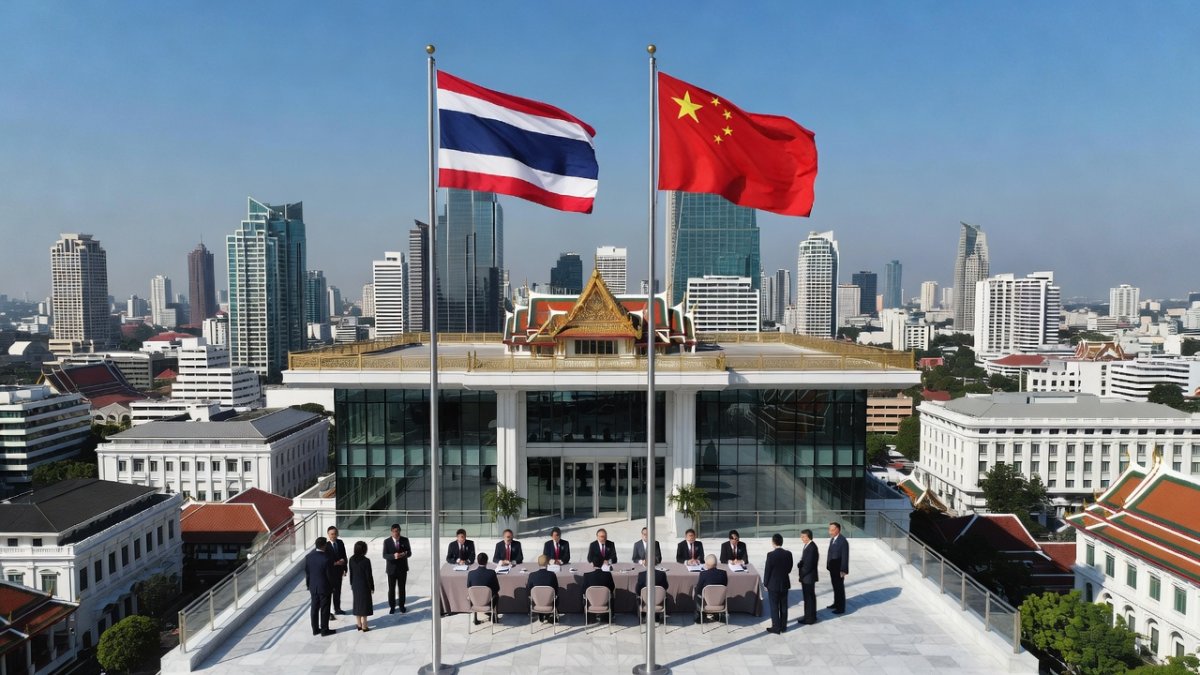
Thailand and China have taken a significant step forward in their security partnership this week. On Monday, officials in Beijing announced the creation of a new 2+2 security dialogue that will bring together the foreign ministers and defence ministers of both nations for regular consultations. The mechanism focuses on practical cooperation against transnational crime that touches communities across Thailand every day.
Thailand-China 2+2 Security Dialogue: A New Era in Bilateral Cooperation
Thailand and China have taken a significant step forward in their security partnership this week. On Monday, officials in Beijing announced the creation of a new 2+2 security dialogue that will bring together the foreign ministers and defence ministers of both nations for regular consultations. The mechanism focuses on practical cooperation against transnational crime that touches communities across Thailand every day.
As Bangkok commuters weave through the familiar morning traffic with patient smiles, the gentle warmth of Thai hospitality fills every neighbourhood, where grandmothers chat over steaming bowls of boat noodles and children play under the watchful eyes of elders who have long valued harmony with neighbours near and far.
Bangkok, Thailand — Article continues...
Details of the 2+2 Security Dialogue
The agreement was reached during high-level talks in Beijing involving representatives from Thailand's Ministry of Foreign Affairs and China's foreign and defence ministries. The dialogue will convene foreign and defence ministers on a regular schedule to coordinate responses to shared threats. Thai officials confirmed the mechanism will operate alongside existing channels such as the Thai-Chinese Joint Commission on Bilateral Cooperation.
Thailand and China first established formal diplomatic ties on 1 July 1975, a relationship that has since deepened through cultural exchanges such as the annual Thai-Chinese Cultural Festival in Bangkok’s Chinatown and joint Mekong River community projects. The new 2+2 format, involving foreign and defence ministers, marks an evolution from earlier bilateral talks that focused mainly on trade. It mirrors Thailand’s existing 2+2 dialogue with Japan, launched in 2012 and held annually in Tokyo or Bangkok, and the strategic security dialogue with the United States that convenes every two years under the 2012 Joint Vision Statement. In practice, the 2+2 structure allows simultaneous discussion of political and military dimensions, enabling quicker decisions on issues affecting Thai border villages and Chinese southern provinces alike.
Unlike the more public ASEAN-led mechanisms, this direct ministerial pairing gives Thailand greater flexibility to address local concerns rooted in its cultural emphasis on harmonious neighbourly relations. Thai analysts note that the format draws on the kingdom’s tradition of balancing external powers while preserving Buddhist values of non-confrontation. The first planned session in Bangkok later this year will likely include representatives from Thailand’s National Security Council, ensuring that voices from rural communities in the northeast are heard alongside Beijing’s Ministry of National Defence.
Addressing Call Centre Fraud and Cybercrime
Call centre fraud operations based along the Mekong River have targeted Thai citizens in Bangkok, Chiang Mai, and the Isaan region with increasing frequency. The new dialogue explicitly includes joint efforts to dismantle these networks, which often involve criminal syndicates operating from border areas. Royal Thai Police units in Udon Thani and Nakhon Ratchasima will gain improved intelligence sharing with Chinese counterparts under the framework.
Thai police recorded losses exceeding 12.4 billion baht from call-centre scams in the first eight months of 2024, with the Royal Thai Police Cyber Crime Investigation Bureau reporting that elderly residents in Isaan provinces such as Khon Kaen and Ubon Ratchathani accounted for nearly 40 percent of victims. Many cases trace back to compounds along the Mekong in Myanmar’s Myawaddy and Laos’s Bokeo areas, where syndicates exploit porous borders that once facilitated legitimate cross-border trade among Thai, Lao, and Chinese communities. The new dialogue will establish a joint cyber forensic laboratory in Chiang Mai, modelled on the existing Thai-Chinese cooperation centre opened in 2021, to share real-time data on SIM-card registrations and cryptocurrency wallets used in “pig-butchering” schemes.
Under the framework, Thailand’s Electronic Transactions Development Agency will exchange encrypted traffic logs with China’s Ministry of Public Security using protocols already tested during the 2023 Operation Mekong Shield. This technical partnership respects local customs by involving village headmen in awareness sessions conducted in the Isaan dialect, helping families recognise the gentle, familiar voices often used by scammers impersonating relatives. Such measures aim to protect the trust-based social fabric that characterises daily life in Thai rural communities.
Combating Drug Trafficking Across Borders
Drug trafficking routes through the Golden Triangle continue to affect villages in Chiang Rai and communities further south in Phuket. The 2+2 talks will prioritise coordinated patrols and information exchange between Thai and Chinese law enforcement agencies. This builds on previous operations that seized large quantities of methamphetamine precursors moving through Laos and Myanmar into Thai territory.
Impact on Thai Daily Life and Local Communities
Residents in Bangkok's Lat Phrao district and families in rural Isaan provinces have reported rising incidents of online scams linked to cross-border syndicates. The dialogue aims to reduce these harms by strengthening border controls and financial tracking mechanisms. Thai Ministry of Foreign Affairs spokespeople noted that faster extradition processes and joint investigations will protect ordinary citizens who rely on mobile banking and social media for daily transactions.
In the quiet villages of Surin and Roi Et, grandmothers who once greeted each dawn with gentle laughter now face the heartbreak of voice-cloning scams that mimic the voices of their beloved grandchildren, leaving entire families shaken. One 72-year-old woman from Buriram recently lost 480,000 baht after scammers used cloned audio to plead for urgent help, a story that has echoed through Isaan kitchens and prompted neighbours to check on one another more often. Banks such as Kasikornbank and SCB have introduced video verification steps for large transfers, while the heartfelt “Stop Scam, Save Mom” campaign spreads through local temples and markets, reminding everyone that protecting our elders is a shared Thai duty rooted in love and respect.
ASEAN Balancing and Regional Implications
Thailand's decision to formalise this 2+2 mechanism reflects its longstanding approach of maintaining balanced relations with major powers while advancing ASEAN centrality. Neighbouring countries such as Vietnam and Malaysia are watching how the dialogue influences broader Southeast Asian security architecture. The arrangement supports Thailand's role as a bridge between mainland Southeast Asia and China without disrupting existing ASEAN-led forums on transnational crime.
China already maintains 2+2 dialogues with Cambodia, formalised in Phnom Penh in 2023, and with Indonesia since 2018, both emphasising maritime and transnational crime issues. Thailand’s version distinguishes itself by remaining embedded within ASEAN frameworks rather than creating a parallel structure, thereby preserving the grouping’s centrality that Thai diplomats have championed since the 2007 ASEAN Charter. Neighbouring states observe that Bangkok’s approach avoids the tighter alignment seen in Phnom Penh while still deepening practical ties with Beijing, a balance that echoes Thailand’s historical role as a cultural crossroads between mainland Southeast Asia and southern China.
The arrangement may indirectly influence South China Sea discussions, as Thailand continues to host informal ASEAN-China meetings on the Code of Conduct. Experts at Chulalongkorn University’s Institute of Security and International Studies, including Associate Professor Thitinan Pongsudhirak, suggest the 2+2 could reduce pressure on Thailand to join Quad-Plus activities, allowing the kingdom to maintain its long-standing preference for inclusive diplomacy rooted in Buddhist principles of mutual respect. This positioning helps smaller ASEAN members feel less isolated when navigating great-power competition.
Future Consultations and Diplomatic Outlook
Regular meetings under the new framework are expected to begin later this year, with the first session likely hosted in Bangkok. Thai defence officials have indicated that topics will expand beyond crime to include maritime safety and disaster response coordination. This development strengthens Thailand's diplomatic toolkit as it navigates economic recovery and regional stability in the months ahead.
By Ann Srisawat, Staff Writer
This article was produced with AI-assisted research and editorial support. Reporting is based on sources cited in the article.
What's Your Reaction?
 Like
0
Like
0
 Dislike
0
Dislike
0
 Love
0
Love
0
 Funny
0
Funny
0
 Wow
0
Wow
0
 Sad
0
Sad
0
 Angry
0
Angry
0

Southeast Asia Correspondent at Global1.News. Based in Bangkok, covering Thai and Southeast Asian politics, economy, technology, and culture. Deep regional perspective on one of the world's most dynamic regions.














Comments (0)