
The $725 Billion AI Bet vs. Apple's $140 Billion Cash Pile — Two Different Futures for Infrastructure
Apple hit an all-time high spending just 2.7B on capex while hyperscalers burn 25B on AI infrastructure financed by debt and 62B in off-balance-sheet lease commitments. The Bank for International Settlements warns AI infrastructure financing is now a systemic risk. A hosting founder on how these ...
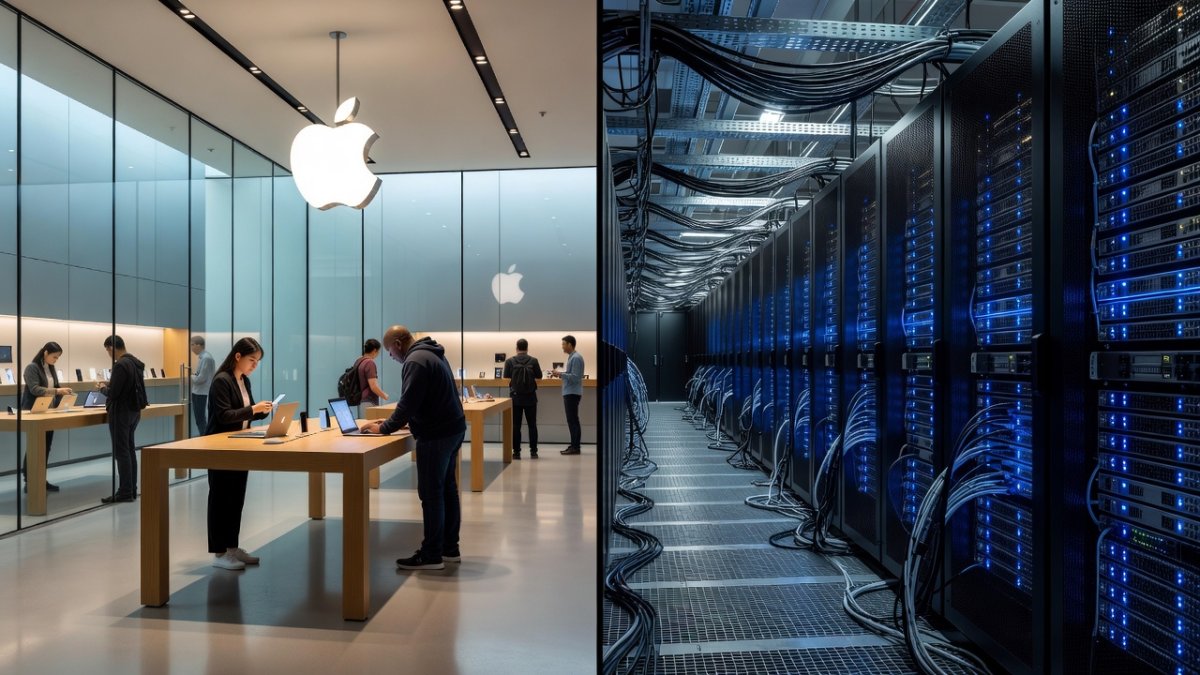
The $725 Billion AI Bet vs. Apple's $140 Billion Cash Pile — Two Different Futures for Infrastructure
Let me tell you about the biggest divergence I've seen in my decade running infrastructure. Two paths. Same AI wave. Completely different financial outcomes. And the gap tells us something important about where we're headed.
On one side, you've got the hyperscalers — Amazon, Microsoft, Alphabet, Meta, Oracle — collectively spending $725 billion on AI infrastructure in 2026. That number is up 77% from $410 billion last year, and it's still accelerating. Citi's latest projection has Google, Meta, and Amazon alone clearing $800 billion in 2027. Morgan Stanley says the full hyperscaler group hits $1.12 trillion that same year. On the other side, you've got Apple — $12.7 billion in capex last year, on track for less than $13 billion this year, and projected to generate $140 billion in free cash flow. Apple hit an all-time high this week as investors rotated out of capex-heavy names and toward cash. The stock is up 16% in 2026. Microsoft is down 20%. Amazon and Alphabet are both more than 10% below their May peaks.
Now, I'm a hosting founder. I run real infrastructure. I know what it costs to build, to power, to cool, to maintain. So when I see a divergence this sharp, I don't just see a stock market story. I see a structural choice that every business that depends on compute — and that's all of us now — needs to understand.
Apple's Strategy — $140 Billion in Free Cash and $4.3 Billion in Capex
Apple's fiscal 2026 numbers are frankly absurd compared to its peers. In the first half of the fiscal year, the company generated more than $82 billion in operating cash flow. Of that, just $4.3 billion went toward capital expenditures. The rest went to operations and shareholder returns. Microsoft, by comparison, spent $38 billion on capex in a single recent quarter — a 63% increase year over year that came at a direct cost to its free cash flow, which contracted 10% over the same period.
Apple's board approved a fresh $100 billion share buyback alongside its fiscal second-quarter earnings. The company has now returned more than $1 trillion to shareholders since 2012. Its free cash flow for 2026 is expected to hit approximately $140 billion, up more than 40% from 2025 and roughly six times Alphabet's projected $21 billion for the same year. Citi raised its price target to $365 and maintained a Buy rating. Analyst Asiya Merchant cited Apple's market share momentum in a softening device market, its pricing power on premium hardware, and the long-term Services revenue tailwind from an AI strategy that conspicuously avoids the data-center arms race.
The engineering behind Apple's capital-light AI posture is specific and defensible. Its AFM 3 Core Advanced model packs 20 billion parameters into a sparse architecture that activates only 1 to 4 billion at inference time. For tasks that exceed on-device capability, Apple routes through Private Cloud Compute — Apple Silicon servers with ephemeral processing — or, for the most demanding generative tasks, through a partnership with Google running Nvidia Blackwell GPUs inside Google Cloud. At more than 2.5 billion active devices, Apple cannot afford to route every inference through cloud GPUs. The cost would exceed its annual revenue. On-device inference isn't a philosophical choice — it's the only economically viable path at Apple's scale.
The Hyperscaler Answer — $725 Billion and a Bet That Free Cash Flow Will Return
The math on the other side is equally stark but headed in the opposite direction. Amazon is on track to spend $200 billion on capex in 2026. Alphabet is spending $180-190 billion. Microsoft is tracking toward $190 billion. Meta raised its guidance to $125-145 billion — and issued $55 billion in debt over six months while halting share buybacks. The combined figure represents the single largest concentrated infrastructure cycle in the history of technology.
Research firm Epoch AI documented on June 16 that capital expenditures across the five largest hyperscalers are growing roughly 70% per year while their operating cash flow grows roughly 23% per year. Those two curves crossed sometime this summer, meaning the group is collectively spending every dollar it earns from operations — and more. Alphabet's first-quarter 2026 free cash flow fell 47% year over year to $10.12 billion. Amazon's trailing free cash flow collapsed roughly 95%, from approximately $38 billion to $1.2 billion. Oracle has already crossed into negative free cash flow territory for fiscal 2026, with its CFO telling analysts the company expects to raise approximately $40 billion in debt and equity in fiscal 2027.
To cover the gap, the industry turned to bond markets. Gross bond issuance by hyperscalers topped $100 billion in 2025, with most maturities set at five years or longer. PIMCO projects that by 2026-2027, capital expenditure will consume approximately 94% of hyperscaler operating cash flow — essentially the entire income from operations reinvested in infrastructure before shareholders see a dollar.
The Secondary Bottleneck Nobody's Talking About — Circular Financing and $662 Billion in Shadow Debt
Here's where this story goes from "aggressive investment" to "genuinely concerning." The Bank for International Settlements — the central bank for the world's central banks — published a study on July 15 concluding that the AI infrastructure buildout has already outpaced every previous technology investment boom in history. Relative to its pre-boom trough, the current AI buildout is on track to outgrow the canal mania of the 1830s, the British railway boom of the 1840s, the electrification surge of the 1920s, and the dotcom boom itself — all within just three years of beginning.
The BIS's concern isn't just the dollar scale. It's the financing structure. Hyperscalers take equity stakes in AI labs. Those labs commit to multi-year compute purchases from the same hyperscalers. The hyperscaler reports the lab's purchases as revenue. The lab uses the hyperscaler's equity investment to pay for them. A substantial share of reported "revenue" in the AI sector traces back to money that originated in the same ecosystem. The BIS calls it a "complex web of private arrangements" whose terms are "typically poorly disclosed, with risks of the same asset being pledged multiple times."
The most concrete example: Nvidia bought $2 billion in additional CoreWeave shares in the first quarter of 2026 while CoreWeave simultaneously committed to adopt multiple Nvidia GPU hardware generations. CoreWeave's revenue backlog reached $99.4 billion. But CoreWeave itself carries roughly $25 billion in debt — borrowed to build for those same customers. The financial structure reads cleanly on paper until the anchor hyperscaler slows spending. Then the backlog, the revenue, and the collateral value of the data centers all reprice simultaneously.
And that's just the visible debt. Moody's estimates that hyperscalers collectively hold approximately $662 billion in signed-but-not-yet-commenced data center lease commitments sitting off their balance sheets — a figure larger than their combined on-balance-sheet debt. The BIS estimates outstanding private credit to AI firms could reach between $300 billion and $600 billion by 2030. These are not bank loans with capital requirements and central bank backstops. They flow through hedge funds and insurance companies with no formal resolution mechanism.
What IBM's 25% Crash Told Us About the Crowding-Out Effect
On July 14, IBM issued an unscheduled Q2 earnings warning. The stock cratered 25% in a single session — its worst day since Black Monday 1987, wiping out roughly $67 billion in market value. IBM CEO Arvind Krishna put it candidly: "We did not adapt and move quickly enough, and numerous large deals failed to close on the timelines we expected." The deals didn't fail because enterprise clients stopped spending. They failed because clients redirected budgets to AI infrastructure.
That's the crowding-out effect. AI infrastructure spending is consuming corporate IT budgets faster than it's delivering the efficiency gains that would justify expanding those budgets. Every dollar that goes to GPU clusters and HBM memory is a dollar not going to software, consulting, traditional enterprise services, or — and this matters for my audience — independent hosting and colocation. The BIS notes that these engineering and construction contractors at the end of the hyperscaler supply chain carry comparatively weak balance sheets with little cushion against a sudden reversal. A pullback at the top cascades through every layer.
What This Actually Means for Independent Hosting Providers
First — understand that you are not competing with hyperscalers on AI workloads, and you shouldn't try to. The $725 billion is flowing to a specific type of infrastructure: massive GPU clusters at enormous scale, financed by debt and circular arrangements that independent hosting cannot replicate. Competing there is suicide. What you can compete on is everything hyperscalers are deprioritizing: traditional compute, storage, database hosting, managed services, and the kind of predictable, relationship-based IT operations that enterprise clients will need when their AI experiments don't replace existing workloads as fast as the capex thesis assumes.
Second — watch the crowding-out effect as an opportunity. IBM's crash is not an isolated event. Every enterprise IT vendor that sits outside the AI capex supercycle will face budget reallocation pressure. Some of those clients will leave hyperscaler platforms entirely as they rationalize spend. We saw this in the cloud repatriation data from earlier this month — 86% of CIOs surveyed were actively moving workloads off AWS and Azure back to on-premise or independent hosting. The reason wasn't ideology. It was cost. That dynamic accelerates when AI capex squeezes every other IT budget line.
Third — be realistic about your pricing and capacity planning. The BIS calls AI infrastructure financing a systemic risk for a reason. If the circular financing loop unwinds — if CoreWeave-style debt structures hit a repricing event, if hyperscaler bond issuance encounters resistance, if private credit vehicles face redemption pressure — the impact on GPU pricing and data center construction could be sudden and sharp. But here's the thing: that event would crater GPU pricing and hyperscaler capacity expansion while leaving traditional compute demand relatively stable. A pullback in AI capex would mean more resources available for everything else: power capacity, construction crews, cooling equipment, memory allocation. Your business benefits from that.
Fourth — diversify your revenue base. The companies with the strongest balance sheets right now aren't the hyperscalers. They're the companies that didn't join the AI capex arms race. Apple's $140 billion in free cash flow is real. It's sitting in bank accounts, being returned to shareholders. Companies that preserved cash during the AI spending frenzy will have the flexibility to invest when the frenzy subsides. Position yourself as the infrastructure provider for those companies.
The Structural Reality — Cash Always Wins in the End
The BIS study uses a contest-theory model to explain why the hyperscalers keep spending: in a market where only a handful of players will ultimately dominate, every competitor rationally over-commits to investment — even knowing the sector as a whole is over-committing — because the cost of being left behind exceeds the cost of over-building. The study's author put it bluntly: "The competition that over-builds the boom is also what selects the fragile financing that turns it into a bust."
That doesn't mean the AI capex cycle is a fraud or that AI itself is a bubble. Nvidia reported quarterly revenue exceeding $46 billion with gross margins above 70%. GPU spot rental prices are rising even for two-generation-old chips. There is real demand. But the financing structure underneath the current buildout has created a vulnerability that the world's central banks are now explicitly tracking as a systemic risk. The question isn't whether AI is real. It's whether $725 billion in annual capex — growing toward $1.1 trillion — is sustainable before the revenue catches up.
The BIS estimates the sector needs to generate roughly $600 billion or more in real end-user annual revenue to cover current infrastructure costs on a sustainable basis. Task-level studies document productivity gains of 20% to 50% in specific applications, but those gains have not yet translated into measurable aggregate economic growth. AI spending is currently substituting for, rather than supplementing, other forms of productive IT investment. That substitution thesis has to flip to addition before the math works at $1 trillion.
The Bottom Line
I've been running hosting infrastructure long enough to know that the businesses that survive technology cycles aren't the ones that spend the most — they're the ones that spend at a pace they can sustain. Apple is spending $12.7 billion a year and generating $140 billion in cash. The hyperscalers are spending $725 billion and watching their free cash flow converge to zero. One of these approaches has room to adjust course. The other one is fully committed, financed by debt and circular arrangements, and crossing its fingers that AI revenue shows up at the rate the capex projections assume.
For independent hosting providers, the play is not to bet against AI infrastructure. It's to build the alternative capacity that will be in demand when the AI capex cycle normalizes — because normalization is coming. It always does. And the providers that survive the normalization are the ones that preserved their margins, diversified their customers, and kept their spending within what their revenue could cover. Not the ones that bet the company on a $1 trillion thesis with a financing structure that the Bank for International Settlements has put on the same risk register as sovereign debt crises and energy shocks.
As I tell my team: cash flow covers the hosting bill. Conviction doesn't.
— Allan Ali, Founder
This article was produced with AI-assisted research and editorial support. Reporting is based on sources cited in the article.
What's Your Reaction?
 Like
0
Like
0
 Dislike
0
Dislike
0
 Love
0
Love
0
 Funny
0
Funny
0
 Wow
0
Wow
0
 Sad
0
Sad
0
 Angry
0
Angry
0

Publisher of Global1.News. Automation architect, systems builder, and the guy making sure the truth gets published.











Comments (0)