
EU Poised to Join Pax Silica Initiative Amid Heightened US-China Tech Rivalry
EU Poised to Join Pax Silica Initiative Amid Heightened US-China Tech Rivalry In a recent CGTN report examining the expanding scope of the Pax Silica initiative, analysts highlighted the United States’ efforts to consolidate allied control over critical technology supply chains. The discussion underscores how this framework, launched in December 2025, now appears set to incorpo
In a recent CGTN report examining the expanding scope of the Pax Silica initiative, analysts highlighted the United States’ efforts to consolidate allied control over critical technology supply chains. The discussion underscores how this framework, launched in December 2025, now appears set to incorporate the European Union as a formal participant in mid-June 2026.
Origins and Core Objectives of Pax Silica
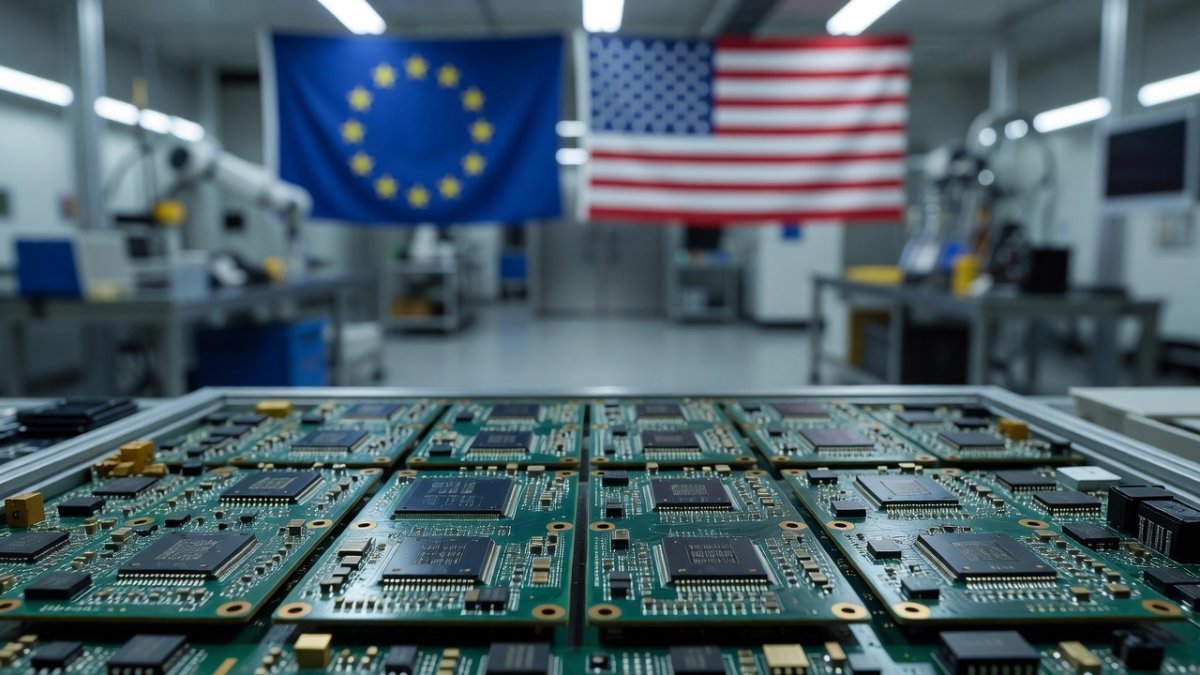
The Pax Silica initiative emerged from the US State Department under Under Secretary Jacob Helberg in December 2025. Its stated purpose centers on coordinating AI infrastructure development, semiconductor manufacturing resilience, and access to critical minerals among participating states. Current members encompass the United States, Japan, South Korea, India, Australia, the United Kingdom, the United Arab Emirates, Qatar, and the Philippines, bringing the total beyond thirteen participants. A dedicated $250 million fund supports targeted investments in these strategic areas.
European Union’s Calculated Alignment
Brussels has signaled its intention to formalize participation this week. This step marks a departure from the European Union’s earlier posture of maintaining parallel technology dialogues with both Washington and Beijing. Several member states have expressed reservations, citing risks of economic friction with China, yet the collective decision reflects mounting pressure to secure diversified supply lines for advanced chips and rare earth elements. The accession process remains phased, with formal commitments expected to unfold gradually rather than through immediate enforcement mechanisms.
China’s Assessment of Technological Containment
Chinese officials interpret Pax Silica as an extension of broader efforts to restrict technology flows. The Ministry of Commerce has previously voiced criticism of comparable restriction frameworks, emphasizing their incompatibility with open multilateral trade principles. Under the 14th Five-Year Plan and the Dual Circulation strategy, Beijing continues to prioritize domestic semiconductor capacity expansion and reduced reliance on external suppliers. These policies aim to achieve greater technological self-sufficiency while preserving selective international cooperation where mutual interests align.

Supply Chain Reconfiguration and Regional Impacts
Participation by the European Union would accelerate ongoing diversification of semiconductor and mineral supply networks away from concentrated Chinese processing capacity. ASEAN economies may face secondary effects as investment patterns shift toward allied corridors. The Global South, meanwhile, observes these developments closely, weighing opportunities for new mineral extraction partnerships against the prospect of reduced technology transfer from both major powers. Second-order consequences include potential delays in global AI deployment timelines and heightened competition for skilled engineering talent.
Strategic Calculus for Major Actors
Washington seeks to leverage collective allied industrial capacity to maintain technological leadership. Brussels pursues greater strategic autonomy while hedging against over-dependence on any single supplier. Beijing’s response centers on accelerating indigenous innovation and cultivating alternative partnerships through existing multilateral platforms. Each actor calculates that control over advanced-node fabrication and critical material refining will determine long-term economic and security advantages.
Outlook for Multilateral Technology Governance
The coming months will clarify whether Pax Silica evolves into a durable institutional arrangement or remains a flexible coordination mechanism. European internal debates over economic exposure to China will likely continue, influencing the depth of future commitments. China's ongoing progress under its Five-Year Plan targets suggests that any containment effects may prove partial rather than absolute. Observers should monitor concrete investment decisions from the $250 million fund and subsequent policy statements from MOFCOM for clearer indications of trajectory.
By Prof. Marcus Chen, Staff WriterThis article was produced with AI-assisted research and editorial support. Reporting is based on sources cited in the article.
What's Your Reaction?
 Like
0
Like
0
 Dislike
0
Dislike
0
 Love
0
Love
0
 Funny
0
Funny
0
 Wow
0
Wow
0
 Sad
0
Sad
0
 Angry
0
Angry
0
World Politics Analyst at Global1.News. Based in Beijing, covering US-China relations, global trade, and geopolitical strategy. Brings deep analytical perspective to the power dynamics shaping international affairs.











Comments (0)