
Japan Portable AC Sales Surge as Kokushobi Heat Grips Nation
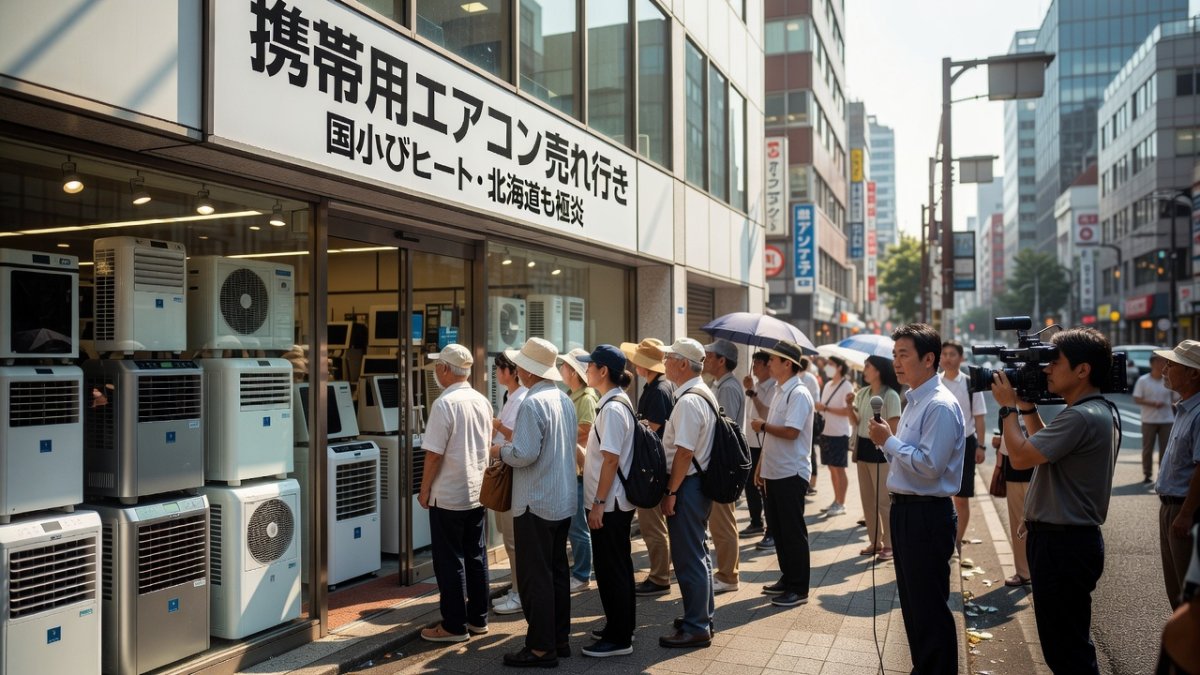
Tokyo, Japan — Japanese electronics retailers and manufacturers are reporting a sharp surge in demand for portable air conditioners as a prolonged heatwave pushes temperatures past 40 degrees Celsius across multiple prefectures, driving consumers toward affordable, installation-free cooling solutions. The Japan Meteorological Agency's newly introduced "kokushobi" classification — literally meaning "cruelly hot day" for temperatures reaching 40°C or higher — has been recor...
Japan Portable AC Sales Surge as Kokushobi Heat Grips Nation
Tokyo, Japan — Japanese electronics retailers and manufacturers are reporting a sharp surge in demand for portable air conditioners as a prolonged heatwave pushes temperatures past 40 degrees Celsius across multiple prefectures, driving consumers toward affordable, installation-free cooling solutions. The Japan Meteorological Agency's newly introduced "kokushobi" classification — literally meaning "cruelly hot day" for temperatures reaching 40°C or higher — has been recorded in at least six cities this month, marking the longest continuous stretch of extreme heat since comprehensive monitoring began in 2010.
Record-Breaking Heat Tests Japan's Infrastructure
The current heatwave, which entered its second week in late July 2026, has shattered previous temperature benchmarks. On July 22, Japan recorded its first official kokushobi since the JMA introduced the classification in April 2026. By July 25, six cities across central Japan — concentrated primarily in Aichi and Gifu prefectures — had reported temperatures exceeding 40°C. The Japan Meteorological Agency issued heatstroke alerts covering a record 43 of Japan's 47 prefectures on July 20, the highest single-day total since the alert system was launched.
Tokyo's power grid has come under significant strain. Tokyo Electric Power Company (TEPCO) has been managing near-record electricity loads as millions of households and businesses operate air conditioning systems simultaneously. The utility has urged consumers to use power responsibly but has thus far avoided rolling blackouts, a scenario that remains a concern as the heatwave shows no immediate signs of abating.
Hospitals across the country have reported treating hundreds of patients for heat-related illnesses. According to the Fire and Disaster Management Agency, the majority of those hospitalized are elderly individuals in homes without adequate air conditioning, underscoring a persistent vulnerability in Japan's aging population.
Portable Air Conditioners: A Surging Market Segment
Japanese retailers including Big Camera, Don Quijote, and Nitori have reported a marked increase in sales of portable air conditioning units. Unlike conventional split-system air conditioners, portable units do not require professional installation — a significant advantage for renters, small apartment dwellers, and households seeking immediate relief without the wait times associated with traditional AC installation services.
According to industry sources cited by Jiji Press, the relatively low price point of portable units — typically ranging from ¥20,000 to ¥50,000 — has made them an accessible option for households on tighter budgets, particularly as Japan grapples with rising living costs amid persistent inflation. Sales figures from major electronics retailers suggest demand has increased by a significant margin compared to the same period last year, though exact percentage figures have not been publicly disclosed by individual chains.
The surge reflects a broader shift in Japan's cooling market. According to research firm Euromonitor, the Japanese air conditioner market saw retail volume grow 6% in 2025, with retail value increasing 9% at current prices, driven by the exceptionally hot summers of 2024 and 2025 and rising consumer demand for energy-efficient products. The 2026 heatwave is accelerating this trajectory, with portable units emerging as the fastest-growing subsegment.
The Kokushobi Economy: Heat Reshapes Consumer Behavior
The concept of a "heatwave economy" has taken on new significance in Japan this summer. Beyond air conditioners, a wide range of cooling products has seen elevated demand. Kao Corporation's Biore Cooling Towel — a single-use portable towel that lowers body temperature by approximately three degrees Celsius for an hour when wrapped around the neck — has become a household essential across the archipelago. Neck fans, portable cooling sprays, and instant-ice packs are similarly flying off shelves.
Don Quijote, the discount retail chain known for its dense, multi-story stores, has expanded its "summer survival" aisles earlier than usual this year, stocking portable fans, cooling sheets, and personal misting devices alongside its traditional summer merchandise. The chain has confirmed to Jiji Press that sales of portable air conditioners have been "particularly strong" across its network of over 600 stores nationwide.
The heatwave's economic impact extends beyond retail. The construction industry has reported delays as outdoor work is suspended during peak heat hours under updated occupational safety guidelines. Agricultural output in central Japan's rice-growing regions faces uncertainty as prolonged high temperatures affect crop development during the critical grain-filling stage.
Structural Drivers: Energy Standards and Housing Realities
Several structural factors are contributing to the spike in portable AC demand. Japan's Ministry of Economy, Trade and Industry (METI) is implementing stricter energy-saving standards for air conditioning units, set to take full effect by April 2027. The new standards require significant efficiency improvements, and industry analysts expect retail prices for compliant models to rise as manufacturers pass on development costs. This regulatory timeline is creating a pull-forward effect, with some consumers opting for lower-cost portable units now rather than investing in expensive split-system upgrades that may become more costly next year.
Japan's housing stock presents another factor. A significant portion of Japan's rental housing — particularly older apartment buildings — lacks pre-installed air conditioning in all rooms. Many units have a single split-system unit in the living area, leaving bedrooms and study spaces without cooling. Portable units offer a practical, low-cost solution that tenants can move between rooms as needed, without seeking landlord permission for installation.
Climate Adaptation: From Seasonal Retail to Permanent Industry
The heatwave-driven demand surge reflects a deeper transformation in how Japanese society is adapting to a warming climate. What was once a seasonal retail cycle — air conditioners selling primarily in June and July — is evolving into a year-round category as consumers increasingly view cooling products as essential household equipment rather than discretionary summer purchases.
The Japan Meteorological Agency's introduction of the kokushobi classification is itself a formal acknowledgment that 40°C days are no longer exceptional events but recurring features of Japan's summer climate. Since comprehensive temperature tracking began in 2010, the frequency of extreme heat days has increased steadily, with 2023, 2024, and 2025 all recording higher-than-average numbers of days exceeding 35°C.
Japanese manufacturers are responding with product innovation. Companies such as Panasonic, Daikin, and Mitsubishi Electric have accelerated development of next-generation cooling technologies including more energy-efficient inverter compressors, AI-driven temperature management systems, and hybrid units that combine traditional refrigerant cooling with evaporative techniques for reduced power consumption.
Implications for Japanese Consumers
For Japanese households, the immediate challenge is financial. With electricity prices remaining elevated — partly due to fuel cost pass-throughs and the weak yen driving up imported energy costs — running air conditioning for extended periods places noticeable strain on monthly budgets. Portable units, which typically consume less power than their split-system counterparts, offer a middle ground between comfort and cost management.
The government has not yet announced direct subsidies for cooling appliance purchases, though various prefectural governments operate heatwave assistance programs for low-income elderly residents. Consumer advocacy groups have called for the national government to include cooling appliances in its energy-efficiency subsidy framework, which currently focuses on insulation improvements and heat pump water heaters.
For businesses, the heatwave presents both opportunities and risks. Retailers are capturing elevated demand for cooling products, but employers also face increased obligations under workplace heat safety regulations, including mandatory rest breaks, hydration stations, and heat index monitoring. The Ministry of Health, Labour and Welfare has reminded employers of their obligations under the Industrial Safety and Health Act to prevent heatstroke in the workplace.
What to Watch For
The key variable in the coming weeks is whether the heatwave persists into August — historically Japan's hottest month — which would further strain the power grid and intensify demand for portable cooling solutions. The JMA's extended forecast suggests above-average temperatures are likely to continue through at least mid-August, with the rainy season having ended earlier than usual this year, removing the moderating effect of cloud cover.
Potential market responses include stepped-up production from Japanese electronics manufacturers, increased imports of portable units from Southeast Asian factories, and possible price increases if supply constraints emerge. Consumers considering a portable AC purchase may face limited inventory at peak-season pricing, suggesting that early adoption — already underway — is the prudent strategy. The structural shift toward portable, energy-efficient cooling solutions appears to have become a permanent feature of Japan's summer economy, driven by a convergence of climatic, regulatory, and demographic forces that show no signs of reversing.
By Kenji Tanaka, Staff Writer
This article was produced with AI-assisted research and editorial support. Reporting is based on sources cited in the article.
What's Your Reaction?
 Like
0
Like
0
 Dislike
0
Dislike
0
 Love
0
Love
0
 Funny
0
Funny
0
 Wow
0
Wow
0
 Sad
0
Sad
0
 Angry
0
Angry
0

Japan Correspondent at Global1.News. Tokyo-based voice covering Japanese politics, technology, economy, and culture. Tracks the intersection of tradition and innovation in one of the world's most dynamic societies.














Comments (0)